New

The Environmental Atlas maps are available in the new Map Application

Berlin Climate Modelling – Urban Climate Planning Guidelines 2022

Maps

Vorschau

04.11.1 Urban Climate Planning Guidelines – Overall Assessment of Daytime and Nighttime Conditions

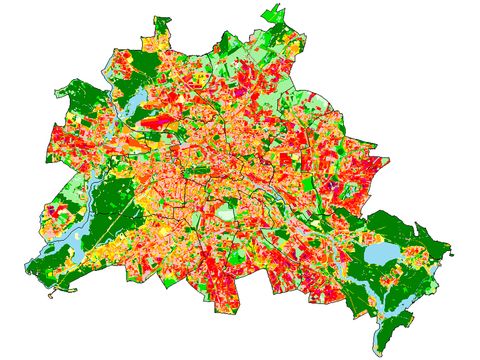
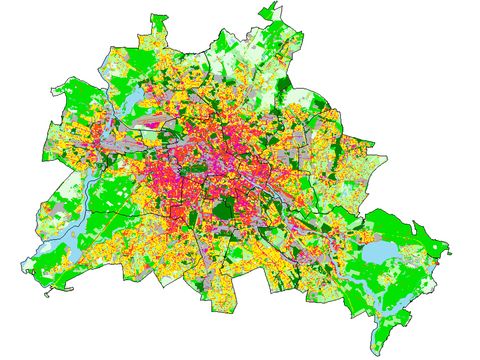
The map titled Overall Assessment of Daytime and Nighttime Conditions provides a comprehensive, citywide evaluation of climatic conditions in urban areas combined for both day and night, including any climate-regulating functions. It serves as a specialised knowledge base informing considerations at both local and citywide planning levels. 04.11.1 Urban Climate Planning Guidelines – Overall Assessment of Daytime and Nighttime Conditions
Vorschau

04.11.1.1 Planning Guidelines – Daytime

Daytime conditions are assessed at 2 pm using the Physiological Equivalent Temperature (PET), an index that reflects human thermal perception. In the evaluation map, thermal stress in settlement areas and the comfort levels of green and open spaces are classified based on these levels of physiological stress. 04.11.1.1 Planning Guidelines – Daytime

Vorschau

04.11.1.2 Planning Guidelines – Nighttime

A restful night’s sleep depends on favourable thermal conditions, making nighttime heat stress particularly significant. Since indoor temperatures in apartments at night can only be influenced through air exchange, the temperature of the outdoor air plays a crucial role in assessing human thermal strain. 04.11.1.2 Planning Guidelines – Nighttime

Vorschau

04.11.2 Supplementary Planning Guidelines

The map Areas Particularly Affected by Urban Climate Impacts and Climate-Vulnerable Areas integrates selected sub-topics of urban development with the analysis results of the main map and combines them with high-resolution factual data and geodata in addition. It supports decision-making for specific sectoral planning processes and other issues, such as urban regeneration, sensitive building/land uses, and demographic factors. 04.11.2 Supplementary Planning Guidelines

Vorschau

04.11.3 Measures

Each type of urban structure and land use presents different starting conditions for climate mitigation and adaptation. Around 53,000 block (segment) and road areas were assigned to one of 16 different measures or planning guidelines. These are based on the ‘Urban Development Plan Climate 2.0’ (StEP Klima 2.0). 04.11.3 Measures

Contact

Leilah Haag