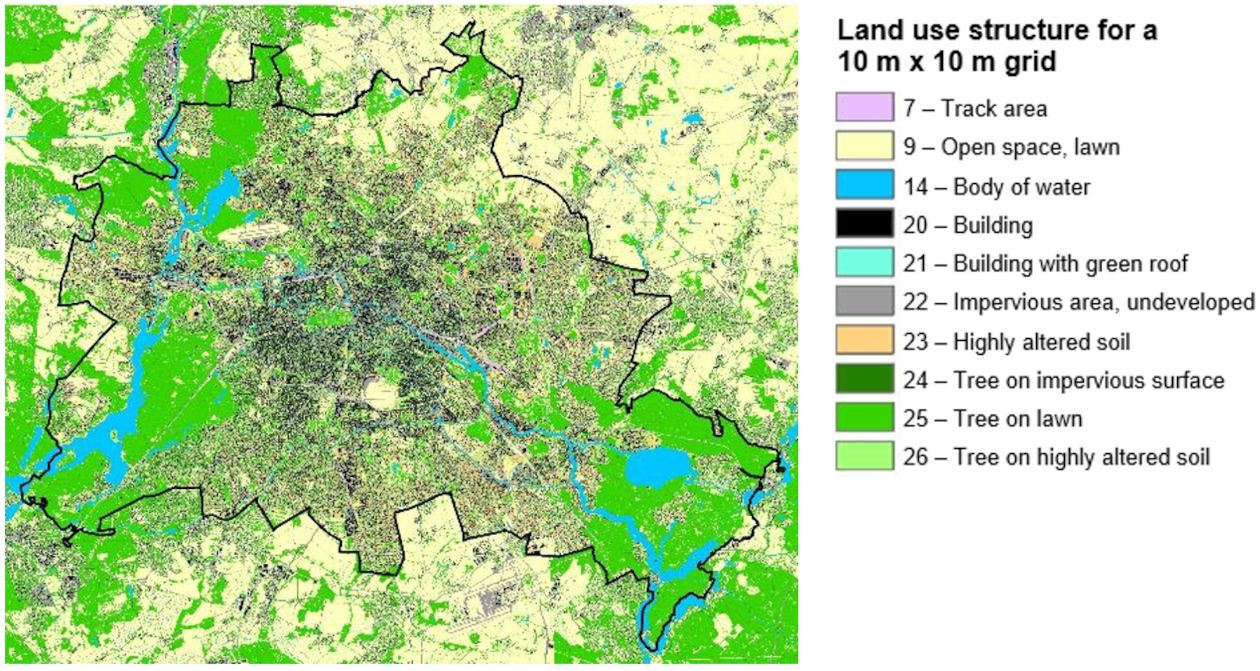
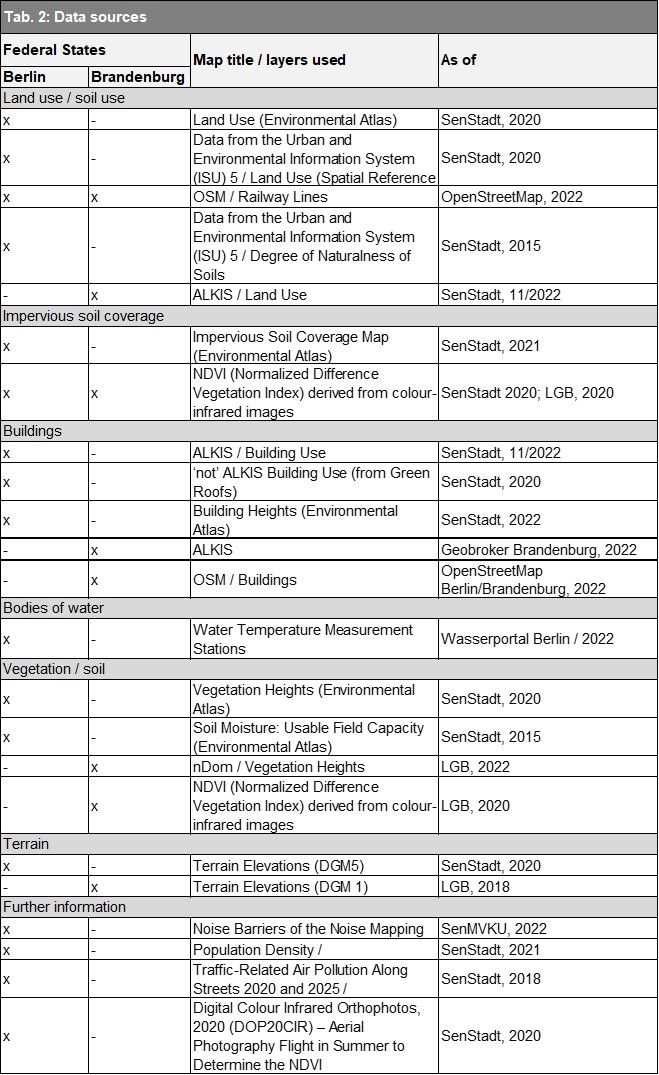
The input grid, which forms the basis for subsequent climate modelling, is generated through the processing of the underlying data. Several processing steps are required to reach this stage. These include (1) defining the study area, (2) compiling and analysing relevant data sources, and (3) designing the query process used in climate modelling. In addition, (4) long-term measurement station data is also assessed to determine the initial temperature for each climate simulation.
Defining the Study Area
Numerical simulation models require a simulation area that extends beyond the actual region being studied and includes the area covered by the underlying data sources and the meteorological boundary conditions. For the citywide climate modelling, this means that not only Berlin itself but also the surrounding regions are incorporated. The modelling area is thus divided into Berlin’s urban territory of 890 km² and its surroundings of roughly 900 km² (cf. Figure 1). By using a sufficiently large input area, the model has space to reach equilibrium or ‘settle’, enabling it to simulate conditions within the city that are as realistic as possible. The citywide climate modelling is based on a study area spanning 1,886 km².