The climate analysis is based on simulated wind and temperature conditions across the State of Berlin. The modelling was conducted in 2022 using the 2022v003 version of the FITNAH-3D (Flow over Irregular Terrain with Natural and Anthropogenic Heat Sources) software, developed by GEO-NET Umweltconsulting GmbH. The following sections provide a summary of the modelling conditions, explain the rationale behind choosing climate modelling, and outline the meteorological boundary conditions used. A detailed account of the modelling process is provided in the technical report Climate Modelling Berlin, 2022 (SenStadt 2025a, available in German only).
Rationale for Using Climate Modelling
There are several ways to analyse and capture the urban climate, ranging from field measurements and remote sensing to wind tunnel studies and the application of numerical simulation models. The latter offers the advantage of effectively representing meteorological conditions that vary significantly over time and space due to the complex nature of development structures.
Regardless of scale or specific application, models developed by other providers draw on the same system of mathematical and physical equations. Differences only become apparent at a detailed level, specifically in the granularity of land use in the model’s input data, which is influenced by spatial resolution. Additional information about the model used here and its underlying synoptic conditions are provided in the following sections and in this documentation (SenStadt 2025a, available in German only).
Methodological Concept of the FITNAH-3D Climate Model
The three-dimensional FITNAH model is built on the conservation equations for momentum, mass, and internal energy, along with balance equations for moisture components and air constituents. The various turbulent fluxes are linked to calculable means using an empirical approach. The resulting turbulent diffusion coefficient is then derived from the turbulent kinetic energy, which is obtained by solving an additional equation.
Atmospheric heating and cooling rates caused by the divergence of longwave radiation fluxes are determined through a method that takes the emissivity of water vapour in the air into account.
When carrying out detailed simulations for real terrain, it is crucial to capture not only orography, but also the influence of forests and urban structures on the distribution of meteorological parameters as realistically as possible. FITNAH contains specific parameterisations for this purpose.
Forests and tree stands are represented in the model using stand-specific variables such as tree height, stand density, and species. This enables the simulation of reduced mean wind speed within the stand, increased turbulence in the canopy layer, and pronounced nocturnal cooling in the upper third of the canopy, consistent with observed data.
City-specific parameters, such as building height, degree of impervious soil coverage and urban development, and anthropogenic heat emissions, allow the model to realistically reproduce the typical formation of urban heat islands under conditions of reduced mean airflow (cf. Groß 1989).
The full system of equations, along with the model’s parameterisations, is converted to a terrain-following coordinate system. This enables a context-specific formulation of the meteorological parameters’ lower boundary conditions, i.e., at the ground surface. The ground surface temperature is then computed using an energy balance approach that integrates sensible and latent heat fluxes, ground heat flux, shortwave and longwave radiation as well as anthropogenic heat flux.
The differential equations of the model system are solved on a numerical grid. The spatial grid spacing used, i.e., the distance between grid points, is 10 metres in both horizontal directions. The vertical grid spacing is not uniform. In the near-ground atmosphere, the model levels are close together in order to realistically represent the strong fluctuations in meteorological parameters. The lowest levels of the model, up to a height of 22 metres, are spaced at 2-metre intervals. Above this, the vertical resolution increases to 4 metres, and continues to widen progressively with height. The upper boundary of the model is set at 3,000 metres above ground level. At this height, it is assumed that surface disturbances caused by orography and land use have dissipated.
Meteorological and Synoptic Conditions Used in the Modelling
In addition to the model’s internal settings, such as spatial resolution and land use parameterisation, the meteorological boundary conditions play a key role as the driving force behind the climate simulation. This is based on long-term measurement data from the DWD stations in Tegel and Tempelhof. The analysed data serves to establish a representative temperature level for the specific weather conditions under investigation. The derived values are fed into the climate model to realistically simulate summer conditions. Within this temperature level determined, the model captures how different urban structures shape the urban climate.
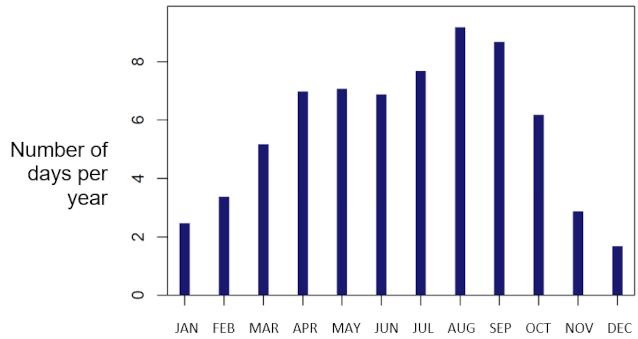
The analysis of the long-term measurement data showed that under the summer conditions examined, characterised by weak air exchange, the mean air temperature at 9 pm was 21.2 °C at a height of 2 metres above ground at the Tegel station, and 20.7 °C at the Tempelhof station, indicating similar values at both locations. However, the Tempelhof data was used as input for the model. Wind speeds are generally low, leading to reduced air exchange in the surface boundary layer. Combined with intense incoming and outgoing radiation, this can result in unfavourable biometeorological conditions and elevated air pollution in localised areas. A typical feature of high-pressure systems is the formation of locally generated cold-air flows driven by temperature differences between cooler open spaces and warmer built-up urban areas.