New

The Environmental Atlas maps are available in the new Map Application

Solar Energy Systems

Introduction

Renewable energy sources – most notably solar, geothermal, biomass and wind – offer an effectively inexhaustible supply and are set to play an increasingly central role in meeting Berlin’s energy needs now and in the future. Among these renewable sources, the expansion of solar energy has become a key pillar of Berlin’s climate strategy. The Berlin Senate has set an ambitious target: a net-zero energy supply by 2045.

To help achieve this, the city has placed strong emphasis on expanding renewable energy, especially by unlocking its urban solar potential, through the BEK 2030 (Berlin Energy and Climate Protection Programme 2030). A central tool for addressing the barriers that have limited solar uptake so far is the Masterplan Solarcity, which entered its second implementation phase (2025-2030) on 6 May 2025. Published by the Senate Department for Economic Affairs, Energy and Public Enterprises after extensive stakeholder consultation, the updated catalogue of measures continues to guide the city’s solar rollout. Berlin is gradually approaching its target of generating 25 % of its electricity from solar power by 2035 (Masterplan Solarcity). Progress has been documented in annual monitoring reports since 2020 (SenWEB 2025; reports available in German only).

Section 19 of the EWG Bln of 19 August 2021 (Berlin Climate Protection and Energy Transition Act) sets out a clear mandate: to expand the generation and use of renewable energy on public buildings. To support this effort, the Senate Department for Economic Affairs, Energy and Public Enterprises assists the boroughs through the SolarReadiness funding programme, which helps ensure that buildings are structurally prepared and equipped with the necessary infrastructure for installing solar energy systems. By accelerating solar deployment across public buildings, Berlin underscores the public sector’s role as a frontrunner in the energy transition.

For the private sector, the SolarG Bln (Berlin Solar Act) of 5 July 2021 has required, since 1 January 2023, that major roof renovations and new buildings include solar installations. Owners of roofs with more than 50 m² of usable space must install and operate a photovoltaic (PV) system. Further information and a practical guide to the SolarG Bln are available here. To support compliance with the Act and improve the economic feasibility of PV systems, the city offers the SolarPLUS funding programme as part of the Masterplan Solarcity. Since the programme launched in September 2022, a total of 24,153 grants had been approved by May 2025.

In May 2019, the SolarZentrum Berlin opened as an independent advisory centre offering comprehensive support on all aspects of solar energy (SolarZentrum Berlin). Operated by the Berlin-Brandenburg Chapter of the German Solar Energy Society (DGS) and funded by the Senate Department for Economic Affairs, Energy and Public Enterprises, it is a key element of the Masterplan Solarcity’s implementation framework.

At the national level, the JStG 2022 (Annual Tax Act) introduced a zero-percent VAT rate on the supply and installation of solar modules, including all necessary components and storage systems (JStG 2022; Section 12(3) UStG). The measure applies to systems on residential buildings, public buildings, and properties dedicated to public-service use. Systems with an installed capacity of up to 30 kWp automatically qualify. The regulation has been in force since 1 January 2023.

Additional momentum came with Solarpaket I, Germany’s first dedicated solar package, which entered into force on 15 May 2024. It bundles a range of measures designed to simplify and accelerate PV deployment, with a particular focus on plug-in systems used for self-consumption (often referred to as ‘balcony power plants’ in Germany). The package also permits electricity generated on one’s own roof to be offered to tenants at reduced rates, while any surplus electricity can be fed into the grid free of charge and without compensation, significantly reducing hurdles for owners of small-scale systems. For larger installations, certification is required for capacities above 270 kW for grid feed-in or for total generation capacities of 500 kW or more.

By the end of 2024, solar power accounted for 4.7 % of Berlin’s total electricity generation (SenWEB 2025).

As energy-related geodata and usage information, such as solar datasets, were previously presented inconsistently and scattered across multiple platforms, the Energieatlas Berlin (energy atlas) has been available since July 2018 as a dedicated resource to support the energy transition. It provides key information in a user-friendly, clearly structured format and is updated on an ongoing basis.

The information on:

  • photovoltaics (PV) – the direct conversion of solar energy into electricity, and
  • solar thermal systems (ST) – the generation of heat from solar irradiation,
    presented in this Environmental Atlas topic is based on datasets from the Energieatlas Berlin. The collection cut-off dates are as follows: PV system location data as of 7 October 2024, and solar thermal system data as of 31 December 2015 or 29 March 2023 for the aggregated BAFA solar thermal data.

As the Energieatlas Berlin continues to develop, improving the quality of solar energy system data – particularly for PV systems – and maintaining regular updates remain key priorities.

Please note that all links in the Introduction section point to resources in German.
Map 08.09.1 Photovoltaics

Compared with solar thermal systems, Berlin has installed far more photovoltaic (PV) systems. By 31 December 2024, a total of 41,723 PV installations had been recorded across the city, with a combined capacity of around 380.6 MWp. The estimated annual electricity yield from these systems is roughly 343 GWh, accounting for a 5 % reduction in generator performance and an average yield of 900 kWh per kW each year. In theory, this could supply around 131,000 households, assuming an average annual electricity consumption of 2,500 kWh per household.

Since its launch, the Energieatlas Berlin has replaced the data collection system of the Solaranlagenkataster (solar installation register) that integrates multiple sources and evaluation methods (see Statistical Base section). Figure 1 illustrates how installation levels vary across the boroughs (see Fig. 1a). Boroughs dominated by single- and two-family homes exhibit the highest installation rates. Reflecting this pattern, the smallest capacity class – up to 30 kWp – clearly predominates, accounting for roughly 37,438 of a total of 38,798 systems (see Fig. 1b). This class mainly comprises plug-in systems on balconies or modules installed on small roofs.

In 2019, the annual number of new PV systems installed nationwide under the EEG (Renewable Energy Sources Act) again exceeded 100,000 for the first time in several years. From 1 July 2022, the EEG levy was reduced to zero and, with the 2023 amendment, abolished entirely. According to BNetzA (Federal Network Agency) data, Berlin recorded its largest annual increase to date in 2024, with 15,556 new systems added.

The most recent data on PV systems in Berlin, including system locations and borough-level deployment statistics, are available in map and chart form via the Energieatlas Berlin (available in German only).

Fig. 1a: Development by borough (data as of 6 March 2025). Data source: Energieatlas Berlin, based on MaStR data of the BNetzA.

Fig. 1b: Development by capacity class (data as of 6 March 2025). Data source: Energieatlas Berlin, based on MaStR data of the BNetzA.

The public sector plays a leading role in driving PV expansion in Berlin. Under the EWG Bln (Berlin Climate Protection and Energy Transition Act), amended in 2021, all new public buildings must be fitted with solar energy systems on every technically suitable roof. Existing public buildings are generally expected to be retrofitted with solar systems by 31 December 2024. Exceptions apply where roof orientation or structure makes installation unfeasible, or where legal provisions prevent it. According to the Masterplan Solarcity study, the State of Berlin owns around 5.4 % of the city’s buildings, which together account for 8.3 % of the total rooftop solar potential (SenWEB 2019). Current progress on the installation of solar systems on public buildings can be explored in the Energieatlas Berlin (available in German only).

As of 31 December 2024, a total of 1,029 PV systems with a combined capacity of 64.6 MWp had been installed on public buildings across Berlin (Solarcity Monitoringbericht). In 2024, around 17 % of the city’s total installed PV capacity was located on public buildings owned by the State of Berlin.

The majority of Berlin’s 42,723 PV systems are installed on privately owned buildings, representing approximately 92 % of all installations. While the buildings themselves are privately owned, the PV systems may not always belong to the same individuals, as roof areas are sometimes leased to third parties. Around 5 % of systems are installed on buildings owned by companies or housing cooperatives. PV systems on private buildings account for roughly 55 % of Berlin’s total installed capacity, with a further 31.3 % found on company and cooperative buildings. Together, these two groups represent the bulk of the city’s installed PV capacity.

Fig. 2: Ownership distribution of PV systems by total number and installed capacity (data as of 31 December 2024, Data source: Energieatlas Berlin, based on MaStR data of the BNetzA.

Map 08.09.2 Solar Thermal Energy

Since its launch, the Energieatlas Berlin has replaced the data collection system of the Solaranlagenkataster (solar installation register) that integrates multiple sources (see Statistical Base section) and presentation methods. By 31 December 2024, around 8,900 solar thermal systems had been recorded across the city. At present, new installations are not systematically monitored. Additional gaps have emerged following the transfer of funding responsibility for solar thermal systems from the Federal Office for Economic Affairs and Export Control (BAFA) to the state-owned development bank KfW. Figure 3 shows that the number of new installations has declined sharply since around 2013 compared with previous years, reflecting an overall downward trend. In Berlin, solar thermal systems are mainly used for domestic hot water and to supplement space heating. There are also several larger systems designed to heat drinking water or swimming pools, as well as solar ventilation and cooling systems. As with PV systems, solar thermal installations are concentrated in the city’s outer boroughs, where housing remains predominantly low-density and landscape-oriented. (For a closer look at data by postcode, see the ‘Solaranlagen – Solarthermie’ map in the Geoportal Berlin and activate the ‘Summe der solarthermischen Anlagen pro Postleitzahl’ layer).

Fig. 3: Development of solar thermal systems in the State of Berlin, by number of systems per borough (data as of 20 February 2024), Data source: Energieatlas Berlin, based on MaStR data of the BNetzA.

The recorded list of solar thermal systems used exclusively for domestic hot water is not exhaustive, meaning the actual number of installations in Berlin is likely higher than official figures indicate. Most systems employ flat-plate collectors and are found on single-family homes. For the years after 2015, only aggregated data from BAFA is available for Berlin, which does not allow distinctions by collector type, building type, or collector area.

Since 2013, the rate of new installations in Berlin has fallen sharply. By 2024, around 8,900 systems with a combined collector area of roughly 94,300 m² had been recorded (SenWEB / Masterplan Solarcity Monitoringbericht, 2024). This figure does not fully reflect all new installations in recent years, suggesting that the true total is somewhat higher.

At the national level, growth in solar thermal collector area has slowed since 2015, reaching an increase of about 0.22 million m² in 2024. Overall, the expansion of both system numbers and collector area has levelled off noticeably in recent years (German Solar Association 2024).

Map 08.09.3 Irradiation

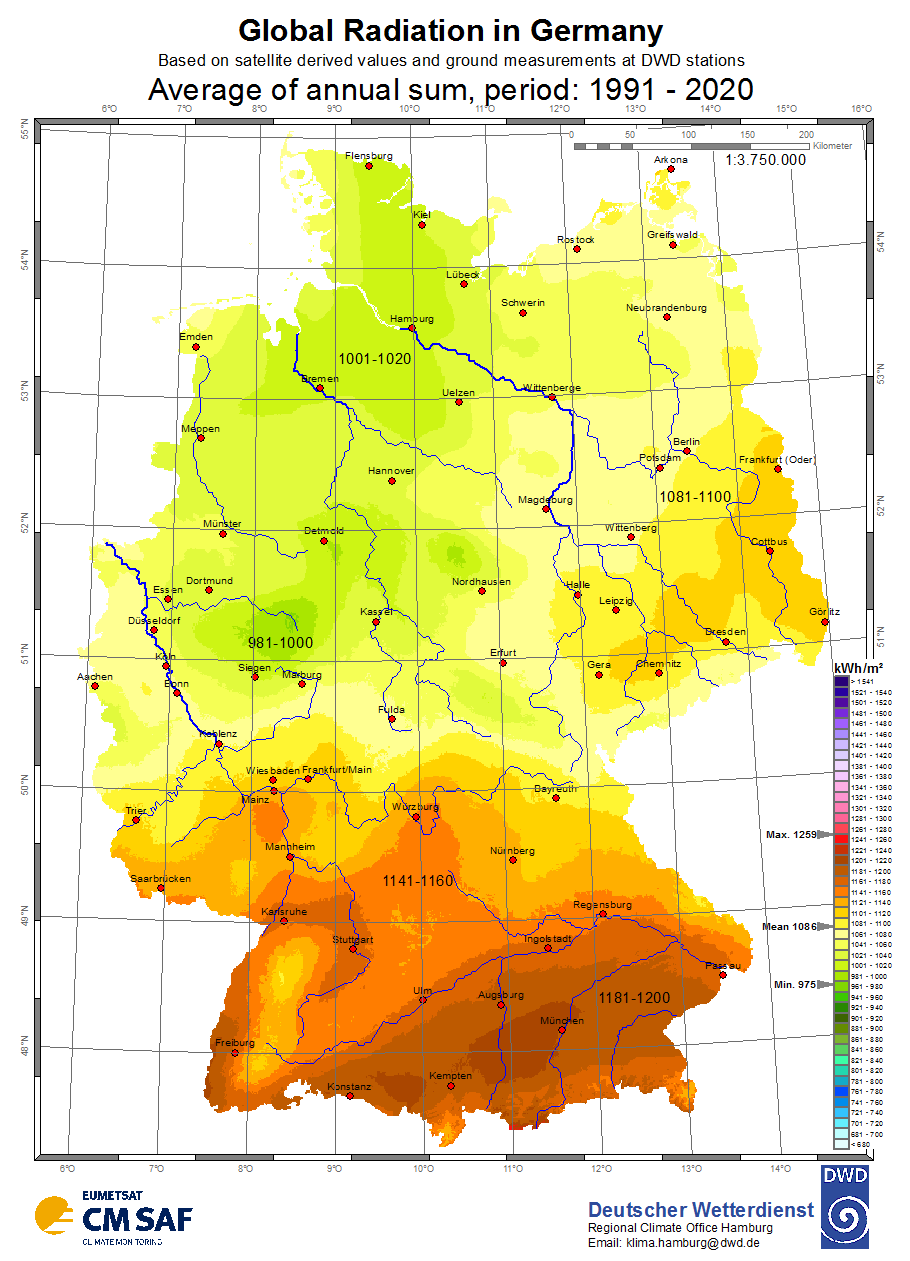
A thorough assessment of solar irradiation (expressed as annual totals) provides the foundation for estimating how much energy Berlin can realistically harness from the sun (IP SYSCON 2022). For the Berlin area, the German Weather Service (DWD) has reported an average annual global irradiation, i.e. the sum of varying proportions of direct and diffuse solar radiation, of 1081 to 1100 kWh/m² on a horizontal surface for the current long-term reference period from 1991 to 2020. Within the national context, Berlin lies roughly at the midpoint of the overall irradiation range (see Fig. 4). Comparing two recent reference periods (1981-2010 and 1991-2020) reveals a clear upward trend: global irradiation in Berlin and Brandenburg has increased by 40 to 50 kWh/m² per year (roughly 5 %) a shift attributed to ongoing climate change. The amount of irradiation received on a horizontal surface depends on local conditions (see Methodology section).

Fig. 4: Average annual sums of the global radiation in Germany for the period from 1991 to 2020 (unaltered reproduction; source: Deutscher Wetterdienst (DWD) 2022)

Environmental Atlas Contact

Berlin Senate Department for Urban Development, Building and Housing
Mr. Hartbecke