Image: Senatskanzlei Berlin
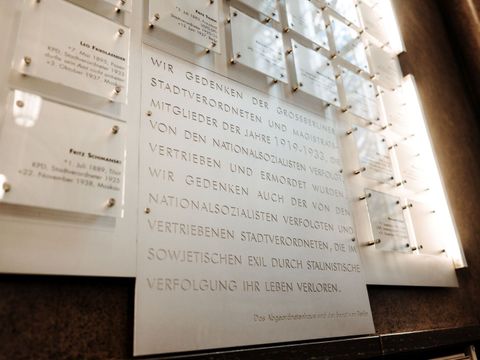
Memorial plaques for city councillors
The memorial plaque commemorates the fate of Berlin’s city councillors who were politically persecuted, imprisoned, or driven into exile during the Nazi period. More information

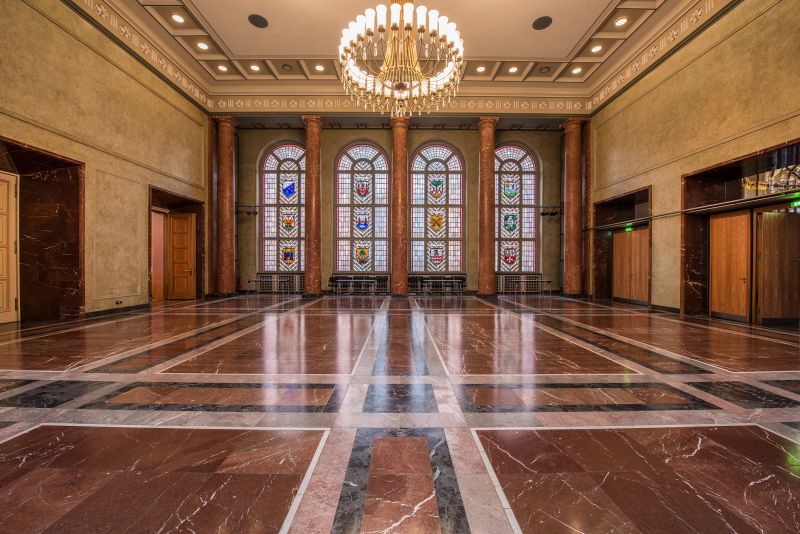
Image: Landesarchiv
In the Hall of Arms, the Governing Mayor receives state guests and hosts ceremonies for the signing of the Golden Book of Berlin.
The name “Hall of Arms” is derived from the 24 coats of arms in the stained-glass windows, which represent the city and its historic boroughs: Berlin (Greater Berlin), Charlottenburg, Friedrichshain, Hellersdorf, Hohenschönhausen, Köpenick, Kreuzberg, Lichtenberg, Marzahn, Mitte, Neukölln, Prenzlauer Berg, Pankow, Reinickendorf, Schöneberg, Spandau, Steglitz, Tempelhof, Tiergarten, Treptow, Wedding, Weißensee, Willmersdorf und Zehlendorf. The historic boroughs’ coats of arms in the Hall of Arms evoke the foundation of the municipality of Greater Berlin in 1920. Berlin’s borough administrations were established at that time. Until 1934, the Hall of Arms served as the meeting room for the city council, Berlin’s municipal parliament. The stained glass windows were destroyed during the Second World War and later reconstructed when the Red Town Hall became the seat of East Berlin’s city government, the “Magistrat.” Surprisingly, the Western boroughs’ coats of arms were included as well. Back then the German Democratic Republic still aimed at the reunification of the two German states. And East Berlin’s government claimed the right to represent Berlin as a whole.
Animals appear in some of the coats of arms. Greater Berlin’s coat of arms, for instance, shows the Berlin bear. Apart from the windows, the natural stone decoration is another remarkable feature of the room. Red marble from Thuringia provides a striking color on the floor and around the doors of this impressive space.
The Governing Mayor of Berlin
- Senate Chancellery -
Veranstaltungsmanagement