The Golden Book of Berlin

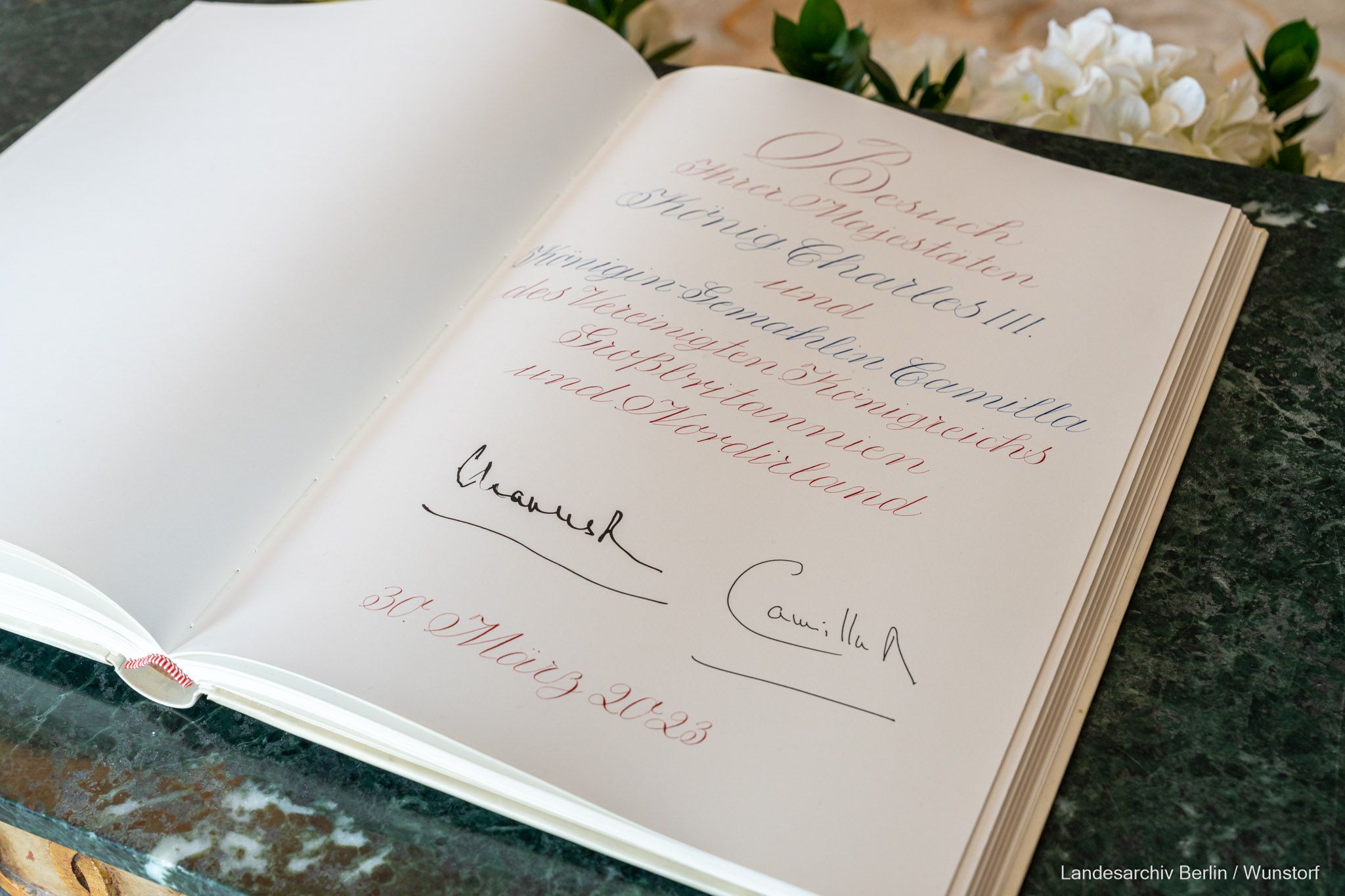
Die Unterschriften von Charles und Camilla im Goldenen Buch

The Golden Book of Berlin

The Golden Book is a symbol of Berlin’s significance on the international stage and a tradition that reflects the city’s political life. It documents the visits of many dignitaries to Berlin.

The Golden Book currently consists of nine volumes. Notables in the first volume include Dr. Rudolf Wissel, who signed the Golden Book on 8 March 1949. A German politician who opposed the Nazis, he was later honored with Berlin’s Honorary Citizen award. Dr. Theodor Heuss, Germany’s first Federal President, added his signature during his first visit to Berlin in October 1949. The first eight volumes of the Golden Book are kept in the Berlin State Archives. The current volume – the ninth – begins with the signature of then US President Barack Obama.

The Golden Book remains part of Berlin’s official ceremonies today. Entries are reserved for crowned heads, heads of state and heads of government, foreign ministers, mayors of our partner cities, and the Federal President of the Republic of Germany.

Berlin’s State Archives have digitized all nine volumes of the Golden Book. Photos have been added to many of the entries.

Berlin’s official guest book

Berlin’s guest book is a valuable collection of entries by notable national and international figures from politics, the business sector, academics and research, culture, and sports. The book currently consists of three volumes. The guest book is signed by mayors of major cities, Berlin participants in the Summer and Winter Olympic and Paralympic Games, and members of the city’s title-winning professional sports teams. Entries were also added by Germany’s world-champion soccer teams in July 1954 and July 2014 and celebrities like Marlene Dietrich, Helen Mirren or Juliette Binoche.

Berlin’s State Archives have digitized all three volumes of the guest book. The third volume is currently still in use.

Visitors can view either the Golden Book or the guest book in a display case located in the gallery at the top of the grand staircase.

State visits

  • What is a state visit?

    A state visit is the highest form of diplomatic visit between two nations at the head of state level. For example, a foreign president or monarch could be invited to visit the Federal President of Germany at Schloss Bellevue (the President’s official residence). During these visits, mutual appreciation and respect are shown in diverse but often similar rituals, ceremonies, and elements known as “highest protocol honors”.

    Visits serve to strengthen relations between the two nations, address political and economic issues, and foster cultural dialogue. In Germany, state visits include a wide range of official events in both Berlin (such as a meeting with the German Chancellor) and another German state.

  • What happens during a state visit?

    State visits are usually preceded by months of detailed planning by the two countries’ foreign ministries. They follow a defined protocol.

    First a ceremonial welcome takes place at the airport. Then the Federal President and their spouse greet the visiting head of state with military honors in the Schloss Bellevue garden. The national anthems are played and the party inspects an honor guard representing the Bundeswehr’s three armed service branches (army, navy and air force). High political and diplomatic representatives of the visitor’s country accompany the visitor and take part in these ceremonies.

    Another recurring element of state visits is the state banquet, a formal dinner hosted by the Federal President for leading politicians and other notable figures from both countries in the ceremonial rooms of Schloss Bellevue.

    The remainder of the state visit may include meetings with further political dignitaries or visits to cultural and social events, academic or research institutions, or charitable organizations in Berlin or another German state. It usually ends with a joint press conference.

    As a special honor, the guest of state’s convoy is escorted to official events by 15 members of the police motorcycle squad.

    The Protocol Office of the State of Berlin organizes meetings of the guest of state with the Governing Mayor of Berlin at the Brandenburg Gate, a symbol of Germany’s division and peaceful reunification and of Berlin as the city of freedom. There they often encounter Berliners, tourists, or people from the guest’s country of origin who have found a new home in Berlin.

    It is always a great honor for Berlin if the guest of state signs the Golden Book of Berlin at the Red Town Hall (the Governing Mayor’s seat) or visits another of the city’s institutions.

    The state visit ends with Germany bidding a ceremonial and dignified farewell to the guest.

  • Why do state visits take place?

    State visits serve different important functions.

    They strengthen diplomatic ties between two nations by fostering friendships, identifying common interests, and lowering existing tensions. Trade and investment agreements are often reached. Both countries can improve economic ties and initiate cooperation in different areas.

    State visits also provide an opportunity for cultural dialogue. Visits to cultural institutions or joint events can strengthen cooperation in areas such as the arts, education, and research. An invitation to a head of state is a sign of international recognition for a country and indicates its important role on the global stage.

    On the whole, state visits are a meaningful contribution to international diplomacy and serve to deepen the relationship of the two countries at various levels.

Contact

The Governing Mayor of Berlin
- Senate Chancellery –

Karina Maaske