
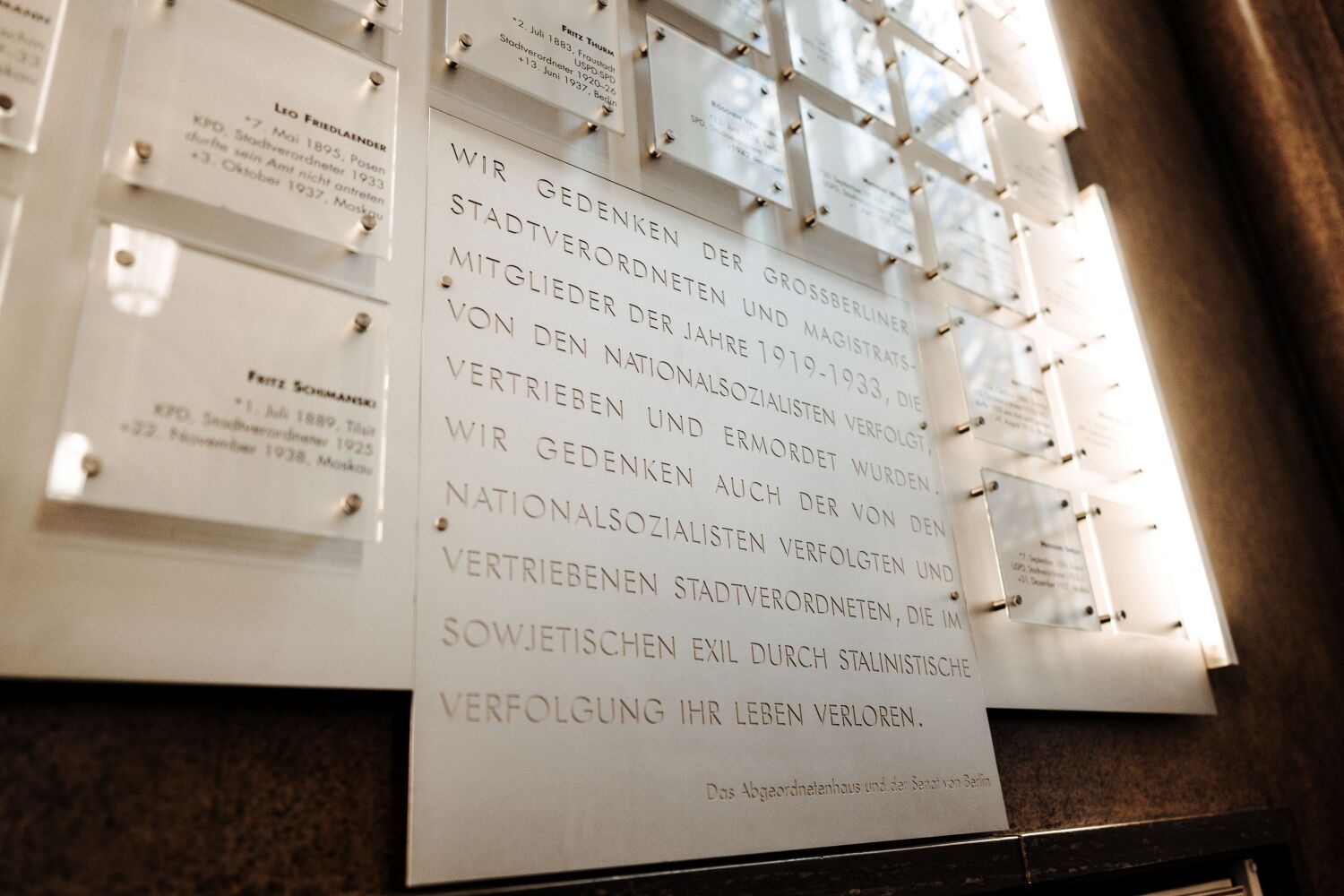
The memorial plaque in the Red Town Hall for city councillors and members of the city government is an important site of remembrance. It shows the fate of people who were persecuted, arrested, or forced into exile under the Nazis.
Until the end of the Weimar Republic, the city council was Berlin’s volunteer municipal parliament. It convened in the Red Town Hall for the first time in 1870 and for the last time in 1933.
After the Nazis came to power, they persecuted democratic representatives, including the 49 politicians commemorated on the memorial plaque on the upper floor of the foyer of the Red Town Hall. It reads: “In memory of the members of the city council and city government of Greater Berlin from 1919 to 1933 who were persecuted, forced to flee, and murdered by the National Socialists. We also honor the memory of the city councillors who fled the Nazis and lost their lives to Stalinist persecution in exile in the Soviet Union. The Berlin House of Representatives and Senate.”
After the defeat of the Nazis, the Allies divided Germany and Berlin in 1949. Their separation lasted until 1990 . In East Berlin, the city government – known as the “Magistrat” – was not based on democratic principles. Its seat was the Red Town Hall. After the Wall fell and Germany was reunited, a democratically elected Governing Mayor returned to the building in 1991.
Additional plaques in the Red Town Hall commemorate the city council, showing how important this municipal parliament was. One such plaque, which memorializes the council’s first meeting, is located in the courtyard. In addition, the names of all city council chairmen from 1809 to 1908 are preserved on a plaque at the eastern entrance.