
Chronicle in Stone
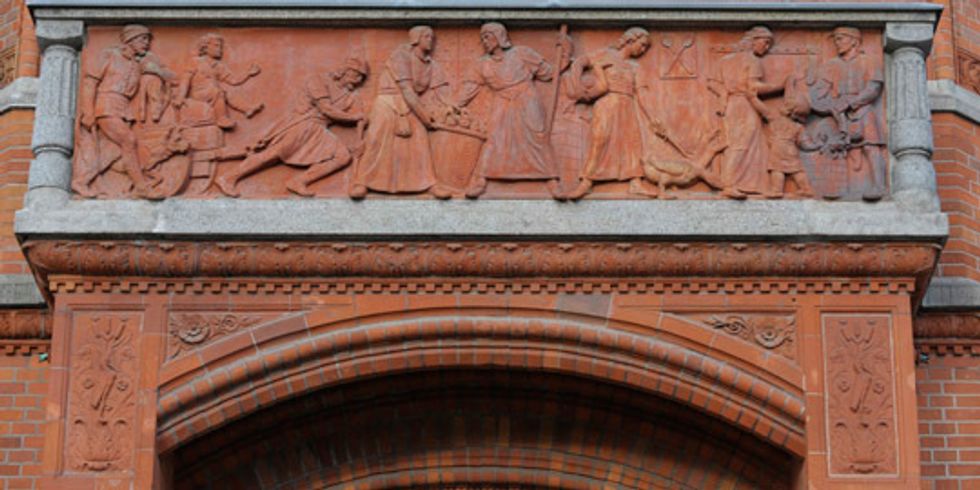
Chronicle in Stone on the Red Town Hall – Going to the Market - Grunerstraße I A panel on the Grunerstraße façade shows a bustling marketplace.
Image: Landesarchiv Berlin
A frieze consisting of 36 terracotta panels runs along the balconies and above the entrances to the Red Town Hall. Following a proposal by the chief architect, Hermann Friedrich Waesemann, these additional decorative elements were added to the Red Town Hall façade in the 1870s. Known collectively as the “Chronicle in Stone,” they are the work of sculptors Ludwig Brodwolf, Alexander Calandrelli, Otto Geyer, and Rudolf Schweinitz. The frieze visually depicts the history of Berlin from the 12th to the 19th century.
Bombing raids during the Second World War caused extensive damage to the Red Town Hall, including the frieze. When work to rebuild the Town Hall began in 1951, records of the frieze designs were incomplete, making reconstruction of the Chronicle in Stone difficult. Fortunately, members of the public shared their personal photos and drawings of the artworks.
The starring role in the Chronicle in Stone goes to the people of Berlin. Half of the panels show life in the medieval city: bustling marketplaces and traveling tradesmen, craftspeople, the legal system, and everyday activities. The remaining panels depict the rule of the Prussian monarchs and Berlin’s dramatic rise in the 19th century. Featured episodes include Berlin losing its status as an independent city in the 15th century and regaining the right to self-government after reforms in the early 19th century. Several panels highlight the city as a center of liberal thought where important scientists, scholars, and artists could leave their mark.
To see the Chronicle in order, start on Grunerstraße (at the corner with Spandauer Straße) and walk counterclockwise (toward Jüdenstraße) around the building.
Events and people in the Chronicle in Stone
| Grunerstraße | Eastward expansion of the Germanic people, conversion of the region’s Slavic inhabitants to Christianity, and establishment of the territory of Brandenburg in the 12th century; founding of Berlin in the 12th/13th century; a market day in early Berlin |
| Jüdenstraße | Everyday life in the late Middle Ages; crime and punishment (pillory on the marketplace, the courthouse arcade where public legal proceedings took place, a fatal robbery); 15th-century religious life, including a wedding |
| Rathausstraße, left | A tavern scene; representatives of medieval guilds; a city market; early schools (separate for boys and girls); Berlin as a center of trade; defeat of the robber knights, medieval medicine; recognition of Elector Friedrich II as ruler after the city rebellion in the winter of 1447/48; construction of the Hohenzollern palace, which began in 1443 |
| Rathausstraße, right | Changes to Church law and the Reformation (1517); Leonhard Thurneysser’s printshop in the nearby Grey Monastery; arrival of the Huguenots in Berlin (in 1685 the Great Elector, Friedrich Wilhelm of Brandenburg, offered them refuge after freedom of religion was ended in France); founding of the Academy of Sciences in 1700 with Princess (later Queen) Sophie Charlotte as patron; the municipal reform of 1808, which gave cities rights of self-government; preparation for the Wars of Liberation and campaign against Napoleon; return of the Quadriga |
| Spandauer Straße | End of the Wars of Liberation and the French occupation; industrialization in the 19th century; opening of the first Prussian railway, which linked Berlin and Potsdam (1838); 19th-century artists, scientists and scholars; the fine arts and Berlin as a center of learning and culture (founding of the University of Berlin in 1810); news from Versailles of the victory in the Franco-Prussian War in 1871 and the choice of Berlin as capital of the German Empire |
Contact
The Governing Mayor of Berlin
- Senate Chancellery -
- Tel.: (030) 9026-0
- Fax: (030) 9026-2013
- E-mail contact the mayor
- Home page English Homepage