Busts in the red town hall

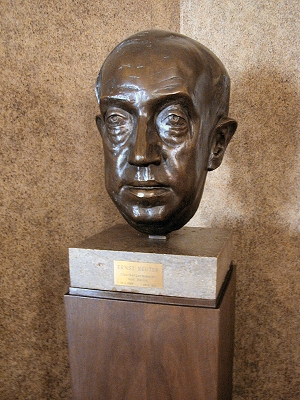
The bust of Ernst Reuter

Ernst Reuter (Social Democratic Party) was Berlin’s Lord Mayor from 1948 to 1950 and then the first Governing Mayor of Berlin until his death in 1953. In effect, he governed West Berlin only. A bust honoring Ernst Reuter can be found in the Red Town Hall. It was sculpted by Erich Fritz Reuter.

A bronze bust of Ernst Reuter is on display on the upper floor of the foyer in the Red Town Hall. It is the work of the sculptor Erich F. Reuter (1911-97), who despite his name was not related to Ernst Reuter. Erich F. Reuter was one of the best-known sculptors of the postwar era. His work can be found at many locations in Berlin. A 13-meter-long bronze relief by Reuter is installed on the façade of the Technical University building on Straße des 17. Juni. It was originally displayed at the West German pavilion at the Montreal World’s Fair as an example of postwar German sculpture. The artist also created the floor mosaics at the Berlin Philharmonie concert hall and the Staatsbibliothek library. The Office of the Federal President (Schloss Bellevue) owns Reuter reliefs of Federal Presidents Theodor Heuss, Heinrich Lübke, and Gustav Heinemann and of Reich President Friedrich Ebert. About two-thirds of the works by Erich F. Reuter are unsigned. They include the bust in the Red Town Hall, which does not identify the artist or Berlin’s famous Noack foundry, where the work was cast.

Bust of Margot Friedländer in the red town hall

Bust of Margot Friedländer

Margot Friedländer (1921-2025) was a Jewish Berliner, Holocaust survivor, witness to history, and recipient of “Berlin’s “Honorary Citizen” award. For her contributions to our understanding of the Shoah and her commitment to keeping the memory of the Holocaust alive, she received Germany’s Order Of Merit, First Class, and a bronze portrait bust of her is displayed in the Red Town Hall. Margot Friedländer became Berlin’s 121st honorary citizen on June 26, 2018. She was awarded the Order of Merit in 2025.

Margot Friedländer’s family were victims of the inhumane Nazi regime. Her father, mother, and brother were murdered in extermination camps. Her mother left a message for her daughter: “Try to make your life.” This sentence guided Margot Friedländer from that time on. She and her future husband survived the concentration camp at Theresienstadt and emigrated to the United States after the end of the Second World War. In 2010 she returned to her hometown of Berlin to promote remembrance of the Holocaust in Germany, especially among young people. She founded the Margot Friedländer Foundation with the same mission in 2023. The Margot Friedländer Prize named for her honors people for their advocacy of tolerance and humanity and their work to combat antisemitism or antidemocratic views. Margot Friedländer died on 9 May 2025 and is buried in the Jewish Cemetery in Berlin’s Weißensee neighborhood.

The bust of Margot Friedländer in the Red Town Hall is located on the upper floor of the foyer. The sculpture, by artist Stephanie von Dallwitz, weighs 12.4 kilograms and is approximately 30 centimeters tall.

Margot Friedländer subscribed to aktuell for many years. This magazine for Berliners forced to emigrate during the Nazi period – and their descendants – has been published by the Governing Mayor of Berlin since 1970. It appears in German and English twice each year, keeping the emigrant community informed about developments in the city they once called home and providing a platform to share memories and information. Subscriptions to aktuell

Hermann-Waesemann-Büste im Roten Rathaus

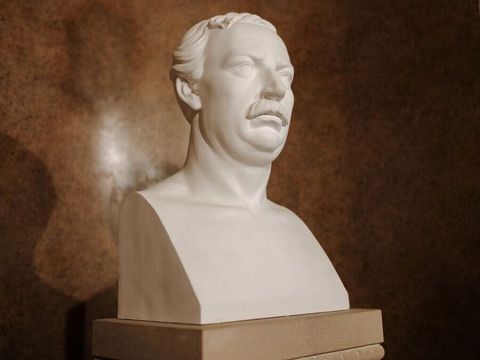
Bust of Hermann Waesemann

Hermann Friedrich Waesemann (1813-79) was a German architect. The Red Town Hall in Berlin is his greatest work. A bust of Hermann Waesemann is on display on the upper floor of the foyer.

Waesemann was born in Danzig. Like him, his father was an architect. Waesemann studied mathematics and science in Bonn and then came to Berlin to study architecture at the Bauakademie. Before he entered the annals of Berlin’s architectural history as the head architect of the Red Town Hall, he played a role in the construction of the New Museum and led the work to renovate and expand the Berlin Palace. The Red Town Hall was built between 1861 and 1870. At that time, it was one of the largest construction projects in the city. The design of the brick building is clearly influenced by the work of the prominent Berlin architect Karl Friedrich Schinkel and his successors, as well as the early Italian Renaissance. Waesemann also drew inspiration during a trip through France, England, and the Netherlands.

Waesemann died in Berlin in 1879 and is buried in the Sophien II cemetery. On the Jüdenstraße side of the building, a memorial plaque on the exterior façade commemorates Hermann Friedrich Waesemann.

Contact

The Governing Mayor of Berlin
- Senate Chancellery -