The finalists for the DTA2026 in the category of Artificial Intelligence

From accessible communication to safeguarding truth: Our finalists in the Artificial Intelligence category

Berlin has firmly established itself as one of Europe’s leading hubs for artificial intelligence. What once was primarily driven by academic research has evolved into a dynamic ecosystem where startups, corporations, and public institutions collaboratively shape the next generation of intelligent systems. Today, the focus goes far beyond efficiency and automation – it is about building robust, trustworthy, and socially impactful AI applications.

The AI category of the Deep Tech Award 2026 reflects exactly this shift. This year’s finalists – Accessful, LiveEO, and Gretchen AI – demonstrate how deep technological innovation can address real-world challenges, from digital accessibility and critical infrastructure to the integrity of information in the digital age.

Design ohne Titel - CEO Stefan Anlang

Stefan Anlang, CEO of Berlin's Accessful.

Automating digital accessibility at infrastructure level

Accessful’s journey began with a problem hiding in plain sight. As the team puts it: “The problem found us before we found it.” What initially appeared as a niche challenge quickly revealed itself as a systemic issue across both private and public sectors, driven by increasing regulatory requirements and a lack of scalable solutions.

Rather than relying on manual processes, Accessful embeds all expertise directly into AI. Their approach is simple yet transformative: “PDF in – accessible PDF out.” By fully automating the creation of accessible documents, the company removes the need for specialized knowledge and integrates accessibility directly into existing publishing workflows. The goal is to make accessibility part of infrastructure, not an isolated task or afterthought.

The impact is immediate and far-reaching: millions of people gain access to digital content that was previously inaccessible, while organizations can meet compliance requirements without fundamentally changing how they operate.

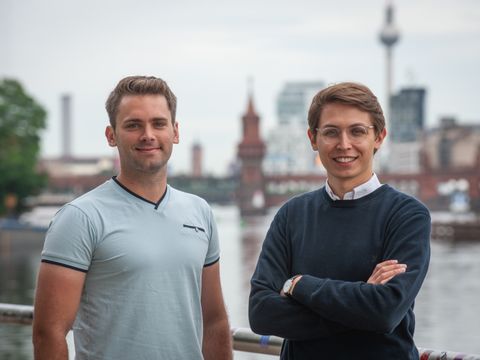
CEOs von Live EO

Daniel Seidel & Sven Przywarra, the two Co-Founders of LiveEO.

Turning satellite data into actionable infrastructure insights

LiveEO leverages the power of AI and Earth observation data to better understand and protect critical infrastructure.

Driven by a clear vision “to harness Earth observation data to help industries better understand and manage critical infrastructure,” the company transforms vast amounts of complex satellite data into actionable, easy-to-use insights. What began with a fascination for space has evolved into a platform with real-world applications across industries such as energy, transportation, and natural resource management.

Its innovation lies in combining multiple advanced technologies into one integrated system that performs reliably under real-world conditions. By bridging the gap between cutting-edge research and practical deployment, LiveEO ensures that its solutions are not only technically advanced but also usable at scale. Ultimately, this helps to “increase resilience, safety, and sustainability” across industries, strengthening the backbone of modern infrastructure.

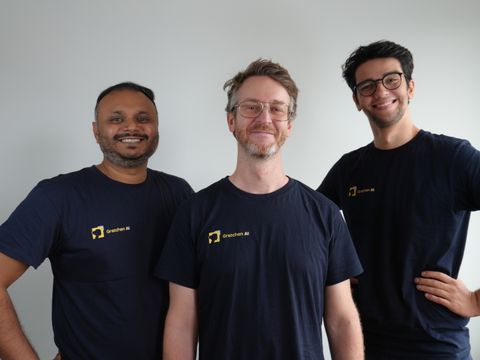
Gretchen AI Leadership-Team

The leadership team of Gretchen AI – CEO Tim Polzehl in the middle.

Technology to protect truth and trust

Gretchen AI addresses one of the defining challenges of our time: misinformation in the digital age.

The starting point was a simple but urgent realization: “it is getting harder and harder for people to tell what is real and what is fake.” From this insight, the company built a broader vision of AI as an active layer of protection in increasingly complex information environments.

Going beyond deepfake detection, Gretchen AI focuses on contextual verification – identifying not only manipulated media, but also authentic content used in misleading ways. To achieve this, the company develops advanced, agent-based systems capable of autonomous research, source evaluation, and cross-narrative analysis. Its mission is to “protect truth, trust, and informed decision-making,” helping individuals, organizations, and societies better navigate digital information and respond to manipulation more effectively.

Berlin: A hub for applied AI with real-world impact

All three finalists highlight Berlin as a key factor in their success. The city’s unique combination of research excellence, entrepreneurial energy, and active policy engagement creates a fertile ground for developing and scaling deep tech innovations. Access to international talent, close proximity to decision-makers, and a strong network of universities, startups, and industry partners all contribute to an environment where ambitious ideas can move quickly from concept to real-world application.

What sets Berlin apart is not only its technical strength, but also its openness to experimentation and its focus on societal impact. This intersection of technology, policy, and purpose enables companies to tackle complex challenges that extend far beyond purely commercial goals.

Whether enabling digital inclusion, securing critical infrastructure, or safeguarding the integrity of information, Berlin provides the conditions to translate cutting-edge AI into tangible, meaningful impact – both locally and on a global scale.