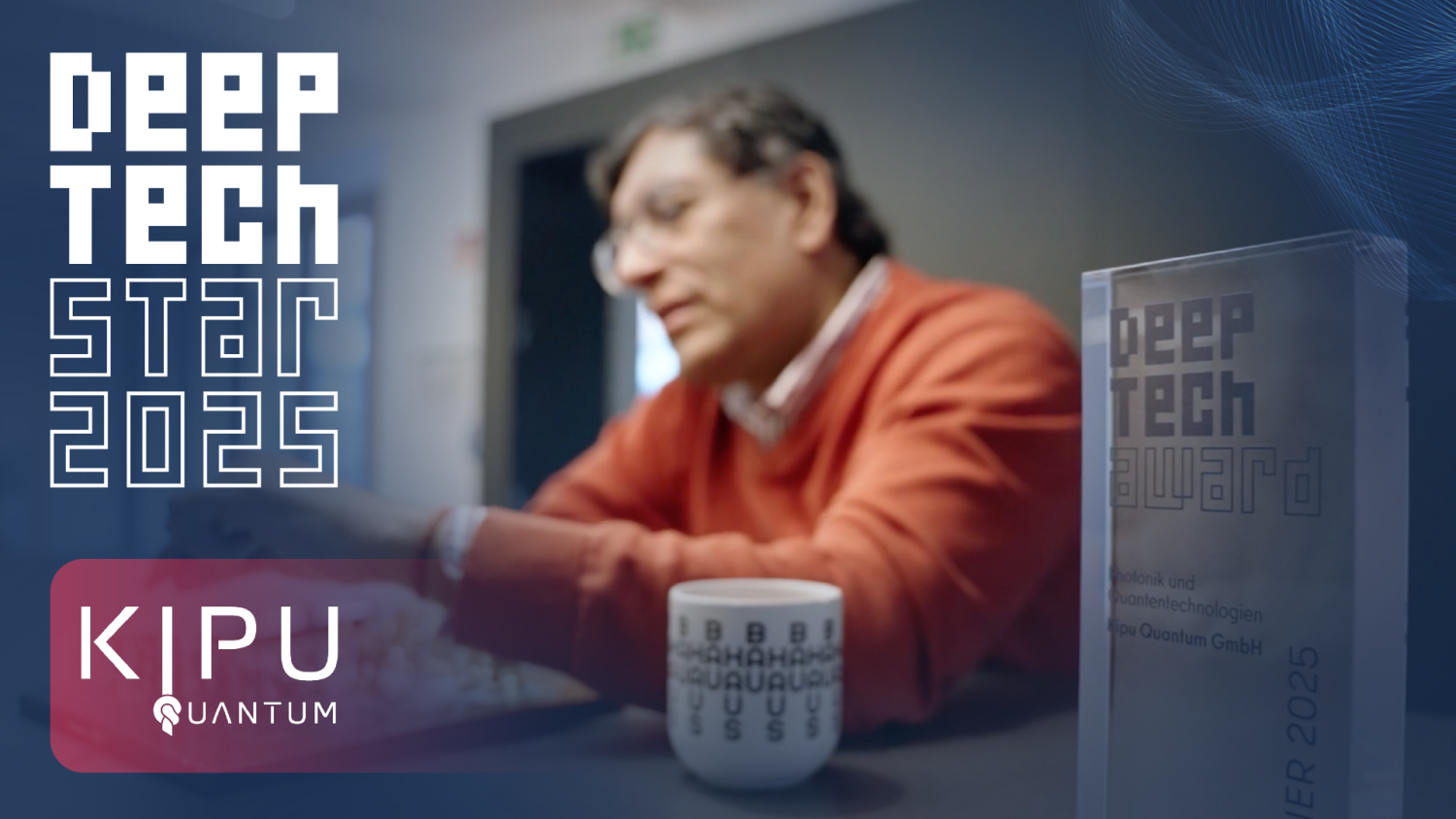
Kipu Quantum is redefining what is possible with quantum computing today. As a Deep Tech Award winner, the Berlin-based company focuses on application-specific quantum algorithms designed to deliver real industrial value on existing quantum hardware. In this Deep Tech Star Talk, the team behind Kipu Quantum shares how the company emerged from a pragmatic critique of quantum hype, why the convergence of quantum computing and AI is becoming essential, and what it takes to translate deep scientific research into real-world impact – at a moment when the future of computing is rapidly taking shape.
Hello Enrique, hello Eugene, hello David. Could you please introduce yourselves?
Enrique: My name is Enrique Solano, and I’m the CEO of Kipu Quantum, a startup based in Berlin. We develop quantum computing algorithms for industrial applications, focusing on making use of the quantum computers that exist today—not those that may arrive in the distant future.
David: My name is David Niehaus. I’m Head of Advocacy and Governmental Affairs at Kipu Quantum. I’m responsible for our interactions with state and national governments, as well as with international institutions such as the European Union.
Eugene: My name is Eugene Oleynik, and I lead the customer team. We work closely with clients to support them in adopting quantum solutions and integrating them into their operations.
Let’s go back to the origins of quantum. Can you briefly explain how you conceived the idea?
Enrique: At the time, I was living in Munich during the pandemic. I had spent many years in academia and had a successful career, but I reached a point where I needed a new challenge. I became one of the harshest critics of the quantum computing field, particularly because I was unhappy with how both the US and Europe were approaching it – often in a very visionary, future-focused way.
I’m a pragmatic person. So I said: let’s create a quantum computing startup that accepts the challenge of making quantum computers useful today, not sometime in the future. Soon after, our co-founders joined, and we were fortunate to receive support from investors who believed in our story.
Where does “Kipu” come from originally?
When I visited the Computer History Museum in Mountain View, Silicon Valley, I saw devices made of strings, cords, and colours, used by the Incas centuries ago to encode information for accounting and finance. I was surprised to see them presented as part of the history of computing.
I was born in Peru and learned about kipus growing up, yet they were never framed as computational tools. That stayed with me, and I knew I wanted to use the name one day. The challenge was that “quipu” is already widely used in quantum computing terminology.
When I returned to Peru, I realized that adapting the name required both cultural and technical sensitivity. In quantum computing, many companies default to “Qu” branding because of qubits and “quantum”, and we wanted something more distinctive while staying true to the heritage. At the same time, in some language variants, “qui” can be replaced by “ki,” which allows us to form “Kipu” – a name that keeps its origins while clearly positioning us in the quantum space.
What also connects us to Berlin is that out of the roughly 1,000 to 2,000 original kipus left worldwide, most are stored here in Berlin, in museums and art collections.
You work at the intersection of quantum computing and AI. Has this been your focus from the start?
Quantum computing is going through difficult times, not because it lacks potential, but because, as a community, we are overselling it. There is too much talk about quantum computers solving climate change, financial crises, or ecological issues in the future. We’ve seen quantum hype cycles before, 10 or 20 years ago, and they collapsed.
Then the AI wave arrived and became impossible to ignore. Rather than resisting it, we decided earlier this year to merge quantum computing and AI. Not to follow hype, but because there is genuine value in combining the best of both technologies as they exist today.
The key is not forcing either technology to do what it cannot, but instead leveraging their respective strengths to create industrial value now.
Moving from theory to practice: how does Kipu Quantum operate, and how will this shift in the next few years?
Eugene: In 2025, our main focus was innovation – bringing demonstrable quantum advantage to industry and to our clients. We believe we achieved that goal. During this phase, the sales team worked on expanding enterprise customer engagements, while product development was less of a focus. Our priority was building a strong customer footprint, particularly in the enterprise segment.
Now our focus will be shifting toward reaching quantum usefulness, working directly on real quantum machines to deliver tangible value for industrial applications.
What types of challenges or use cases do clients come to you with?
Analysts often say that finance will be one of the biggest beneficiaries of quantum computing, and this is certainly an important area for us. We already work with some of the world’s largest banking organizations, with several commercial engagements either in place or in preparation.
Beyond finance, we also see strong demand in logistics, retail, and oil and gas. Many of these use cases revolve around optimization—for example, optimizing truck routes, vessel routing for shipping, or improving machine learning applications. One example is analysing drone imagery of oil refineries to detect leaks with greater accuracy.
Do you still see hesitancy on the client side when it comes to committing to quantum solutions?
Yes, but the mindset is clearly changing. We are now able to demonstrate quantum usefulness in concrete industrial use cases, which puts us in a strong position. We can show clients relevant examples from previous work, making the technology more tangible.
Many large enterprises now recognize the potential value of quantum computing and are beginning to take their first steps. This is exactly where we excel—working hands-on with industry to translate highly scientific concepts into applicable solutions.
David, from a regulatory perspective, what challenges do you face most often?
David: One major challenge, especially for a quantum software startup, is that public funding still favours quantum hardware and the broader supply chain around quantum computers. Software and industrial application development have not yet received the same level of recognition.
At both European and national levels – particularly in Germany – we see strong investment in building domestic quantum hardware capabilities. While this progress is impressive, the industrial application side is not yet considered equally relevant by many funding bodies.
Is Berlin recognizing the potential of quantum software and applications?
The Deep Tech Award recognition is very important in this context. It shows that quantum software is seen as relevant at the governmental level. Berlin understands software as a business model and has a strong ecosystem of software-driven startups.
We’ve also worked closely with the state of Berlin to promote industrial adoption of quantum software. One example is the first Berlin Quantum Hackathon, which we were mandated to run. It brings teams from around the world to Berlin to solve quantum software challenges using our platform and algorithms.
Do you see differences at the national or European level?
David: Quantum software is gaining recognition, particularly in ongoing discussions. In Germany’s recently published high-tech agenda for example quantum software is explicitly mentioned. At the European level, we also see a shift: while hardware dominated past initiatives, new programs are beginning to entertain including quantum software solutions.
Does this increased focus mean stronger competition for you?
Competition is certainly increasing. The number of industrial customers actively engaging with quantum technology is still limited, so expanding that customer base is essential. This means convincing more industrial players of the importance of engaging with quantum now.
There is also a strong sentiment to European sovereignty in quantum computing. This must include not only hardware, but also a thriving quantum software ecosystem—where Europe is already strong and must remain so.
What makes Berlin the ideal location for Kipu Quantum?
Enrique:I can’t be impartial about Berlin. We chose to move here as a family to build Kipu Quantum, and we’ve never regretted it. Berlin is a city of our dreams, with a young and dynamic quantum ecosystem, excellent universities, and a vibrant startup scene.
I’m always surprised when people debate whether London, Paris, or Berlin is the best startup city. For me, the answer is very clear, though I admit I’m passionate about Berlin.
What motivates you personally and as a team to work on Kipu Quantum every day?
Enrique: Opportunities like this may come only once in a lifetime – the chance to influence technology, society, and the course of human history. I feel a responsibility to use our skills to move things forward and make a positive impact.
I can only work with people who share that passion, and I’ve been fortunate to build a team so dedicated that I sometimes have to tell them to slow down and take breaks. Together, we are driven by the opportunity to make quantum computing and AI useful for humankind and to advance what I call the history of intelligence.
David: We are at the forefront of a new technological revolution. Bringing this vision not only to life, but also into public and industrial awareness, is incredibly motivating. Seeing recognition from both government and industry fuels the energy we have here as a team.
Eugene: This is a rare opportunity, you don’t get many chances like this. We are right at the edge of something new. The strong team spirit and the positive feedback we receive from clients, partners, and the broader industry keep us motivated and moving forward.