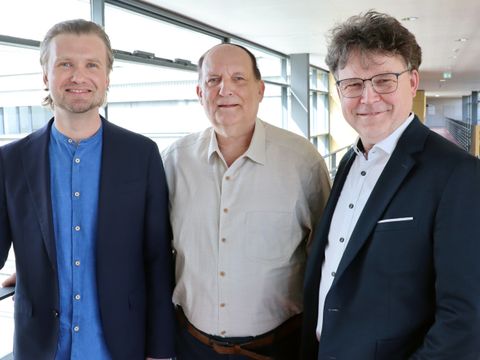
Finalists for the 2026 Deep Tech Awards in the Quantum, photonics and microelectronics category

When Deep Tech Leaves the Lab: Deep Tech Award 2026 Finalists in Quantum Technologies, Photonics & Microelectronics

Many of the technologies shaping our future operate beyond what we can see – in photons, quantum states, and microscopic systems. In Berlin, these fields are increasingly moving out of research environments and into real-world applications. The city has become a place where scientific excellence and entrepreneurial ambition intersect, enabling deep tech companies to translate complex research into scalable solutions.

The Quantum Technologies, Photonics & Microelectronics category of the Deep Tech Award 2026 reflects this shift. This year’s finalists – XAVVEO, Watergenics, and Rydberg Photonics – demonstrate how advances in sensing, measurement, and photonic integration are being turned into technologies with tangible impact across mobility, industry, and infrastructure.
Xavveo Team

Meet XAVVEO, one of this year's Deep Tech Award finalists.

When perception becomes the limiting factor

For XAVVEO, the starting point was a recurring challenge: despite rapid progress in autonomous driving, sensing systems continued to fall short in real-world conditions. As the team puts it:

“We kept seeing autonomous vehicle programmes stall because the sensor suite simply wasn’t reliable enough. Cameras fail in direct sunlight, LIDAR struggles in rain and fog, and conventional radar lacks the resolution.”

Rather than refining existing approaches, XAVVEO developed a fundamentally new architecture. Its distributed photonic radar system combines ultra-compact silicon photonics with AI-driven perception, enabling high-resolution sensing that remains robust in adverse environments.

The goal is clear: “Autonomous vehicles can change that, but only if they can actually perceive their surroundings reliably in every condition.”

This capability is not limited to mobility. The same approach has potential applications in industrial automation and other safety-critical environments where reliable perception is essential.

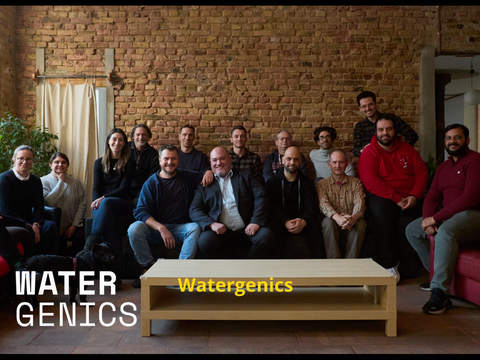
The team of Watergenics.

Team photograph of Berlin's Watergenics.

Making water systems transparent

Watergenics focuses on a resource that is both fundamental and often under-analysed in industrial contexts: water. The company’s origins lie in research on environmental economics and industrial inefficiencies.

As the team explains, this perspective “was fundamental to understand the essential role of water in industrial processes and the industrial management inefficiencies related to it.”

Its technology enables continuous, real-time monitoring of industrial water streams across more than 30 chemical and physical parameters – directly in the process and even under harsh conditions, without calibration or chemical reagents. At the centre of this approach is a clear mission: “We make water quality visible.”

By turning previously invisible processes into actionable data, Watergenics helps industries optimise operations, reduce resource consumption, and lower emissions – while also supporting a broader shift toward integrating environmental factors into industrial decision-making.

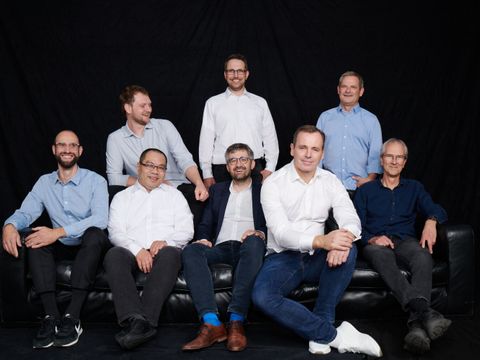
Rydberg Photonics Team

Meet the co-founders of Rydberg Photonics.

Turning quantum engineering into deployable systems

In quantum technologies, the key challenge is no longer only scientific discovery, but practical implementation. Rydberg Photonics addresses this transition by focusing on the industrialisation of quantum systems.

As the team notes: “Quantum technology has reached a point where the next breakthroughs are no longer purely scientific—they are engineering challenges.”

Building on more than 15 years of research at the Ferdinand-Braun-Institut, the company develops hybrid-integrated photonic platforms that enable compact, robust systems designed for operation outside laboratory conditions.

This shift is essential for broader adoption: “For quantum technology to shape markets, it must move beyond prototypes and into products that industries can trust and adopt.”

With applications ranging from sensing and navigation to secure communications and space technologies, these systems are laying the groundwork for the next generation of precision infrastructure.

An ecosystem built for translation

What connects all three finalists is not only their technological depth, but also their environment. Berlin offers a unique ecosystem where research institutions, industrial expertise, and deep tech investors are closely interconnected.

This proximity accelerates the translation of scientific breakthroughs into viable products, while providing access to specialised talent, infrastructure, and long-term capital – all critical factors for hardware-driven innovation.

Whether enabling reliable machine perception, optimising resource use, or bringing quantum technologies into real-world deployment, the finalists in this category illustrate how Berlin continues to turn cutting-edge science into meaningful impact.