

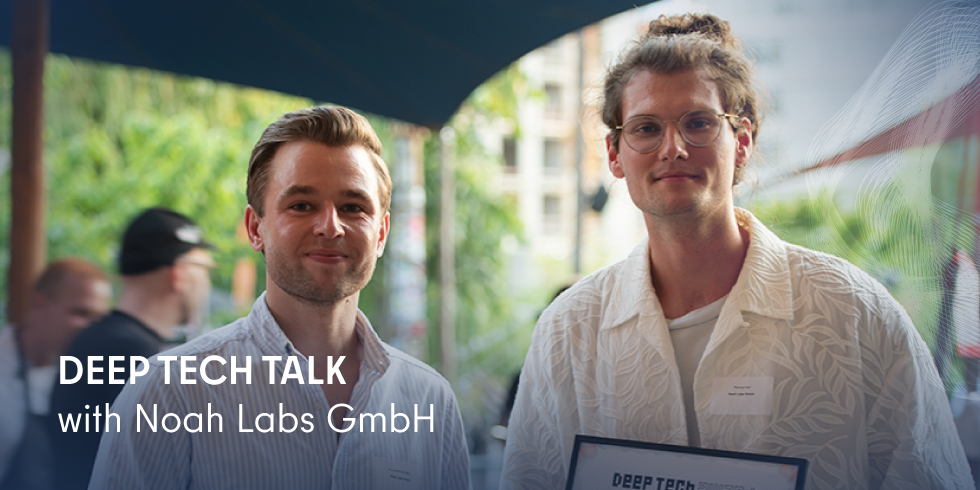
Noah Labs is revolutionizing heart diagnostics by using AI to detect heart failure through voice analysis. Their solution enables early detection and continuous monitoring via everyday devices, making heart care more accessible. By combining medical research with deep tech, they’re creating a future where health can be heard. Based in Berlin, Noah Labs is setting new standards in digital healthcare.
What inspired the founding of your company – and what personal story is behind your idea?
Our Chief Medical Officer Dr. Leonhard Riehle worked with Chronic Heart Failure (CHF) patients as a Medical Doctor at Charité Berlin noticing changes in the voice of hospitalised patients. His professor, Dr. Friedrich Köhler, one of the leading Key Opinion Leaders in the CHF space initiated the first trials at Charité Berlin. They ended up investing in Noah Labs and, in turn, letting us commercialize the tech use the data – a perfect example of how the Berlin ecosystem can drive innovation.
Prior to founding Noah Labs, our CTO Marcus Hott, a machine learning expert, conducted research at Harvard Medical School focused on cardiovascular applications, giving him deep experience in applying ML in a medical context. Our CEO, Oliver Piepenstock, had previously founded another healthcare startup before launching Noah Labs together with Marcus. Together, they bring complementary backgrounds and expertise, forming the ideal team to drive our innovation forward.
How would you describe your company’s philosophy – what drives your team and what is your long-term vision?
We enable patients to live longer, healthier lives! For us, the patient is at the centre of all our decisions. We want to improve quality of life, extend life expectancy and reduce hospital admissions. We want to build the new frontier of technology that allows 10x better diagnostics and monitoring of chronic conditions in cardiovascular and beyond utilizing voice as a biomarker.
What makes your solution particularly innovative from a technical perspective – and where do you see its greatest societal impact?
Congestive Heart Failure (CHF) is the leading cause of hospitalization and one of the biggest cost drivers in healthcare, affecting over 4 million people in the country ( >22 million across the U.S. and EU). Current monitoring methods are either invasive implants, which are costly and only suitable for a small subset of patients, or external devices that often detect deterioration too late.
At Noah Labs, our vision is to revolutionize chronic disease monitoring by developing voice-based biomarkers that leverage everyday mobile technology to detect early signs of decompensation non-invasively, affordably, and at scale. By replacing complex and late-stage interventions with simple, proactive voice-based diagnostics, we aim to save thousands of lives, reduce healthcare costs, and empower patients to live healthier, longer lives.
Why is Berlin the right place for you and what do you appreciate most about the local deep tech ecosystem – also with regard to their field of technology?
Berlin is the ideal location for Noah Labs because it offers a unique convergence of world-class medical research, cutting-edge AI talent, and a thriving startup ecosystem. With institutions like Charité and the HU Incubator, we are close to top-tier clinical partners and academic resources. The city’s vibrant international talent pool and strong presence of machine learning experts support our deep tech development. Additionally, Berlin’s reputation as a healthcare and medtech innovation hub gives us access to both venture capital and public non-dilutive funding such as ProFit, making it the perfect launchpad for globally scalable healthtech solutions.
Which technological or societal developments do you currently find most exciting – and why?
Healthcare moves at its own pace and often lags behind broader technological innovation. However, once it adopts new technologies, they tend to create step-change improvements. In healthcare, we are currently witnessing the onset of the AI revolution—and it’s only the beginning. Today, we know that the human voice carries rich insights into the body’s physiological and pathological state, offering a powerful, untapped source for detecting and managing disease.