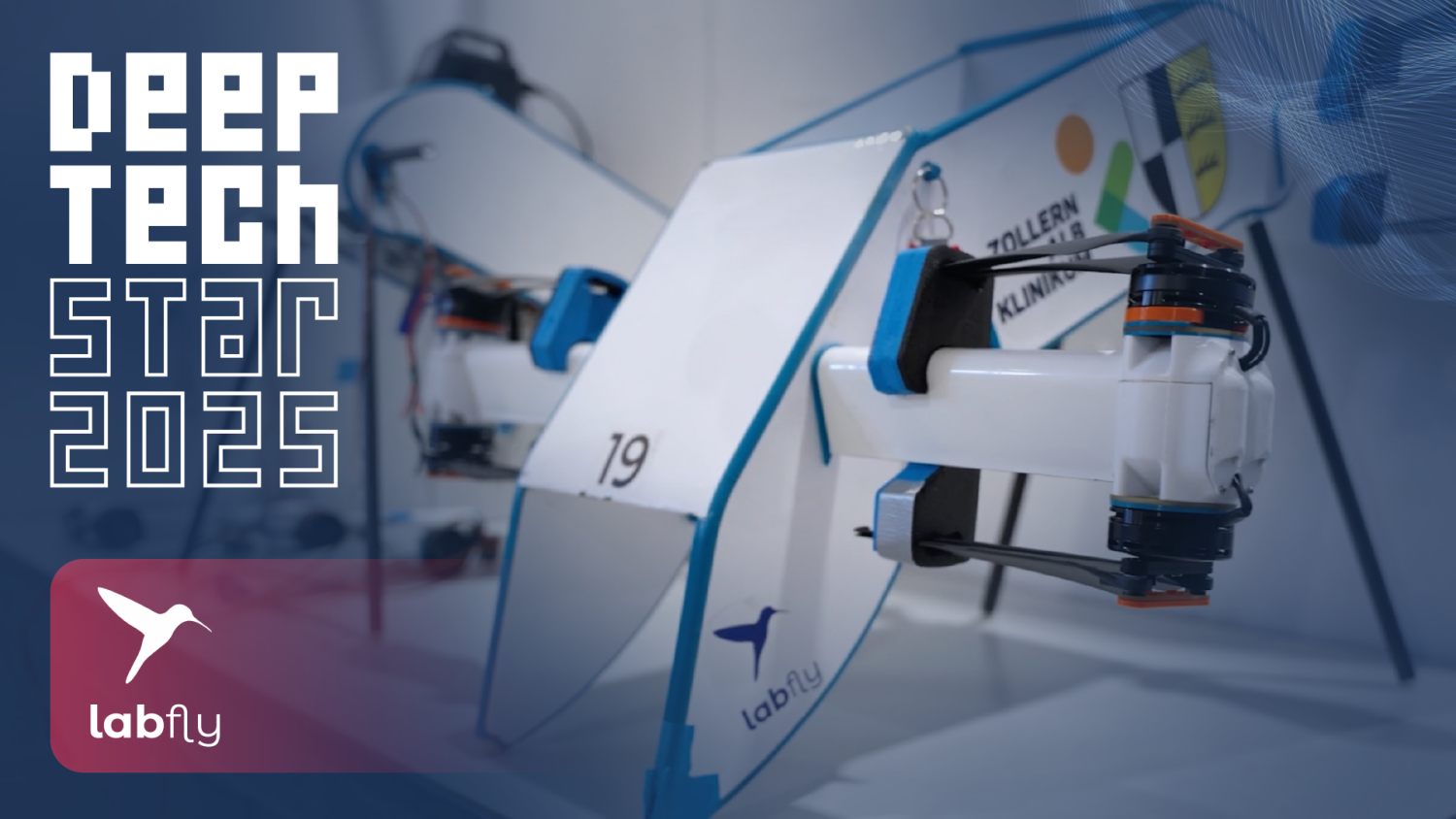
Labfly is on a mission to reshape medical logistics with certified drone operations that can safely fly beyond visual line of sight – an innovative solution recognized with the Deep Tech Award 2025 in the robotics category. In this interview, CEO Tim Fischer shares how Labfly emerged at a pivotal moment in drone technology and regulation, enabling fast, low-emission delivery of lab samples and medicine to hospitals, pharmacies and even patients’ homes. Read on to find out why decentralized logistics are essential for improving healthcare access, especially in rural regions facing demographic change as well as their vision for scaling medical drone transport throughout Europe.
Hi Tim, could you please introduce yourself and explain what you do at Labfly?
My name is Tim Fischer, and I’m the co-founder and CEO of Labfly. Labfly is a medical drone delivery company and a spin-off from TU Berlin. We started in 2019 and have since developed our own drone technology and operational capabilities. What we do is transport lab samples and medicine for hospitals and pharmacies. We are fully certified, which allows us to fly above populated areas and beyond visual line of sight.
How did the idea for your technology come about? Was there a specific problem or moment that prompted you to found Labfly or develop the product?
Drone technology has evolved significantly over the past few years. When we started Labfly, these developments made it possible to turn drone-based delivery of goods into a reality. At the same time, we were at a tipping point not only technologically, but also in terms of regulation—especially because the goods we transport are considered dangerous in aviation terms.
After extensive collaboration with regulators, we became the first company in Germany to obtain permission to fly beyond visual line of sight over populated areas.
The need for our solution was very clear. Rural areas are aging rapidly and often have limited access to healthcare. While we see many advances in the healthcare sector, such as digital prescriptions and online doctor appointments, decentralized logistics are still missing. That’s where Labfly comes in. We counteract this demographic change by connecting urban and rural regions—put simply, young people in cities can bring real benefits to a grandmother living in a village.
Winning the Deep Tech Award 2025 is a significant achievement. How has this award impacted your company, your team and your visibility, and what new opportunities or partnerships have resulted from it?
The Deep Tech Award was a major milestone for us. It showed that the work we’ve been doing over the past nearly six years has truly paid off. It also increased our visibility and connected us with many new contacts, including on the political level.
As a result, we are now part of a research project funded by the Berlin Senate called U-Space Berlin. The goal is to bring our technology not only to rural areas, but also into urban environments. Within the next three years, we plan to have drones flying within Berlin to transport lab samples between hospitals.
Let’s take a step back and talk about your current projects. Where do we see Labfly drones in action today?
At the Zollernalb Klinikum in Balingen, we operate the complete logistics chain for lab samples. The hospital has 120 beds, and we transport all samples by drone from one hospital site to the main laboratory. We do this on a daily basis, with multiple flights per day—typically between six and ten flights.
What was their issue initially?
First, they faced very poor road infrastructure, and second, there was a shortage of skilled personnel. One of their hospital laboratories had to be closed, so lab samples were previously transported by taxi, which took about 30 minutes. Due to recent road closures, that journey would now take between 45 and 60 minutes.
With our solution, we reduced delivery times by half, cut CO₂ emissions by 96%, and lowered delivery costs by 50%.
Are there any further projects you are currently running?
Yes. We have an ongoing project in Bavaria where we are implementing the transport of medicine from a wholesaler to local pharmacies. This allows us to bring additional logistical capacity to rural areas.
We also have an active project in Saxony-Anhalt that enables the delivery of medicine from local pharmacies directly to patients’ homes. This project focuses on palliative care, where medication often needs to be adjusted as a patient’s condition changes. As a result, there is a high demand for frequent and flexible delivery of new prescriptions.
To our knowledge, we were the first company in Germany to receive approval from local pharmacy authorities to offer full-cycle medical delivery by drone.
Which challenges do you face as a deep tech company in the field of robotics?
There is a lot of innovation happening, especially when it comes to the potential of AI in robotics. In our case, however, this is not yet fully applicable, as we operate in a highly regulated environment. Using AI to automate processes in the drone or aviation sector is therefore quite challenging.
At the moment, AI is most relevant for us in the maintenance domain, where we use it for automated analysis of our drones. In the long term, however, it will certainly play a much larger role in our operations.
What do you think might be the next big step? What do your plans for the next five years look like?
Over the next five years, our first goal is to expand our operations to serve more hospitals and laboratories across Germany. In parallel, we plan to scale our services in the pharmacy sector.
What’s particularly interesting is that the flight permissions we already hold are valid across Europe. This allows us to focus on transporting critical medical goods throughout Europe within the next five years.
What is your motivation to keep innovating? What fuels your vision for the future?
My motivation comes from my own background. I grew up in a rural area in East Germany, so I know firsthand how limited access to medical goods and treatment can be—and I see that the situation is getting worse. If we can make a meaningful difference with Labfly, that is incredibly motivating.