
Reimagining Life by Reimagining the Pulse
Keynote mit Shigehisa Kuriyama
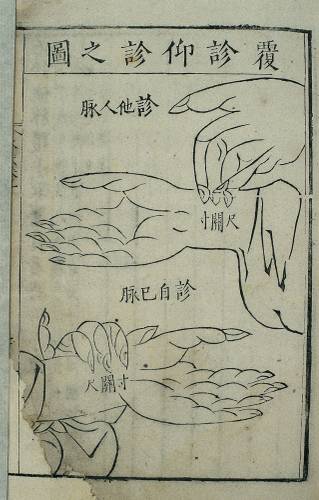
Woodcut illustration showing pulse diagnosis techniques known as fuzhen and yangzhen, Zhang Shixian (Ming period, 1368–1644)
© Wellcome Collection/Public Domain
Reimagining Life by Reimagining the Pulse
Keynote mit Shigehisa Kuriyama
For about two thousand years, the practice of traditional Chinese medicine has relied heavily on the art of pulse diagnosis. In the Han dynasty (206 BCE–220 CE), for instance, classical Chinese physicians perceived the pulse very differently compared to today; the classic medical text Su Wen, for example, lists nine pulses at different sites of the human body, indicating a typology of pulsation. In this keynote, historian of medicine Shigehisa Kuriyama proposes recovering such alternative understandings of the pulse and the forgotten ways of sensing it, thereby offering renewed insights into the art of living.
Where modern medicine, both in the East and in the West, locates the pulse in the mechanics of the beating heart, classical Chinese physicians read it as a language of place and time, as a correspondence between the microcosm of the human body and the macrocosm of heaven and earth. In this sense, to diagnose requires the art of outward contemplation—of turning the mind’s eye away from the isolated body and toward the ever-evolving cosmos in which all embodied life is embedded. In this understanding, pulse diagnosis in classical Chinese medicine begins with—and indeed depends on—a sensitivity to how the pulse feels during different seasons. Does the patient’s pulse match or deviate from the feel expected for that time of year? In other words, how closely do the vital flows within a person align with the cosmic streams that rhythmically shape the surrounding world? Drawing on decades of research into the histories of Greek and Chinese medicine, Kuriyama invites the audience to recover this ‘lost’ pulse—and, through it, an older, more entangled way of sensing the living body.
Part of L is for the Way You Look at Me II
Keynote mit Shigehisa Kuriyama
For about two thousand years, the practice of traditional Chinese medicine has relied heavily on the art of pulse diagnosis. In the Han dynasty (206 BCE–220 CE), for instance, classical Chinese physicians perceived the pulse very differently compared to today; the classic medical text Su Wen, for example, lists nine pulses at different sites of the human body, indicating a typology of pulsation. In this keynote, historian of medicine Shigehisa Kuriyama proposes recovering such alternative understandings of the pulse and the forgotten ways of sensing it, thereby offering renewed insights into the art of living.
Where modern medicine, both in the East and in the West, locates the pulse in the mechanics of the beating heart, classical Chinese physicians read it as a language of place and time, as a correspondence between the microcosm of the human body and the macrocosm of heaven and earth. In this sense, to diagnose requires the art of outward contemplation—of turning the mind’s eye away from the isolated body and toward the ever-evolving cosmos in which all embodied life is embedded. In this understanding, pulse diagnosis in classical Chinese medicine begins with—and indeed depends on—a sensitivity to how the pulse feels during different seasons. Does the patient’s pulse match or deviate from the feel expected for that time of year? In other words, how closely do the vital flows within a person align with the cosmic streams that rhythmically shape the surrounding world? Drawing on decades of research into the histories of Greek and Chinese medicine, Kuriyama invites the audience to recover this ‘lost’ pulse—and, through it, an older, more entangled way of sensing the living body.
Part of L is for the Way You Look at Me II
Treffpunkt: Miriam Makeba Auditorium
Nächster Termin:
Verkehrsanbindungen
-
U-Bahn
-
U Bundestag
- U5
-
U Bundestag
-
Bus
-
Haus der Kulturen der Welt
- 100
-
Platz der Republik
- 100
-
Katharina-Paulus-Str.
- 245
-
Berlin, Kleiner Stern
- 100
-
Lüneburger Str.
- 245
-
Reichstag/Bundestag
- 100
- M41
-
Berlin, Paulstr.
- 187
-
S+U Hauptbahnhof/Washingtonplatz
- 245
-
Schloss Bellevue
- 100
- 187
-
Alt-Moabit/Rathenower Str.
- 187
-
Lehrter Str./Invalidenstr.
- 123
- 142
- N40
-
Haus der Kulturen der Welt
-
Tram
-
Lüneburger Str.
- M8
- M5
-
Lesser-Ury-Weg
- M8
- M10
- M5
-
Alt-Moabit/Rathenower Str.
- M10
-
Clara-Jaschke-Str.
- M8
- M5
-
Lüneburger Str.
-
Regionalbahn
-
S+U Berlin Hauptbahnhof
- RE3
- RE5
- RE4
- FEX
- RB10
- RE8
- RE20
-
S+U Berlin Hauptbahnhof
Fragen zum Veranstaltungskalender beantwortet unsere Hilfe. Nutzungsbedingungen finden Sie unter Informationen zu unseren Partnern und Nutzungsbedingungen.