

The ‘EAST WEST EAST – Postwar Modernism in Berlin’ exhibition turns advertising spaces on the platforms of the Weberwiese and Schillingstraße stations into a photo gallery. This brings perspectives on postwar modernism on Berlin’s Karl-Marx-Allee from the urban space to the underground platform level for commuters and other people waiting for trains. 36 photographic artworks, by five different photographers, expand the horizons of the exhibition’s subject. The artistic impressions encourage viewers to explore the internationally renowned street with its districts for themselves. In the two stations, the photographers were given free rein over all of the advertising spaces along the platforms. The artists were chosen based in a competitive process. On either side of the Weberwiese underground platform, you can see photo series by Arlett Mattescheck as well as Philipp and Pascal Kapitza, while the Schillingstraße platform displays photo series by Maria Sewcz and Werner Huthmacher await you.
Photography on the platforms of the Weberwiese and Schillingstraße stations (U5)
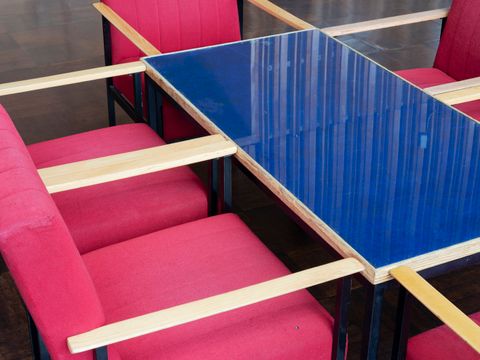
Image: Maria Sewcz
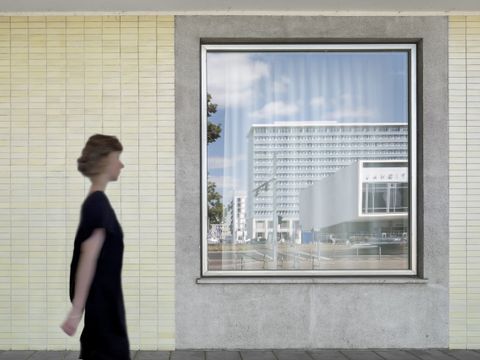
Image: Werner Huthmacher
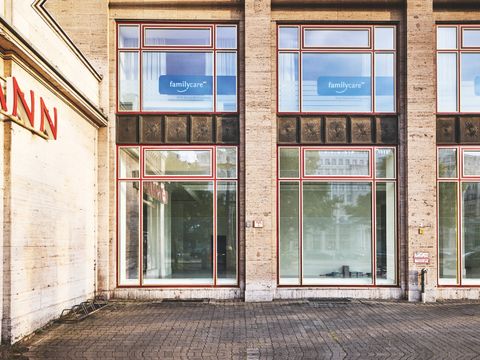
Image: Arlett Mattescheck
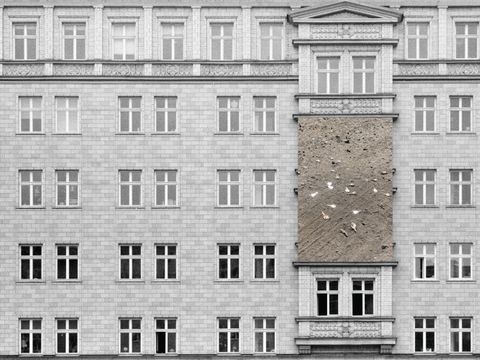
Image: Philipp & Pascal Kapitza
Photography at Weberwiese station
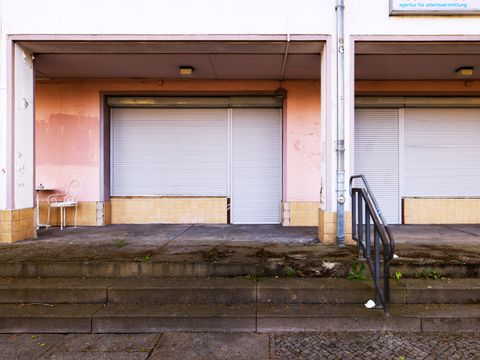
Image: Arlett Mattescheck
Arlett Mattescheck
In her photography, Arlett Mattescheck combines precise image composition with narrative sensitivity. Her work focuses on portrait, architecture and travel photography with a keen sense of atmosphere and visual narrative.
Photo series on Karl-Marx-Allee,
Construction phase I
Lost in Transition, 2024–2025
“An avenue at the intersection of the past and the future: historical prestige meets modern realities. Established residents and new citizens share the space, while shops selling everything from bargains to luxury stand side-by-side. Vacancy and vibrancy are juxtaposed. The series observes architectural spaces in the state of social permeability. Clear image compositions unite utility and absence, construction and memory.”
Image: Philipp & Pascal Kapitza
Philipp & Pascal Kapitza
work as a team at the intersection of artistic and architectural practice in the context of planetary crises. Their interests revolve around the need to visualise and involve more than human entities in urban contexts.
Photo series on Karl-Marx-Allee,
Construction phase I
I had a relative, 2024–2025
“The end was a mistake. Modernism is rooted in humanism and begets both humankind and all inhumanity. The constitution of modernism separates these entities, but this separation cannot be upheld. Hybrid creatures are created. We will always need oxygen to breathe, while producing our bodies from the carbon of others.”
Photography at Schillingstraße station
Image: Werner Huthmacher
Werner Huthmacher
photographs at the intersection of architecture depiction and free art. His work combines precise, yet narrative depictions of space with artistic representation of place with individual concepts.
Photo series on Karl-Marx-Allee,
Construction phase II
everything merges with the light, 2024–2025
“By overlapping situative moments with special views of listed architecture above the platforms, Huthmacher creates multi-layered images. Perspectives that could also be stills from the Jacques Tati movie “PlayTime” compress the location in the image. Details, moving silhouettes and objects poetically blend interiors and exteriors as well as the 1960s, when the buildings were built, with the present.”
Image: Maria Sewcz
Maria Sewcz
examines urbanity in the process of transformation. Her photographs are the result of precise observation and artistic analysis, combining composition and intuition to reveal the relationship between urban space and time.
Photo series on Karl-Marx-Allee,
Construction phase II
meanwhile, 2024–2025
“I rely on analytical vision, spatial structuring, and the formal conciseness of the details I see and highlight photographically. My works integrate divergent aspects in terms of motifs and perspectives, transferred proportions or spatial situations. During the rather short stay on site, I invite you to contribute your remembered perceptions, but also to discover new views above the Schillingstraße underground station.”
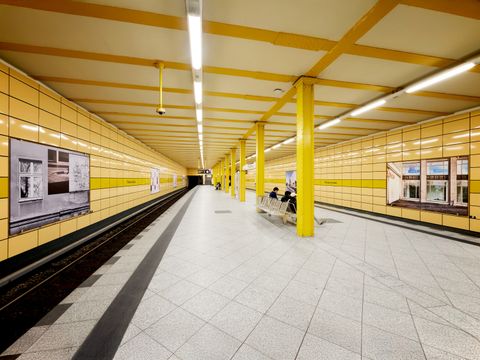
Image: Arlett Mattescheck
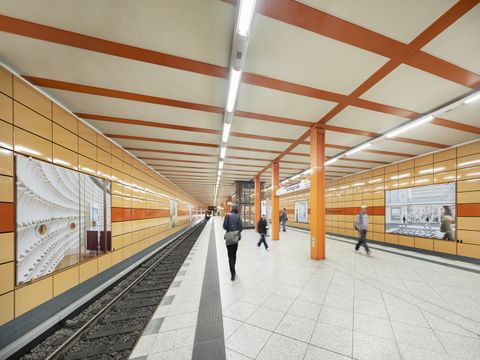
Image: Werner Huthmacher