

Marchlewskistraße 25 (south side)
Construction period: 1951/1952
Architecture: collective Hermann Henselmann
Weberwiese green space
Created: 1952–1954
Landscape architecture: Helmut Kruse
A key building in Berlin’s architectural history
Why is the high-rise at Weberwiese so well known in Berlin? It inspired the architecture of the buildings in the first building phase of the former Stalinallee, or Karl-Marx-Allee after 1961.
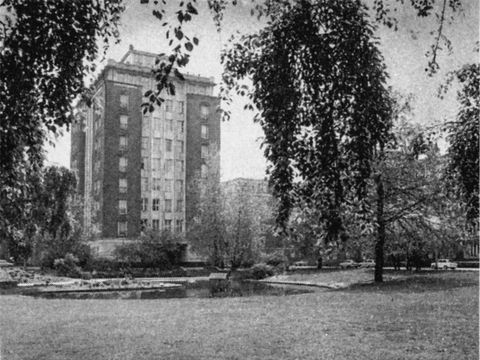
Its characteristic feature is visible on the exterior of the nine-floor block:
Its building corners are effectively emphasised by rendered double axes. The lower wall surfaces feature an expressive cladding with bright ceramics. The striking rooftop with a glazed roof garden is a particular highlight. Neoclassical ornamentation effectively highlights the symmetrical, monumental architecture.
The design of the high-rise building also impressed the political leaders. It became the flagship of the SED’s National Rebuilding Programme and a role model for the ornamental National Traditions building style, which was to dominate the new socialist cites.
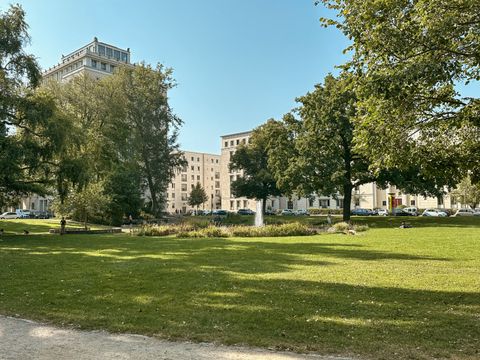
The high-rise is part of an ensemble with a lower transverse wing and two residential blocks in Marchlewskistraße. It frames the Weberwiese green space, an oasis of calm away from the heavy traffic of Karl-Marx-Allee. The slightly sculpted lawn with a curved path and copses of trees adheres to the principles of landscape architecture.
The green spaces and buildings interact through intentional sight lines. An example of this is the natural stone feature of the kidney shaped pond. Helmut Kruse positioned it precisely so that the high-rise would be reflected on the surface of the water.