

Karl-Marx-Allee 47–51 (north side)
Construction period: 1959–1961
Architecture: Josef Kaiser collective
Another new dawn – Housing construction with prefabricated panels
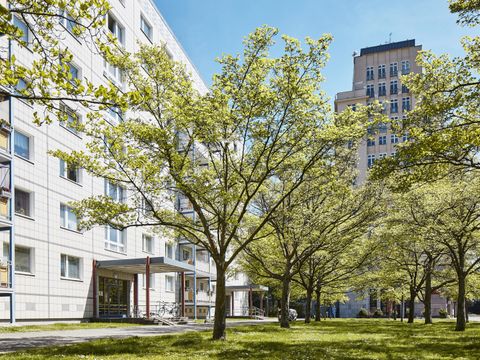
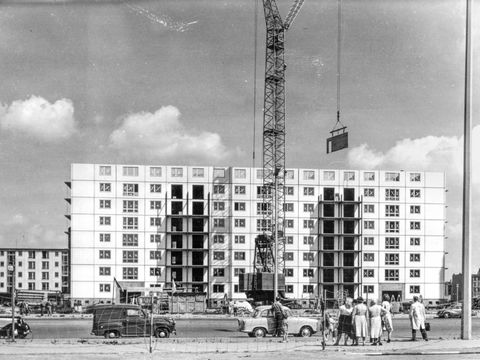
The large panel building beside Haus Berlin marks the beginning of new construction on Karl-Marx-Allee in the second construction phase (KMA II).
It symbolizes the “major paradigm shift in construction”: a transition from construction in National Traditions on the other side of Strausberger Platz and towards “better, cheaper and faster building” on the section leading to the new urban centre at Alexanderplatz.
The residential slab block, whose construction started in October 1959, was the first industrially prefabricated housing project in the GDR, demonstrating state-of-the-art assembly of high-rise buildings in the centre of East Berlin – a milestone in the history of prefabricated panel construction.
The eight-floor terrace building was based on construction type Q P (short for Querwand-Plattenbauweise, transverse wall prefabricated panel construction). This method of construction was primarily developed by Josef Kaiser for the residential area around Karl-Marx-Allee. The steel balconies on the long sides and the cantilevered balconies on the narrow sides are among its characteristic features.
The special cladding with light-coloured tiles is a reference to earlier buildings along the avenue.