Current language: English

Priceless – Money, Power, Values

  • Fotografie „Eine Rentnerin protestiert mit aufgenähten Banknoten gegen die Geldentwertung“ – Schwarzweißfoto mit älterer Person, die ein Schild mit Bildern und Text haelt. Kleidung mit Geldscheinen. Menschenmenge im Hintergrund.

    Fotografie „Eine Rentnerin protestiert mit aufgenähten Banknoten gegen die Geldentwertung“ – Schwarzweißfoto mit älterer Person, die ein Schild mit Bildern und Text haelt. Kleidung mit Geldscheinen. Menschenmenge im Hintergrund.

  • Louis-Alexandre Bottée: Medaille „Darstellung der Justitia an einer Geldprägemaschine“ – Silberne Medaille mit geprägten Figuren. Person sitzt, hält Waage. Text: "UNITÉ PRECISION REGULARITÉ".

    Louis-Alexandre Bottée: Medaille „Darstellung der Justitia an einer Geldprägemaschine“ – Silberne Medaille mit geprägten Figuren. Person sitzt, hält Waage. Text: "UNITÉ PRECISION REGULARITÉ".

  • Stuckkopf (Fälschung), Mexiko, Detail, Datierung unbekannt, Gips – Nahaufnahme einer antiken Skulptur eines Gesichts mit dunklen Markierungen um die Augen. Mittiger Riss im Stein. Kunstwerk aus Stein, Detailaufnahme.

    Stuckkopf (Fälschung), Mexiko, Detail, Datierung unbekannt, Gips – Nahaufnahme einer antiken Skulptur eines Gesichts mit dunklen Markierungen um die Augen. Mittiger Riss im Stein. Kunstwerk aus Stein, Detailaufnahme.

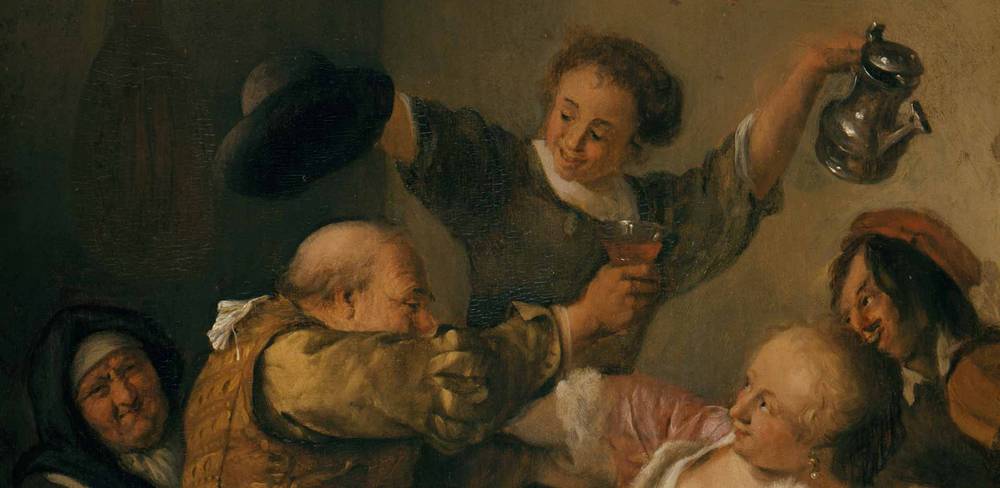
  • Jan Steen: Lockere Gesellschaft, um 1661/63, Detail – Fünf Personen bei Feier; mittlere Person haelt Glas hoch, links darueber Gusskanne; Ölgemaelde, barocke Kleidung, fröhliche Stimmung.

    Jan Steen: Lockere Gesellschaft, um 1661/63, Detail – Fünf Personen bei Feier; mittlere Person haelt Glas hoch, links darueber Gusskanne; Ölgemaelde, barocke Kleidung, fröhliche Stimmung.

  • 8 Escudos, Bolivien: 1841, Rückseite mit der Darstellung des Cerro Rico (Silberberg) bei Potosí – Goldmünze mit Prägung REPUBLICA BOLIVIANA, Berg mit Sonne und Lama, acht Sterne, Inschrift 8S 1841 L R.

    8 Escudos, Bolivien: 1841, Rückseite mit der Darstellung des Cerro Rico (Silberberg) bei Potosí – Goldmünze mit Prägung REPUBLICA BOLIVIANA, Berg mit Sonne und Lama, acht Sterne, Inschrift 8S 1841 L R.

Everything revolves around money: returnable bottles are collected, a rubber glove is worn, or a mobile phone is now ubiquitously used to pay at check-out. Yet money is more than just coins and bills, or a digital bank balance. Since its inception, money has shaped our perceptions of the world and quantifies what and who is considered valuable. How much should a banana, a T-shirt, a flat, someone’s labour, or a lifespan cost?

Money and Value in Flux: From a Mayan Stucco Head to the Cocoa Bean

The Priceless – Money, Power, Values exhibition examines how money shapes us, our history and our world – and at whose expense. It links the origins of money to questions of power and social structures, using objects from the Stiftung Preußischer Kulturbesitz (Prussian Cultural Heritage Foundation) collections to tell the story of global interconnections and personal fates within the context of shifts in value. Identified as a forgery, a Mayan stucco head loses its value as an antiquity but gains a new one as a research subject. Cocoa beans have evolved from a historical currency to a global foodstuff. Returnable bottles are rubbish for some while being a necessary source of additional income for others. The disposable glove becomes a symbol of unseen care work. A hurdy-gurdy resounds as an instrument of both rich and poor, played by itinerant musicians as well as for courtly entertainment. The collection objects are not only evidence of economic systems but should also be seen as means of representation, instruments of power and as assets.

Which Carries More Weight?

Interactive stations offer hands-on experiences with money: Visitors can stamp their own banknotes, weigh various commodities, listen to a hurdy-gurdy and share their thoughts on inequality, wealth and poverty. Curatorial interventions bridge the gap between historical perspectives and topical issues surrounding capital, consumption and social responsibility.

Curatorial Team

The exhibition is curated by museum assistants in-training at Stiftung Preußischer Kulturbesitz: Leonard Brey, Yannick Dreessen, Drossilia Dikegue Igouwe, Judith Fütterer, Tabea Harney, Klara Harthun, Flavia Hennig, Isa Hirtz, Marie-Luise Hugler, Ann-Kathrin Illmann, Jessica Knebel, Johannes Köhler, Sofie Lechner, Lea Nohr, Louis Petitjean, Elisabeth Pieper, Lu Tian, Sarah Unger, Zhining Zhang

Atelier Ambient created the exhibition design and scenography.

Exhibition at Two Venues

Priceless – Money, Power, Values is on display at the Forschungscampus Dahlem (Dahlem Research Campus). A focus display case at the Stabi Kulturwerk expands on the exhibition’s themes.

Stabi Kulturwerk Opening Hours:

Wednesday: 10 am – 6 pm
Thursday: 10 am – 8 pm
Friday – Sunday: 10 am – 6 pm
Closed Monday and Tuesday

Admission to the Forschungscampus Dahlem and the Stabi Kulturwerk at the Staatsbibliothek on Unter den Linden is free.

Funded by Museum & Location

A special exhibition of the Staatliche Museen zu Berlin

Runtime: Fri, 02/10/2026 to Sun, 17/01/2027

Takes place here:

The help page for the event calendar answers common questions.. Information about coperations and imprint can be found on our page about partners and terms and conditions.