Current language: English

On Intuition, Memory, and Becoming

Date details

Map

A visual map representation follows.Skip map

Show on map

End of map.

Public transportation

On Intuition, Memory, and Becoming

An Artist Talk with Edi Rama and Anri Sala

On Intuition, Memory, and Becoming: An Artist Talk with Edi Rama and Anri Sala
In conversation with Natalia Gierowska
3:30 pm
 
An artist and Prime Minister of Albania, Edi Rama works at the intersection of artistic production and political activity. His drawings—produced during meetings and negotiations—translate attention into visual form. More recent sculptural works extend this process, reworking drawings into three-dimensional structures and proposing a multifaceted understanding of temporality. Against the backdrop of and parallel to Albania’s post-Communism transition, Rama developed a relationship with artist Anri Sala.
This conversation, moderated by political scientist and art critic Natalia Gierowska, examines Rama’s expanded practice through his long-standing dialogue with Sala. Join the artists as they discuss their shared interest in perception, the limits of language, the role of form in shaping collective experience, and, importantly, how artistic modes of thinking can remain operative within contemporary political practice.

Edi Rama (b. 1964, Tirana) lives and works in Tirana. He trained as a painter at the Academy of Fine Arts in Tirana, where he later taught as a professor. After several years working as an artist in Paris, he returned to Albania in 1998 to serve as Minister of Culture and has been Prime Minister since 2013. His first solo exhibition, “Chrysalizing,” at Société opens in late April on the occasion of Gallery Weekend Berlin. Recent solo exhibitions include “Edi Rama,” Marian Goodman Gallery, Paris (2024); “Improvisations,” Zappeion, Athens (2023); and “Work,” which traveled from Kunsthalle Rostock, Germany (2018) to the Nevada Museum of Art, Reno (2019). Earlier presentations of his work have been held at the New Museum, New York (2016); the Venice Biennale (2017, 2003); Centre Pompidou, Paris (2010); Haus der Kunst, Munich (2004); and the São Paulo Biennial (1994).
Anri Sala (b. 1974, Tirana) constructs transformative, time-based works through multiple relationships between image, architecture, and sound. His works investigate ruptures in language, syntax, and music, inviting creative dislocations, which generate new interpretations of history, supplanting old fictions and narratives with less-explicit, more-nuanced dialogues. His work has been the subject of solo exhibitions at Bourse de Commerce, Paris (2023); Kunsthaus Bregenz (2021); Buffalo Bayou Park Cistern, Houston (2021); Centro Botìn, Santander (2019); Mudam, Luxembourg (2019); the Castello di Rivoli Museo d’Arte
Contemporanea, Turin (2019); Museo Tamayo, Mexico City (2017); the New Museum,
New York (2016); Haus der Kunst, Munich (2014); Centre Pompidou, Paris (2012);
Serpentine Gallery, London (2011); Museum of Contemporary Art North Miami (2008);
and ARC, Musée d’Art Moderne de la Ville de Paris (2004). He has also participated in
major group exhibitions and biennials internationally, including the 57th Venice Biennale (2017), dOCUMENTA (13) (2012), the 29th São Paulo Biennial (2010) and the 4th Berlin Biennale (2006). In 2013, he represented France in the 55th Venice Biennale.
Natalia Gierowska is a political scientist and art critic working at the intersection of politics and visual culture. Her academic research focuses on European harmonisation processes as well as broader questions of governance and displacement. She has published in academic journals including Springer and contributed book chapters on migration policy and refugee law, particularly in relation to the Middle East. She previously worked in political lobbying, academia, and diplomacy, experiences that inform her interdisciplinary approach to art criticism. She is Editor-at-Large at The Brooklyn Rail and co-leads the Stefan Gierowski Foundation in Warsaw, advancing its cultural and educational programmes.

Price info: plus admission

Alternative events

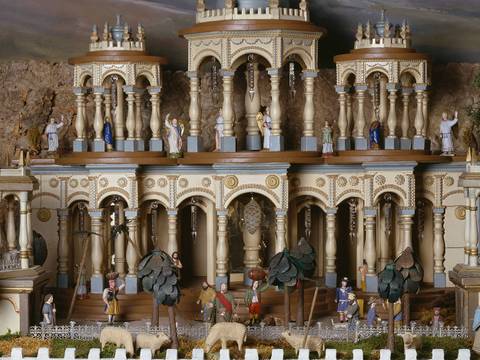
The Giant Mechanical Nativity Scene from the Ore Mountains

One highlight in the permanent exhibition at the Museum of European Cultures is the mechanical 'Weihnachtsberg', a giant nativity scene set in a hillside town that originates from the Erzgebirge, near the border of Germany and the Czech Republic, in the... moreabout: The Giant Mechanical Nativity Scene from the Ore Mountains
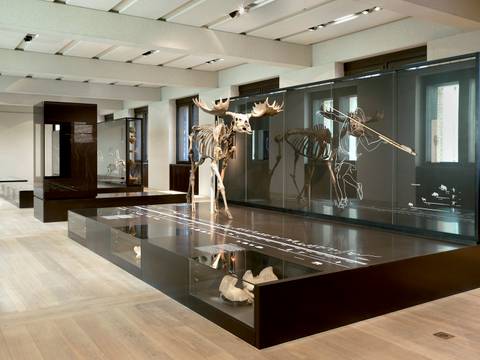
The Crown of Kerch

Gold jewellery from the migration period found near the Black Sea, silver brooches and magnificent belts from early medieval graves in France, Italy, Spain, and Germany: selections from the collection of Johannes von Diergardt will be on view again in... moreabout: The Crown of Kerch
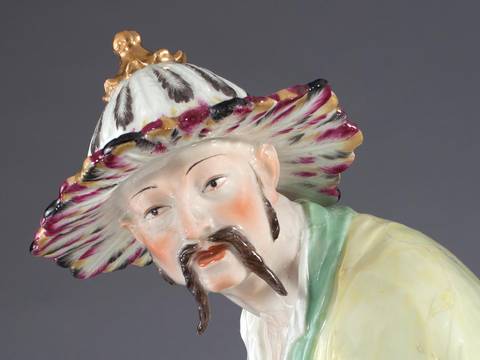
The Worlds of Rococo

The eighteenth century was the century of porcelain. Princes, aristocrats and the well-to-do bourgeoisie were absolutely addicted to this “white gold”. People would even speak of the maladie de porcelain. Those who couldn’t afford genuine porcelain turned... moreabout: The Worlds of Rococo
Show more events in the category "Ausstellungen"…

The help page for the event calendar answers common questions.. Information about coperations and imprint can be found on our page about partners and terms and conditions.