Current language: English

Katharina Sieverding

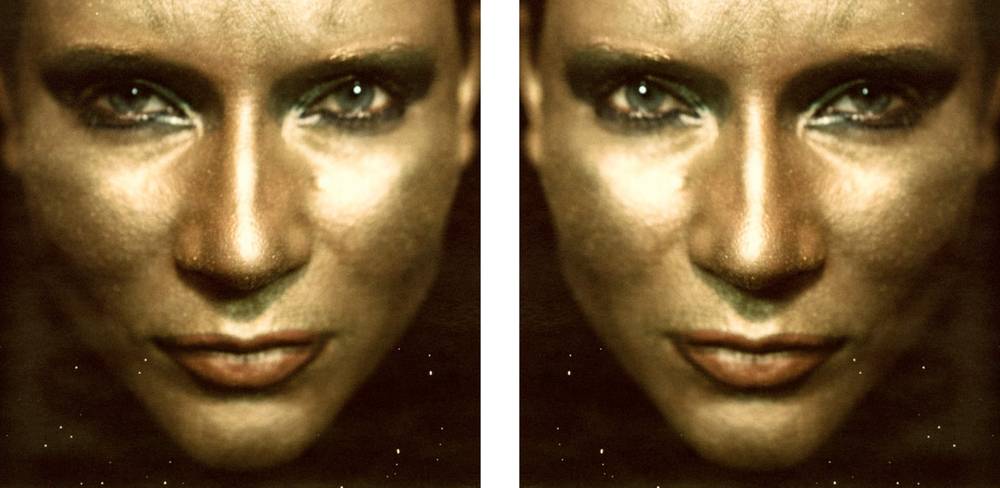
  • Katharina Sieverding, Die Sonne um Mitternacht schauen III/196 26 A/B, Detail, 1973, Farbfotografie, Acryl, Stahlrahmen – Zwei identische, frontal und nebeneinander angeordnete Portraits einer Person mit intensivem Blick. Die Bildtechnik erzeugt einen metallischen Glanz.

    Katharina Sieverding, Die Sonne um Mitternacht schauen III/196 26 A/B, Detail, 1973, Farbfotografie, Acryl, Stahlrahmen – Zwei identische, frontal und nebeneinander angeordnete Portraits einer Person mit intensivem Blick. Die Bildtechnik erzeugt einen metallischen Glanz.

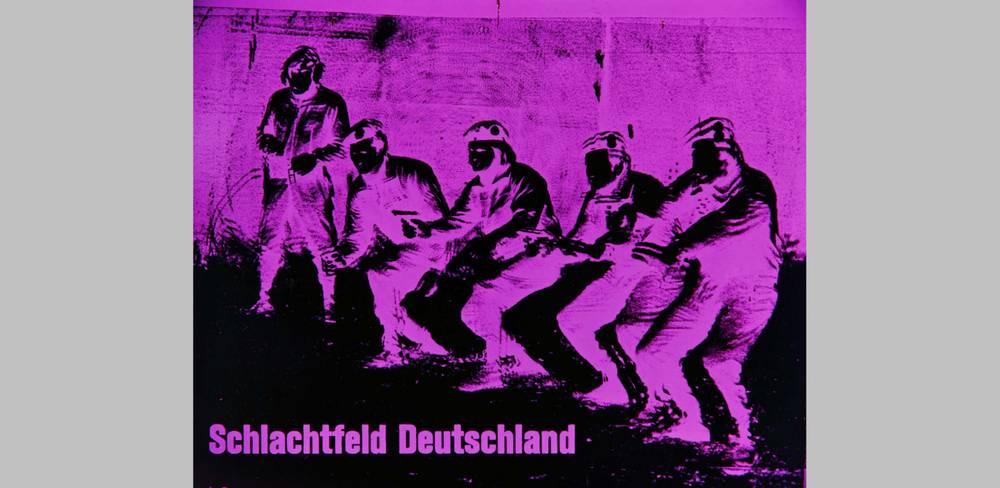
  • Katharina Sieverding, Grossfoto XI/1978, Schlachtfeld Deutschland, 1978, Farbfotografie, Acryl, Stahlrahmen – Schwarz-weiße Fotografie von sechs uniformierten Personen mit Helmen in einer Reihe, eingefärbt in violett. Text unten: Schlachtfeld Deutschland.

    Katharina Sieverding, Grossfoto XI/1978, Schlachtfeld Deutschland, 1978, Farbfotografie, Acryl, Stahlrahmen – Schwarz-weiße Fotografie von sechs uniformierten Personen mit Helmen in einer Reihe, eingefärbt in violett. Text unten: Schlachtfeld Deutschland.

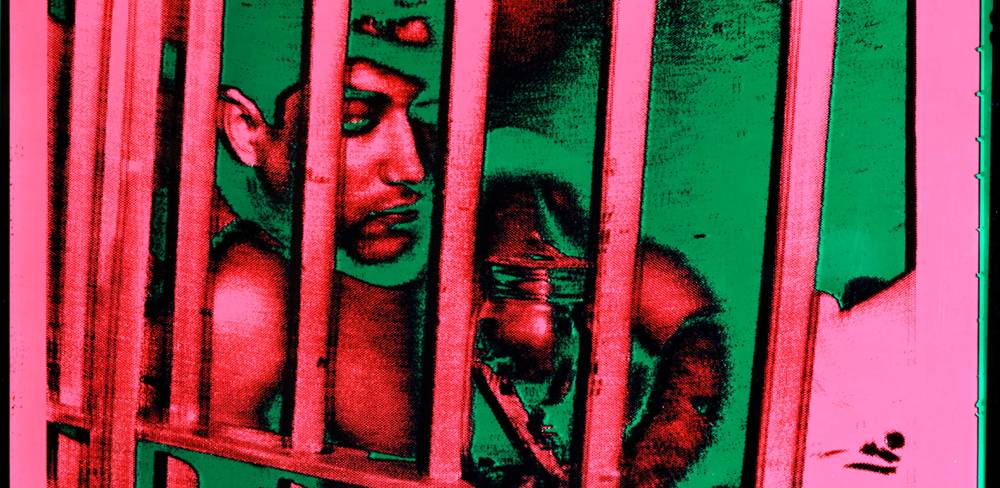
  • Katharina Sieverding, XIX/1980 Norad II, Detail, 1980, Farbfotografie, Acryl, Stahlrahmen – Poster in Rosa und Gruen mit einem Menschen hinter Gittern. Die Person traegt ein Mikrofon und schaut nach rechts. Stilisierte und kontrastreiche Darstellung.

    Katharina Sieverding, XIX/1980 Norad II, Detail, 1980, Farbfotografie, Acryl, Stahlrahmen – Poster in Rosa und Gruen mit einem Menschen hinter Gittern. Die Person traegt ein Mikrofon und schaut nach rechts. Stilisierte und kontrastreiche Darstellung.

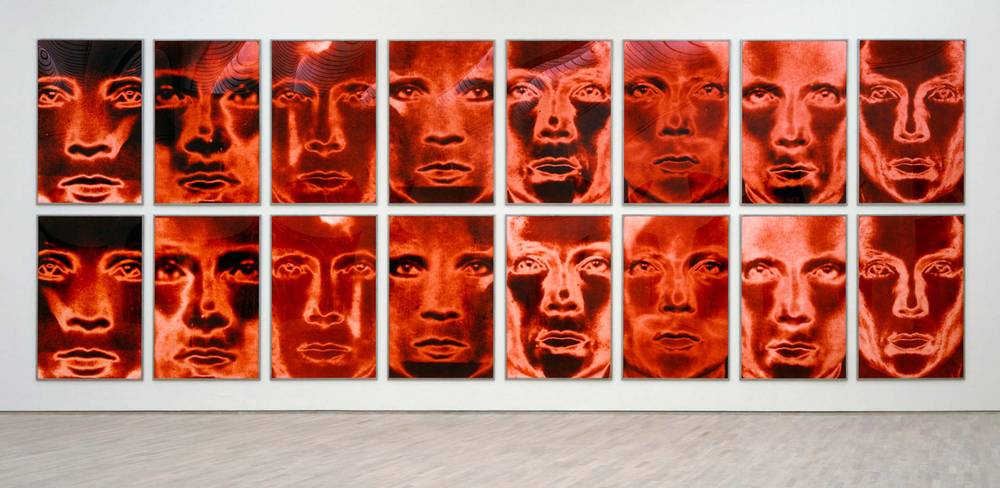
  • Katharina Sieverding, Stauffenberg-Block I-XVI, 1969/96, Farbfotografie, Acryl, Stahlrahmen, Installationsansicht: Katharina Sieverding 1967-1997, Kunstsammlung Nordrhein-Westfalen Düsseldorf 1997-98 – Eine Collage mit fünfzehn Porträts in Rot- und Orangetönen. Verschiedene Perspektiven von Gesichtern mit sternenförmig angeordneten Details.

    Katharina Sieverding, Stauffenberg-Block I-XVI, 1969/96, Farbfotografie, Acryl, Stahlrahmen, Installationsansicht: Katharina Sieverding 1967-1997, Kunstsammlung Nordrhein-Westfalen Düsseldorf 1997-98 – Eine Collage mit fünfzehn Porträts in Rot- und Orangetönen. Verschiedene Perspektiven von Gesichtern mit sternenförmig angeordneten Details.

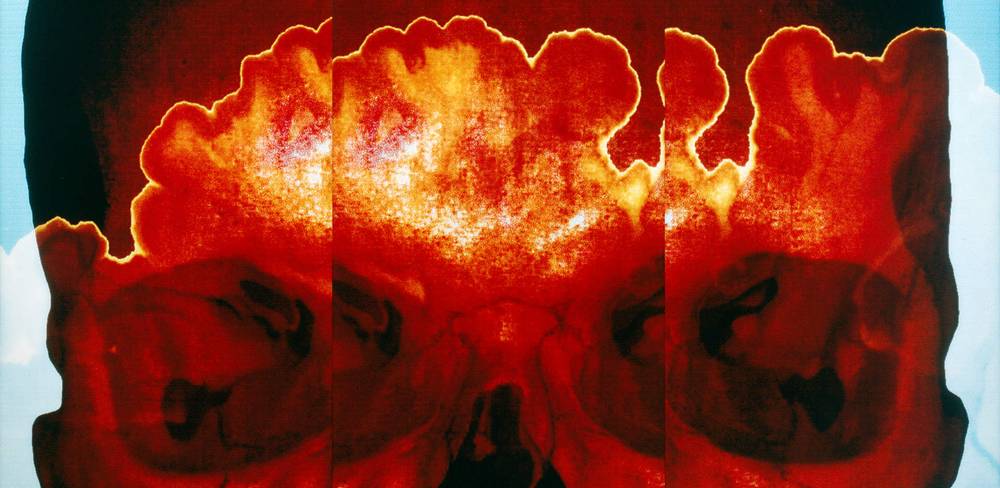
  • Katharina Sieverding, STEIGBILD X, Detail, 1997, Farbfotografie, Acryl, Stahlrahmen – Röntgenaufnahme eines Schädels in Rot- und Gelbtönen. Helles Leuchten an der Oberseite und dunkle Bereiche unten. Keine Schriftzeichen oder weitere Details.

    Katharina Sieverding, STEIGBILD X, Detail, 1997, Farbfotografie, Acryl, Stahlrahmen – Röntgenaufnahme eines Schädels in Rot- und Gelbtönen. Helles Leuchten an der Oberseite und dunkle Bereiche unten. Keine Schriftzeichen oder weitere Details.

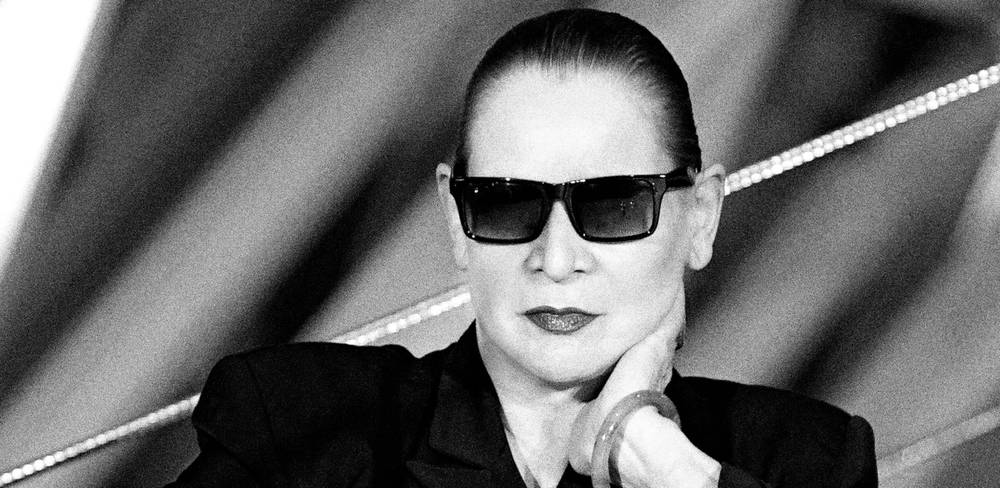
  • Katharina Sieverding, Porträt – Schwarzweißfoto, eine Person trägt Sonnenbrille und dunkles Oberteil, lehnt Kinn auf Hand. Glatter Hintergrund, diagonale Linien im Hintergrund sichtbar.

    Katharina Sieverding, Porträt – Schwarzweißfoto, eine Person trägt Sonnenbrille und dunkles Oberteil, lehnt Kinn auf Hand. Glatter Hintergrund, diagonale Linien im Hintergrund sichtbar.

This solo exhibition at the Neue Nationalgalerie is the first in Berlin to honour the complete oeuvre of Katharina Sieverding, spanning nearly six decades. She is regarded as a pioneer of photography and media art and has enjoyed international renown since the 1970s. The artist was born in Prague in 1941 and lives in Düsseldorf, yet she also has close ties to Berlin. From 1992 to 2010, she was a professor at the Berlin University of the Arts, where she founded the Visual Culture Studies programme.
The Neue Nationalgalerie is an ideal venue for Sieverding’s politically oriented work, which engages directly with society. From the open glass hall, her monumental photomontages project into the urban space. The exhibition focuses on works that address Germany’s particular history, raise questions about identity, or refer to global political contexts.
Sieverding’s artistic practice builds on a close interplay of space, image and text. This combination can be traced back to her beginnings in theatre, in stage design, where she explored the idea of a Gesamtkunstwerk (synthesis of the arts). From 1967 to 1972, she studied under Joseph Beuys at the Kunstakademie Düsseldorf. During this period, her conviction that art can have social and political impact solidified. Since then, Katharina Sieverding has expanded photography with elements of performance, body art, experimental film and painting into an interdisciplinary, multimedia practice. Together with the artist Klaus Mettig, she has been developing characteristic techniques such as multiple exposures, solarisation, superimpositions, strong colour contrasts, and image-text montages since the early 1970s. Her unmistakable visual language comes with layered content, transformations and openness to interpretation.
Through around 40 large-format works, the exhibition traces the most important phases of Sieverding’s oeuvre. Drawing on historical modes of presentation, some works are shown unframed on a monumental scale. While her powerful self-portraits question conventional gender roles, image series including Norad, Kontinentalkern, and the Steigbilder address existential themes such as illness and healing, death and transformation, and the nuclear threat. The cosmic film projection Die Sonne um Mitternacht schauen (Looking at the Sun at Midnight), ongoing since 2010, turns its gaze to the relationship between humans, energy and planetary processes.
In Sieverding’s artistic statements, socio-political themes merge with a critique of media images. Fact and fiction, masking and unmasking, individual and mass flow into one another. As if on an open stage, the politically relevant works are presented in the glass hall in relation to the outside space and thus to society. In this way, the urgent relevance of Sieverding’s art today becomes directly tangible. The exhibition offers a thought-provoking panorama of world history from 1970 to the present, encouraging self-reflection.
Curators
Curated by Uta Caspary and Joachim Jäger
Assistant curator: Ricarda Bergmann

A special exhibition of the Nationalgalerie – Staatliche Museen zu Berlin

Runtime: Sat, 24/04/2027 to Sun, 29/08/2027

Takes place here:

The help page for the event calendar answers common questions.. Information about coperations and imprint can be found on our page about partners and terms and conditions.