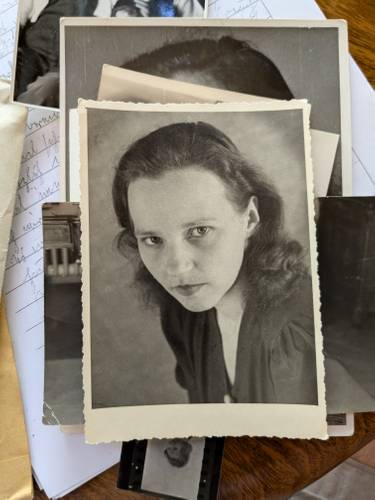
Starting September 10, 2026, the Mitte Museum will present an exhibition on the writer and journalist Susanne Kerckhoff (1918–1950), a defining voice of the early postwar period. Between 1948 and 1949, Kerckhoff published fictional portraits in the Berliner Zeitung under the title “Menschen in unserer Zeit” (“People of Our Time”), which addressed central issues of early postwar society: guilt, denazification, anti-Semitism, and democracy. The exhibition systematically explores this body of work for the first time.
Shortly after the end of the war, Berlin was the stage for Germany’s still-uncertain future—and language itself became the arena for debates about this future and how to come to terms with the past. Kerckhoff’s conviction that change can only be achieved through language is at the heart of the exhibition.
Kerckhoff’s questions are not historically resolved. Five artistic works created specifically for the exhibition place her texts in dialogue with the present, which is itself marked by upheavals and unresolved questions. Visual art, composition, and a literary intervention engage with Kerckhoff’s language: Jeanno Gaussi, likabari a.k.a. Melika Akbari, Eric Meier, Peter Wawerzinek, and Jens-Karsten Stoll developed their own works for the exhibition. Drawing on their own biographies, experiences, techniques, and personal approaches, they reinterpret Kerckhoff’s work.
Curator Heike Albrecht has been engaged with Kerckhoff’s work for some time: in 2023, she curated a series of interviews and readings based on her “Berlin Letters,” and in 2025, she curated a series of discursive performances at the Theaterdiscounter Berlin.
Biographies of the Artists and the Curator
Jeanno Gaussi, born in Kabul, Afghanistan, grew up in Kabul, Delhi, and Berlin. Drawing on a narrative concept, she creates intimate installations exploring space and memory. Her work encompasses various media, such as video, photography, objects, and texts. A central theme of her practice is the exploration of places and the encounters associated with them. Building on this, she addresses questions of memory, the search for identity, and the social and cultural processes triggered by these. She has participated in numerous exhibitions, film festivals, and symposia (dOCUMENTA 13, Havana Biennial, TEDx Marrakech). She was a fellow at the Käte Hamburger Kolleg “Dis:connectivity in Processes of Globalization,” received the Ann Wolff-Tutsek Foundation Fellowship, and was awarded the Körber Foundation’s Exile Visual Arts Special Award in 2025.
Eric Meier, born in 1989 in East Berlin, is a photographer and sculptor who grew up in Frankfurt an der Oder and lives and works in Berlin. He studied at the Academy of Visual Arts in Leipzig, as well as at the Berlin University of the Arts and the Ostkreuz School of Photography in Berlin. Eric Meier’s work explores his family and political experiences in the East German city of Frankfurt an der Oder, on the border with Poland. His photographic work can be understood as a search for the metaphorical potential of images, as well as a form of social criticism. His artist’s monograph “Eric Meier – FF” was published in 2021. His works are represented in the Dresden State Art Collection, the Federal Art Collection, and the Hoffmann Collection, among others.
likabari, also known as Melika Akbari, is a multidisciplinary performance and visual artist. After studying architecture (B.A., Tehran, Iran, 2016) and choreography (M.A., HZT, Berlin, 2022), she has been working as a choreographer, performer, set designer, and costume designer. Her conceptual works are site-specific, multifaceted, and detail-oriented. She explores the realm of material forms and movement through deconstruction, abstraction, and minimalism. In her creative practice, she blurs the boundaries between reality and imagination. Her most recent works include conceptual performances, short films, set designs, and costume designs.
Jens-Karsten Stoll, born in 1965 in East Berlin, is a musician and composer. He studied accompaniment and composition at the Hanns Eisler Academy of Music in Berlin. As a musical director, composer, and pianist, he has worked on numerous theater productions throughout the German-speaking world, including at the Berliner Ensemble, the Deutsches Theater Berlin, and the Schauspielhaus Hamburg. He has collaborated continuously with cabaret artist and director Rainald Grebe at numerous theaters since 2008. Concerts and workshops have taken him to Mexico City, Guadalajara, Bangkok, Hong Kong, Washington, Abidjan, Barcelona, Brussels, Warsaw, Genoa, Zurich, and Tashkent, among other places.
Peter Wawerzinek was born in Rostock in 1954 under the name Peter Runkel. He grew up in various children’s homes and foster families on the Baltic Sea coast. Since 1988, he has been a freelance writer, director, and radio playwright. Peter Wawerzinek received the Berlin Critics’ Prize for Literature (1991), the Radio Play Prize from the Berlin Academy of Arts (1993), the Ingeborg Bachmann Prize and the audience award of the same name (2010), was shortlisted for the German Book Prize (2010), received the Honorary Award from the German Schiller Foundation (2024), and has been awarded numerous fellowships, including the writers’ fellowship from the German Academy in Rome, Villa Massimo.
Heike Albrecht is a curator and dramaturg in the interdisciplinary performing arts program. She directed the Performing Arts Program at LOFFT Leipzig, curated numerous festival formats (including Westend 05 know your rights and Tanznacht Berlin), and served as artistic director and managing director of the Sophiensaele Berlin from 2007 to 2010. For the Goethe-Institut, she curated “As We Speak” as part of the European Capital of Culture “Maribor 2012.” At the Academy of Arts, she served as curator for the 2019 program series “What the Body Remembers. On the Relevance of Dance Heritage.” In 2023, she curated a series of interviews and readings based on Susanne Kerckhoff’s “Berliner Briefe,” and in 2025, she curated a series of discursive performances at TD Berlin.
Curator: Heike Albrecht
Design: Carsten Stabenow / milchhof atelier
Curatorial Assistant: Camille Compere
Public Relations: Luise Haubenreiser (CAMPI Fellow)
Supported by the Capital City Culture Fund.
The Mitte Museum is largely accessible. An elevator provides wheelchair-accessible access from the outdoor area to the exhibition spaces, the archive, and the event venues.
An accessible restroom is located on the ground floor of the museum. You can borrow a key from the reception desk to use it. Please call (030) 4606019-10 to request assistance.
Translated with DeepL
Runtime: Thu, 10/09/2026 to Sun, 21/02/2027