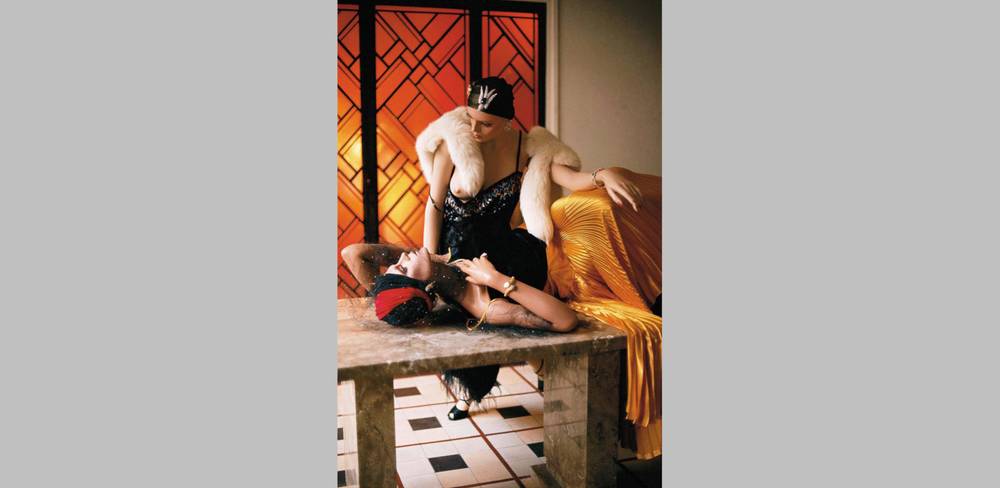
The exhibition is devoted to three early, iconic books by Helmut Newton. He planned each book himself, down to the last detail; each volume follows its own concept and scope. Together, the more than 200 photographs form a kind of “best of” his work from the 1970s and early 1980s.
Helmut Newton is one of the most influential photographers of the 20th century. Famously, he staged his images to be seductive and provocative, at times pushing past the bounds of prevailing social norms. His strikingly inventive photographs, most of them shot on assignment for the most prestigious magazines of the day, were published regularly from the 1950s onward. In 1975 he also began showing his work in galleries, and a year later came his first book, White Women (also called Femmes Secrètes), which sold very well and won the Kodak Photo Book Award that same year – though it was controversial from the start. Sleepless Nights (also called Nuits Blanches) followed in 1978, and Big Nudes (also called 47 Nudes) three years later. The different titles reflect the books’ various publishers and languages; their contents remained virtually unchanged. As celebrated as they are notorious, these books established Newton’s international reputation beyond his countless magazine publications and are now classics of the photo book genre.
The Newton Foundation marks the 50th anniversary of Femmes Secrètes with an exhibition that once again brings together numerous photographs from all three books. Like earlier versions, the new presentation is based on the exhibition conceived in 2012 for the Museum of Fine Arts, Houston, when the photographs published in the books were turned into modern exhibition prints. During Newton’s lifetime, these early images – some of them iconic, all poised between fashion, portrait and nude photography – were never shown together. Vitrines also present the original book maquettes with their alternative cover designs, alongside small-format work prints, medium-format lifetime prints that probably served as masters for the lithographs, and reviews from magazines of the period.
Femmes Secrètes
With his first photo book, Newton pulled off a daring coup, paving the way for an eroticization of fashion imagery that culminated in 1980–81 in his famous series Big Nudes and Naked and Dressed for various editions of Vogue. He had been laying the groundwork for this unconventional idea – contemporary fashion in diptychs, the model clothed in one frame and nude in the other – as early as the mid-1970s, and he offered a glimpse of it in Femmes Secrètes: a variant of his iconic fashion image Yves Saint Laurent, Rue Aubriot, shot one night in 1975 on the street of the same name for French Vogue. A few minutes later, he made a second version, this time with a nude model. In this book, he brought nudity and fashion together for the first time – subtly, in images that read like film stills.
Sleepless Nights
He assembled his second book, Sleepless Nights (1978), with comparable finesse: a different selection of recent black-and-white and color images that had previously appeared in numerous magazines. Here again the subject is women – their bodies and their clothes. Many of the images are not only fashion pictures but also portraits or partial nudes. Among them are three smaller, iconic series: images of models in orthopedic braces, made shortly after the publication of J. G. Ballard’s legendary novel Crash; models with Hermès leather saddles, which drew particular controversy; and the so-called “dummies.” In the mid-1970s, while on fashion assignments for French Vogue, Newton worked with shop mannequins – for instance, having them secured with wire late at night on the Pont Alexandre III bridge over the Seine. Stylists made them up so convincingly that it could take a second or third look to tell whether a figure was a live model or a life-size mannequin. It was an unusual, even radical idea, one Newton first introduced to fashion photography in the mid-1960s.
Big Nudes
It was the publication Big Nudes that finally made Newton, by then in his early 60s, world-famous. Like his earlier books, it remained in print for decades after 1981, ran to hundreds of thousands of copies, and appeared with several publishers and in several languages. Karl Lagerfeld contributed a foreword to the German edition. In his autobiography, Newton traced the origin of the Big Nudes to the oversized wanted posters for Red Army Faction (RAF) members issued by the German police: they gave him the idea of shooting full-body nudes with a medium-format camera in the studio, then printing them life-size. He first showed them at that unusual scale in 1981 at Galerie Daniel Templon in Paris, alongside the first edition of the book – not yet called Big Nudes but simply titled Helmut Newton, published by Éditions du Regard, Paris. The first five Big Nudes of 1980, numbered in Roman numerals, have been on display in the foundation’s upper lobby since it opened in the summer of 2004, together with the diptych Sie kommen (They’re Coming), also printed life-size, from the Naked and Dressed series. They are among his best-known bodies of work.
A special exhibition by the Newton Foundation at the Museum für Fotografie – Staatliche Museen zu Berlin
Runtime: Thu, 03/12/2026 to Sun, 16/05/2027