Netta Weiser (born 1991 in Israel) works across sound installation, performance, and experimental radio. The Humboldt Forum Listening Space presents the artist's first sound exhibition in Berlin. In her interdisciplinary practice, Weiser develops choreographic approaches to sound, exploring how radio broadcasting can render muted histories audible and how collective listening can generate temporary communities. In fuga, archival sounds from 1930s Egypt, queer histories, and diasporic memory intermingle into a choreographic listening experience.
fuga emerges from Weiser's artistic research at the Phonogramm-Archiv, housed at the Ethnological Museum in Berlin. Her research focused on a collection of wax cylinder recordings made in Egypt in the 1930s by Brigitte Schiffer (1909–1986), a German-Jewish composer whose life was shaped by displacement and exile. Schiffer studied composition and ethnomusicology in Berlin. As part of her doctoral research, she conducted fieldwork in Siwa, an isolated oasis in western Egypt. Travelling with a phonograph, she documented a wide range of vocal practices within the local Amazigh community. Among her recordings are rare sonic documents, including women's songs, laments and work songs. After submitting her dissertation in 1935, Schiffer fled Germany following the rise of the Nazi regime, going into exile in Egypt, where she lived for the next 30 years and became an important figure in the cultural life of cosmopolitan Cairo.
Through sound, performance, and spatial composition, Weiser approaches Schiffer’s recordings as living traces, re-activating them through a queer-diasporic perspective that amplifies silenced narratives and subversive histories of emotion.
Sound Installation in Two Parts
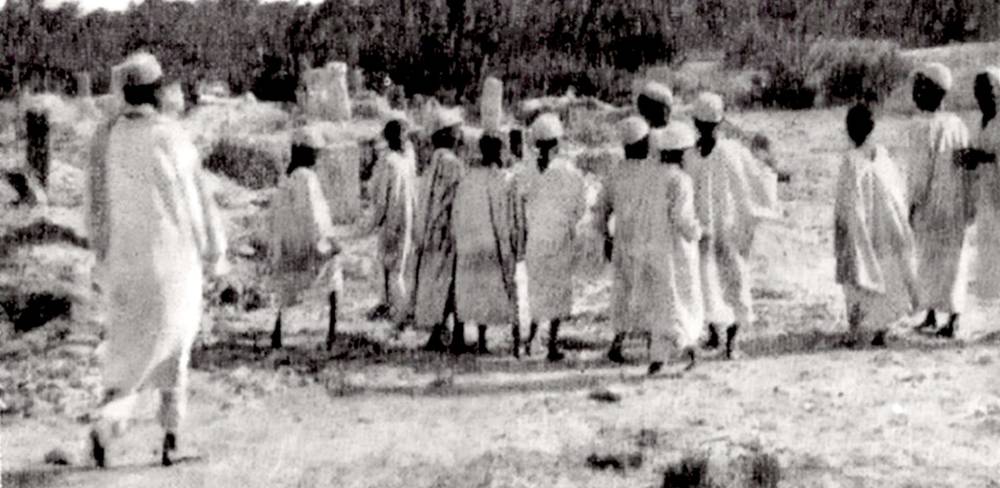
The sound installation unfolds in two parts. The first centres on a recording of a group of children singing a lament during a funeral procession in the Sahara Desert. Schiffer herself composed a piece inspired by this melody in 1934. In her composition, Weiser combines the original recordings from Siwa, excerpts from Schiffer's piece, electronic sounds derived from the wax cylinders, and reenactments performed by a group of children. She collaborated with flutist Roy Amotz, who improvised in response to these materials.
The second part revolves around a collection of recordings of songs performed by agricultural labourers in Siwa during the date harvest. These call-and-response songs were performed from the tops of palm trees across the oasis gardens, and their lyrics weave together themes of migration, economic struggle, and hints of queer love. Weiser collaborated with vocalist Chanan Ben Simon, who reenacts the vocal gestures found in the recordings, embodying the responding voice missing from the archive. The resulting composition is a shouted love song between contemporary and historical voices emerging through a sonic landscape of noise textures processed from the original wax cylinder recordings.
Created against the backdrop of ongoing wars in the Middle East, the work reflects the artist's personal engagement with questions of migration, artistic practice in times of war and navigating shifting political realities. The spatial composition unfolds through layers of circular movement surrounding the listener, emphasizing the cyclical repetition of history across different perspectives of time and place.
The sound installation is accompanied by a six-channel video work created by Itay Marom. Slowly moving through a single archival photograph of the children's choir reproduced in Schiffer's 1936 dissertation, the work introduces a visual layer of movement, texture, and memory.
The Listening Space
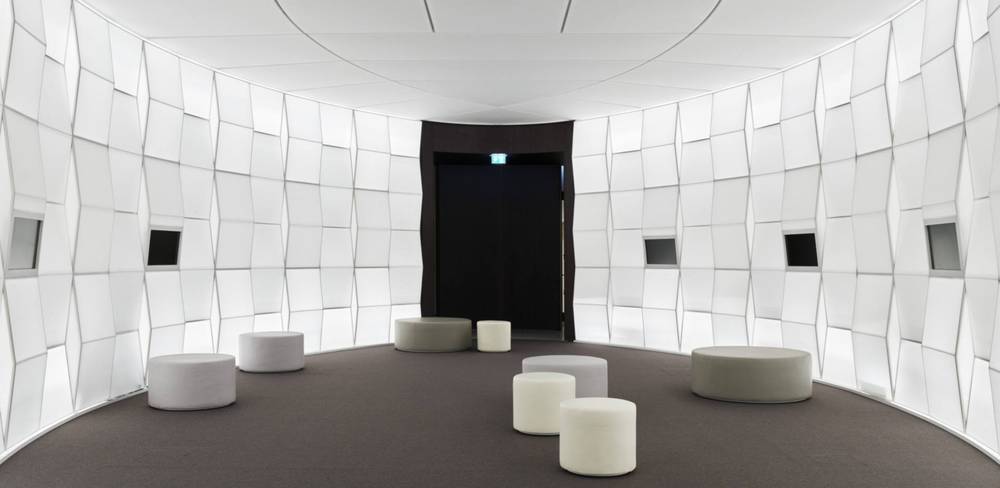
Created specifically for the unique acoustic architecture of the Humboldt Forum Listening Space, fuga activates the space as a choreographic listening environment. The Listening Space's three-dimensional spatial audio system allows sound to move throughout the space, making listening a physical and immersive experience. In this way, fuga approaches the archive not as a static historical document, but as a site of dialogue, transformation, and a living terrain in which embodied forms of knowledge can re-emerge.
Accompanying Programme
The exhibition is accompanied by a public programme of performances, conversations, collective listening events in the Humboldt Forum, and a radio programme on reboot.fm:
Guided Listening Session as part of Lange Nacht der Museen (29 August 2026, 6:30 pm)
Sound Performance at the Hörraum (29 August 2026, 8 pm)
Dance: “The Skin Listens Too” (12 September 2026, 2 pm)
Talk: “Brigitte Schiffer: Sounds of Exile” (16 September 2026, 5 pm)
Accompanying radio programme
Opening Hours
fuga can be experienced in the Listening Space in the second floor, Wednesday through Monday from 4 pm until 6:30 pm.
About the Artist
Netta Weiser (born 1991, Israel), is a Berlin-based artist and choreographer working across performance, sound installation, and experimental radio. In 2019, she founded Radio-Choreography, a long-term artistic research project exploring the transformation of dance into sound, the relationship between live broadcasting and muted histories, and collective listening as a choreographic practice.
Her work has been presented internationally, most recently at Akademie der Künste and KW Institute for Contemporary Art Berlin, Tanzquartier Wien, Badischer Kunstverein Karlsruhe, University of Cambridge, Tanznacht Berlin, Onassis Stegi Athens, WDR (West German Broadcasting), TONSPUR at the MQ Vienna, Suzanne Dellal Centre for Dance Tel Aviv, Zwerglgarten Pavilion Salzburg, and Villa Medici Rome.
Weiser is the recipient of fellowships from the Studio for Electroacoustic Music at the Akademie der Künste Berlin and the VALIE EXPORT Center Linz. She also broadcasts a monthly radio show on reboot.fm – Free Artists Radio from Berlin.
Collaborating Artists
Flute: Roy Amotz Vocals: Chanan Ben Simon Video: Itay Marom Sound Engineer & Electronics: Michael Hauschke Research Dialogue: Prof. Dr. Matthias Pasdzierny
Special Thanks to Eleanor and Naomi Volaski Aram.
fuga is commissioned by the Media Department, Ethnologisches Museum / Museum für Asiatische Kunst, Staatliche Museen zu Berlin. The Listening Space is cooperation between the Technical University of Berlin, the Stiftung Humboldt Forum im Berliner Schloss and the Stiftung Preußischer Kulturbesitz.
Supported by Artis through its Exhibition Grant Initiative.
An early version of this work was presented at the Maamuta Center for Art and Research at Hansen House, Jerusalem, in collaboration with the Goethe-Institut Jerusalem Residency Program.
A special exhibition of the Ethnologisches Museum and Museum für Asiatische Kunst – Staatliche Museen zu Berlin at the Humboldt Forum
Runtime: Sat, 29/08/2026 to Wed, 31/03/2027