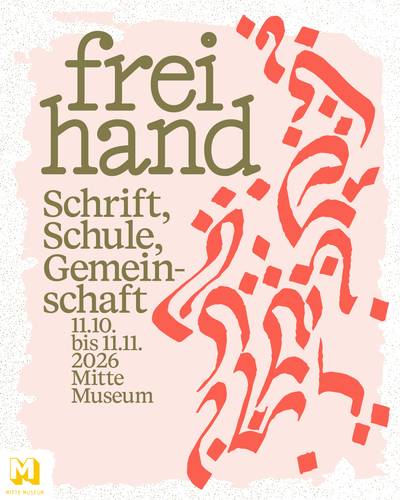
On October 9, 2026, at 3:00 p.m., the Mitte Museum will open the exhibition “freihand. Writing, School, Community.” It features works by students from the Mitte district spanning roughly a century: calligraphy pieces from an art class at the Herbert Hoover School and twenty handwritten notebooks that children at the 308th Public School on Leopoldplatz wrote, drew, and bound themselves from 1926 to 1928. In both cases, the students decided what would be written on the paper.
The calligraphic works were created in 2025 as part of the Calliversity project. Under the guidance of artist Daniel Arab, sixteen students in an elective art course—taught by Hella Mittrücker and Ingolf Watzlaw—learned to work with pen and ink, fractals, and decorative lettering. The result was abstract calligraphy, in which the writing is detached from the meaning of the words.
The 308th Community School was a secular experimental school of the Weimar Republic. As a “community-based school,” it followed its own curriculum; each class devised its own four-year study plans. “It was in the spring of 1926 when we founded the class newspaper,” H. Fink begins. After that, many contributed: essays about their experiences, puzzles, comics, and instructions for linocut printing with precise amounts in pfennigs. The editorial staff changed over time, and the newsletter wasn’t always published on time.
In 1933, this progressive educational practice came to an end. Principal Heinrich Mäcke and Vice Principal Else Hiebsch were dismissed; former principal Max Kreuziger was later interned in a concentration camp, and the school library was burned. The fact that the issues have been preserved is thanks to Bruno Stephan, who had been a teacher at the school since 1922 and became director of the Wedding Local History Archive after 1946.
In April 2026, the same students handled these booklets at the Mitte Museum—wearing cotton gloves—and deciphered the unfamiliar handwriting. Questions raised by the old articles inspired them to write their own texts. In art class, the students traced the illustrations with ink, colored them as they had been in the second issue of the historical newspaper, and bound them into a booklet. This new collaborative newspaper is on display in the exhibition alongside the originals.
Curation and Project Management: Luise Haubenreiser (CAMPI Fellow)
Design: form und konzept
The calligraphic works were created as part of the “Calliversity” project at the Herbert Hoover School, a certified cultural school within the Language Education Network. The project days with Daniel Arab were funded by the Pankstraße Cultural Education Network of the Mitte District Office and supported by cultural agent Anne Krause as part of the “Cultural Agents for Creative Schools Berlin” program. The program is implemented by the German Children and Youth Foundation and funded by the Senate Department for Education, Youth, and Family Affairs.Translated with DeepL
Runtime: Sun, 11/10/2026 to Wed, 11/11/2026