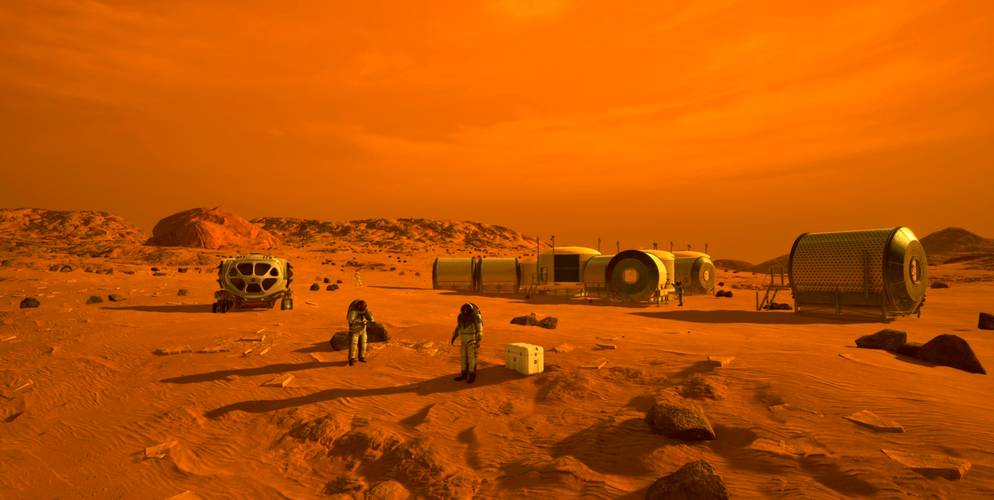
The search for water is widely regarded as one of the most promising pathways to the discovery of extraterrestrial life. Yet long before life is ever found, images come into being. High-resolution observations from the James Webb Space Telescope, the Artemis missions, and computer-generated visualisations shape our understanding of the Universe. Space images do not merely represent reality; they actively participate in constructing concepts of life, habitability, and otherness. In her short talk Who Determines What Counts as Life? Space Images and the Decolonisation of Astrobiology in the Artemis Era, Ulrike Ernst-Auga explores why visuality in astrobiology functions both as a scientific instrument and as a cultural narrative. From a critical epistemological perspective, she asks how space research can be decolonised and how we might think about life beyond Earth without reproducing colonial assumptions of superiority, ownership, or hierarchical forms of otherness in our understanding of the Universe.
PARTICIPANTS
Ulrike Ernst-Auga
Ulrike Ernst-Auga is a cultural and religious studies scholar and Professor of Religious Studies and Intercultural Theology at Humboldt University of Berlin. She is also an Associate Research Fellow at Stellenbosch University (South Africa) and an affiliated researcher in the German Research Foundation (DFG) Research Training Group “Transformative Religion: Religion as Situated Knowledge in Social Processes of Knowledge Production”. As a Fellow of the Center of Theological Inquiry (CTI) in Princeton, she participated in the NASA-funded fellowship programme “Inquiry on the Societal Implications of Astrobiology”, where she conducted research on the epistemological foundations of astrobiology. Her work brings together Religious Studies, Gender Studies and postcolonial epistemologies with questions of visuality, digitalisation and space research. She developed the concepts of “Religion as Situated Knowledge”, “Religion as a Discursive, Intersectional and Performative Category” (DIP), and “Extended Epistemological Analysis” (EEA). Her recent article on decolonising space exploration was published in Iglesia Viva in 2026. Ernst-Auga’s work has been recognised with the Käthe Leichter Prize of the University of Vienna, the Mary Douglas Prize of the University of Lausanne, and the Humboldt–Princeton Strategic Partnership Grant. She has also reached a wider public through the ARTE documentary “Flick Flack – The Yoko Ono Effect”.
- Language: German
- Location: Humboldt Lab, 1st Floor
- Part of: On Water
- Ticket for Lange Nacht der Museen required