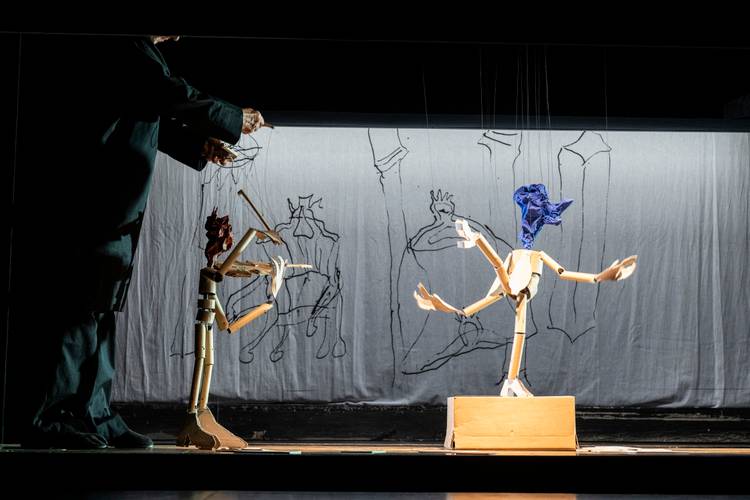
Die Geschichte vom Soldaten, Salzburger Marionettentheater – Zwei Holzkasper stehen auf einer Bühne, ein Mensch bedient die Fäden, Hintergrund Leinwand mit Zeichnungen.
© Bernhard Müller
Igor Stravinsky’s Histoire du Soldat is a unique work: not an opera, but a play “to be read, to be played and to be danced”. Matthias Bundschuh’s staging of the music theatre can now be seen at this year’s Musikfest Berlin, following its much-lauded premiere at the 2025 Salzburg Festival in cooperation with the Salzburg Marionette Theatre. The marionettes for the production were designed by Georg Baselitz: Central to the painter, sculptor and graphic artist’s thinking was the idea that the marionettes should be created by the simplest means and reduced to their very essence. The distinguished artistic team is completed by the actor Dominique Horwitz as the speaker and a top-quality miniature orchestra that includes the violinist Isabelle Faust and her friends.
The world premiere of the Histoire du soldat in Lausanne in 1918 marked not only a significant moment in the history of 20th-century Swiss theatre, but it also made it a key work of musical modernism. During the First World War, Stravinsky found himself in exile on Lake Geneva, where he became acquainted with the writer Charles Ferdinand Ramuz. In response to their lack of a regular income, the two artists decided to collaborate on a form of travelling theatre. They found the story of a soldier who has deserted, the Devil, a violin and a Princess in a Russian fairy tale, and Stravinsky and Ramuz proceeded to rework key points of the original.
The protagonists of Histoire du Soldat are not individual characters but figures from the repertoire of puppet and fairground theatres. The music is written for a seven-strong ensemble and consists of 16 concise numbers, in which Stravinsky works with general musical tropes from the march to the tango. These are typically constructed out of small elements – varied but remaining stable in substance – superimpose different layers, each with its own rhythms, and display a certain dry and hard sonic quality.
The Salzburg Marionette Theatre is one of the world’s most distinguished traditional puppet theatres and was founded in 1913 by the sculptor Anton Aicher. The ensemble consists of ten puppeteers who have been trained in the profession’s diverse crafts and are able to construct the puppets, stage sets and props themselves. In 2016 the Salzburg Marionette Theatre’s performance practice was placed on UNESCO’s list of Intangible Cultural Heritage. After a visit from the artist Georg Baselitz, who has maintained a long-standing interest in this art form, a collaboration seemed almost inevitable. They quickly chose the Histoire du Soldat, and Baselitz’s marionette designs acknowledge the artificial and constructed nature of the theatre: “I took a very thin sheet of metal that I could bend easily and handle very freely in formal terms. […] I crumpled all the characters into shape myself. I showed their bodies, which are usually hidden under clothing, only as skeletons – they consist entirely of cardboard tubes.”
Igor Stravinsky (1882–1971)
L’Histoire du Soldat (1917/18)
A stage work to be read, played and danced
Text by Charles Ferdinand Ramuz in the German adaptation by Hans Reinhart
Scenic performance
Artists/Collaborators: Matthias Bundschuh, Georg Baselitz, Leonhard Winkler, Isabelle Faust, Pascal Moraguès, Giorgio Mandolesi, Reinhold Friedrich, Ian Bousfield, Wies de Boevé, Raymond Curfs, Dominique Horwitz, Edouard Funck (Der Soldat), Ursula Winzer (Der Soldat), Philippe Brunner (Der Teufel), Eva Wiener (Der Teufel), Vladimir Fediakov (Die Prinzessin), Maximilian Kiener-Laubenbacher (Die Prinzessin), Veronika Grimme (Der König / Der Veteran), Marion Mayer (Der Ausrufer / Der Trompeter), Philipp Schmidt (Der Trommler), Salzburger Marionettentheater (Dorfbewohner)
A co-production of the Salzburg Marionette Theatre (Puppet Theatre) with the Salzburg Festival, supported by Galerie Thaddaeus Ropac
The 2026 tour is supported by fürst developments, Salzburg.
A Berliner Festspiele / Musikfest Berlin event