A Better Life Thanks to SGE

Mario Katsch

Mario Katsch
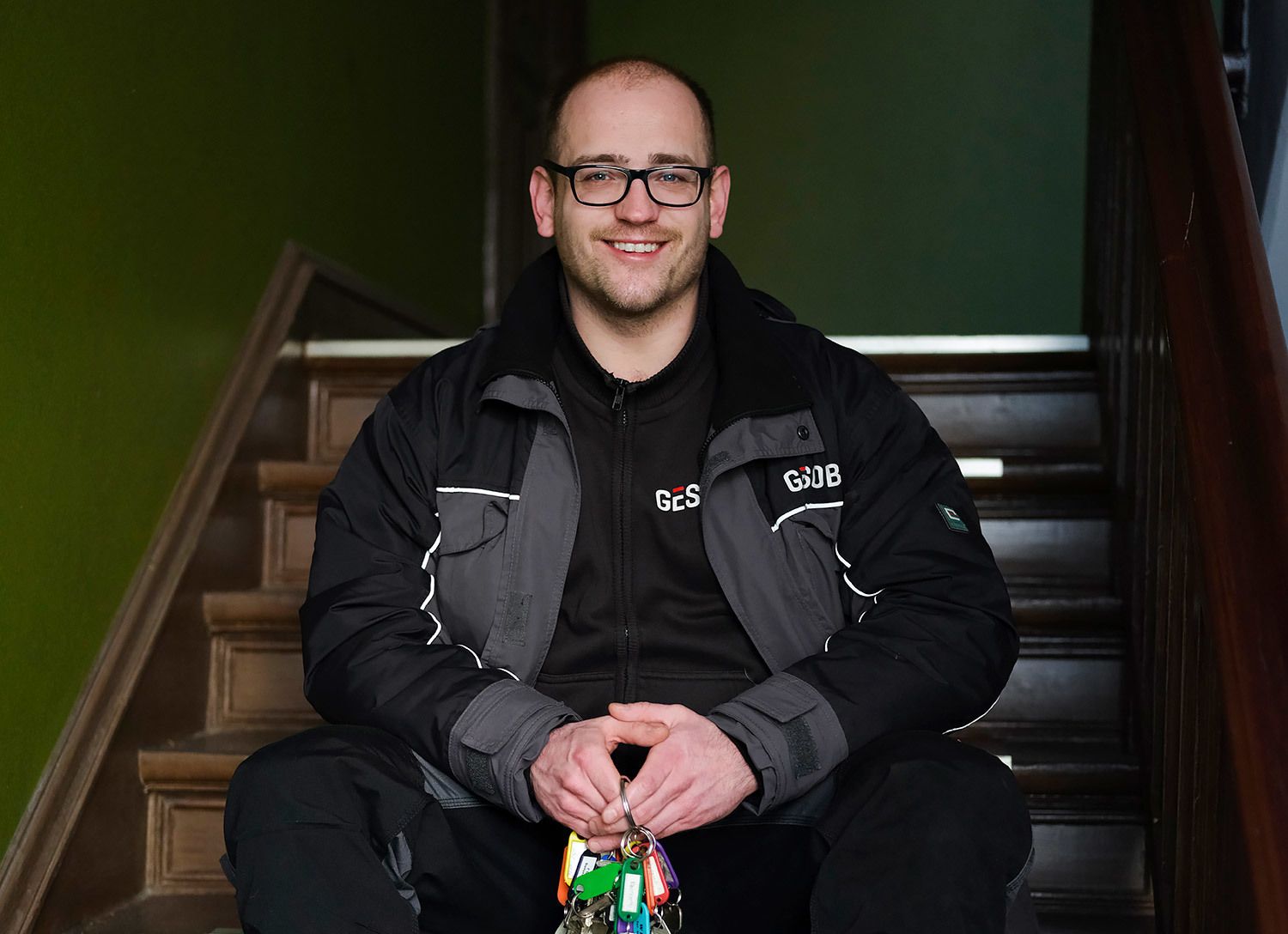
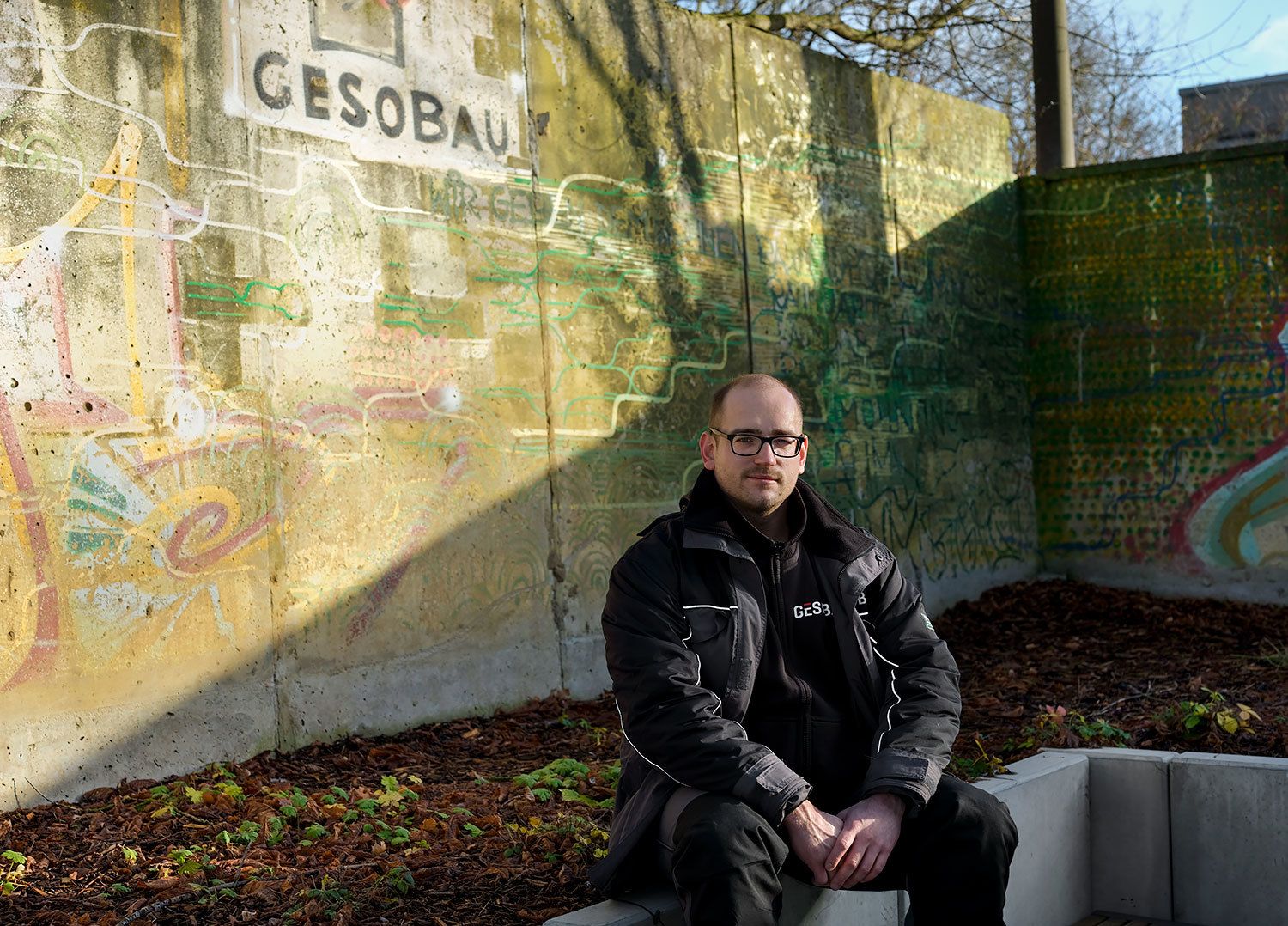
works as a neighborhood runner at berlinwohnen Hausmeister, a subsidiary of municipal building association GESOBAU which performs janitorial services.

They say fortune favors the hard-working. In light of modern employment histories like that of Mario Katsch, this old adage sounds like a mockery. Becoming a father, and making time for his child, was just one of the reasons why it took him a long time to find his way back to working life after a long phase of unemployment; something he only managed with the help of the Solidary Basic Income project and a position at a subsidiary of housing association GESOBAU.

For Mario Katsch, born in 1987, his unsettled life began before he was even fully aware of what was happening around him. He was an infant when his mother fled with him from East Berlin to West Germany, mere months before the collapse of the German Democratic Republic. They ran aground in Solingen in North Rhine-Westphalia; Katsch’s father, a bricklayer and tiler, joined them a short while later, after the Berlin Wall had come down. The family lived in Solingen for a few years, until his parents moved Mario and his new baby brother to his grandparents in Zeuthen in Brandenburg. But family life increasingly became a struggle. Like a thief in the night, his mother left his father, fleeing with her children once again. Their first stop was a refugee accommodation center; unemployed and without a home of her own, his mother finally found shelter at a women’s refuge.

“It took a while for us to get our own apartment,” Katsch remembers. “We moved from one women’s refuge to the next. I had to look after my baby brother and it was hard for me to make friends, because I kept changing kindergartens.” Under these conditions, Katsch developed an anomaly: He spoke so incredibly fast that hardly anyone could understand him; he was diagnosed with a learning disability.

During his first two years at school, Mario Katsch attended a school for children with learning difficulties. When his speech began to improve, he switched to an elementary school in Lichtenberg, where he was held back in second grade. “From that time forward, I was always a bit older than my class mates.” After sixth grade, Katsch would have even been able to attend the “Gymnasium,” the highest level of secondary school within the German school system. “But I was a bit lazy and hadn’t realized that I needed to apply.” Instead, he received a letter from the district office, allocating him to the Secondary School at Lichtenberg Town Hall (“Oberschule am Rathaus Lichtenberg”), which at the time was a “Hauptschule,” the lowest level of secondary school within the German school system. However, the school offered a model project, a course that allowed students to obtain a fully valid degree from a “Realschule,” the middle level of the German school system. “I passed the exams with pretty good grades,” says Katsch.

Mario Katsch

Degree in hand, Katsch began an apprenticeship as a cook at the Protestant St. John’s Foundation (“Evangelischer Johannesstift”) in Spandau. His mother had worked as a cook before him, when the family was still living in Berlin-Buch. “The apprenticeship was extremely labor-intensive. We didn’t just cook à la carte, we also prepared food for hospitals and daycare centers in our own canteen kitchen.” When operations at Tegel Airport were gradually discontinued, the kitchen also supplied Lufthansa and Continental Airlines with food. “Which increased our workload even more. The production of airplane food is subject to stricter regulations, we were only allowed to work in gloves and protective suits.” Working overtime became the norm. “Officially, we apprentices stayed after hours of our own free will, of course, because we wanted to learn more.”

Katsch endured the apprenticeship, after which he applied to the German Armed Forces as a cook. He learned to work in a field kitchen, but had to take some time off due to a severe knee injury. “That meant I wasn’t around when the company went into the woods for a month, where I would have learned how to cook in a bivouac,” he says. His staff sergeant didn’t like the fact that he was away from work for health-related reasons and therefore did not approve the extension of Katsch’s contract. “When he changed his mind just before the contract expired, I was too proud to stay.”

After that, Katsch slogged away in various restaurant kitchens, where he proved a hard-working and dedicated employee. Sometimes, he would be cooking for “tourists,” sometimes for “regulars” – his way of differentiating the restaurants he worked for. “Tourist kitchens often don’t have the most hygienic conditions,” he says. “I would repeatedly have to clean the kitchens for weeks before I could cook in them with a clear conscience.”

When Katsch talks about his life as a restaurant chef today, he immediately associates it with one word: slavery. “The conditions in that job were the worst. Working ten days without a break was normal – and those were twelve to fourteen-hour days,” he tells us. “I always tried to cope with the situation, but at some point, I just couldn’t keep it up. I’d had it to here and started looking for another job.”

Mario Katsch

First, he tried his hand at selling cell phone contracts. “It was well paid, and I had to work fewer hours than I did in the kitchen,” says Katsch. “But I wasn’t very good at it.” Talking people into concluding gagging contracts and conning them out of their hard-earned money didn’t sit well with him. Instead, he signed up with a security service that employed him as a security guard, store detective, and bouncer, taking the occasional job in construction to improve his meager salary. During this period, he lived in apartment shares because he couldn’t afford a place of his own, staying with girlfriends or his mother in between times.

When an acquaintance got him a job in a company specializing in facility management, Katsch switched jobs once again. What started as a janitorial job, however, soon escalated into piecework. “I was basically doing three jobs in one, it was really bad,” Katsch says. Besides doing janitorial work, he had to clean the entrance halls, clear the pathways in winter, and do the gardening.

In 2017 his life took a fundamental turn: Mario Katsch became a father. “I wanted to see my son grow up, spend time with him, not get home late at night, exhausted,” he says. “As luck would have it, my company lost contracts and fired me. This meant I was entitled to draw unemployment benefits for one year – time to look after my son.”

The year soon passed. The relationship to the mother of his son ended and Katsch was asked to move out of their mutual home. “Finding an apartment when you’re unemployed is a losing game,” he says. “We slept on friends’ couches, which wasn’t a permanent solution, because of my son alone.” Ultimately, Katsch moved back in with his mother, who lived in a three-bedroom apartment. Here, Katsch can offer his son a home and look after him every other week, alternating with the child’s mother. “It’s a challenge, but it works quite well,” Katsch says. “There are just too many toys lying around. I buy Legos and Playmobil toys for my son when I see them on sale; I enjoy spoiling him like that. Whenever we have a spare moment, we play with them together and he makes up little stories.”

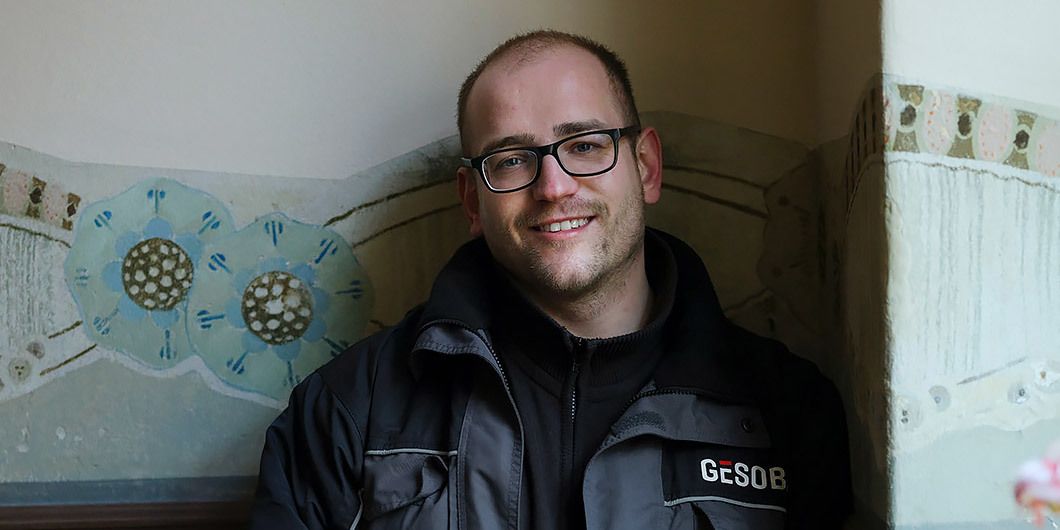
“The back-breaking jobs I did for so many years had hours that just could not be reconciled with looking after my son.”Mario Katsch
Mario Katsch

Katsch wanted to go back to work, but was rejected time and again – mostly because he doesn’t have a driver’s license. He also had a difficult relationship with his placement officer at the job center, which pays benefits to and finds jobs for long-term unemployed persons. “She kept trying to force me to take one-Euro jobs,” Katsch tells us. “In her mind, I had to take them if I wanted support. I told her outright that I don’t want those kinds of jobs.” Katsch stood firm and complained to the higher-ups. Which was exactly the right decision, as he later found: He was allocated to a new placement officer who asked if he would like to participate in the Solidary Basic Income (“Solidarisches Grundeinkommen,” SGE) project and offered him a job as a neighborhood runner at berlinwohnen Hausmeister, a subsidiary of municipal building association GESOBAU which performs janitorial services.

“My interview was in late October 2020 – and I started the job that November,” Katsch says. Neighborhood runners support full-time janitors at housing associations by performing a range of tasks. Katsch currently works in Pankow, primarily in old buildings and modernized old buildings. His key responsibility is checking the condition of the housing estates; in concrete terms, this means he is there when apartments are handed over, helps coordinate different trades, changes locks, and organizes the disposal of bulky waste. “I talk to the tenants, take calls, and solve simpler problems myself. I also assist our older tenants by taking their groceries upstairs for them. Outside the buildings, I do the weeding and trim the hedges.”

Mario Katsch

Due to the SGE framework conditions, as well as for insurance-related reasons, Katsch is not allowed to do every type of work, but he does do smaller jobs himself. Occasionally, tenants let their anger out on him, which he takes in good spirit. “Once, an elderly gentleman complained that GESOBAU is the worst and things were much better in the German Democratic Republic. I was speechless; I’d showed up at his apartment a mere thirty minutes after he’d called – I truly don’t think that was par for the course in the GDR.”

Katsch is very happy with his job at GESOBAU. “It’s a great employer. Whenever I have any problems, they help me right away. I really have to give thanks to the senate, from the bottom of my heart, for launching this project.” Katsch thinks similarly highly of the coaching offer that accompanies the SGE position and aims to help prepare participants for the transition to the regular labor market. He is full of praise for his coach. “She supports me actively and in many different ways. Sometimes she even gives me tips on how to raise my son,” he laughs.

“Her focus is on helping me find a profession I will want to do for many years to come.”
Mario Katsch

Above all, she tries to help Katsch find out where his future perspectives lie. Participants in the SGE project can take part in extra-occupational trainings, retraining and even apprenticeships, without loss of salary. “I’d like the option of a higher position; further training would help me with that,” Katsch says. With her expertise in numerous modern methods, his coach is there to support him as he makes this decision.

Currently, Katsch is in the midst of this very process: thinking about what to do after the SGE project. He doesn’t want to rush the decision, because the fact that he will be doing something seems a foregone conclusion; in this respect, the SGE project has already served its purpose for Katsch. His current boss has recommended that he apply for a permanent position as a janitor at GESOBAU in the near future. This would mean that Mario Katsch could switch to a regular working relationship long before his five-year SGE contract expires. His perspectives are no longer as uncertain as they were in 2020: “My boss definitely wants to keep me, and I’d still have time for my son.”

Copy: Katrin Rohnstock / Rohnstock Biografien

Contact

Senate Department for Integration, Labour and Social Services