Header Andreas Schneid

Andreas Schneid on his "Music Education Revolution"

Learning drums in a different way: Schneid, founder of GroovIT, combines his many years of experience as a musician and drum teacher with his fascination for games. With his computer game, “Drum Revolution”, children can learn to play the drums by playing a jump-and-run game, without the need for traditional tutorials, and at their own pace. In this interview, Schneid discusses how he came up with the idea, the innovative power behind the project, the rocky road to development, and why Berlin is the right place for him to start a business.

How did GroovIT come about, and what prompted you to start it?

Honestly, I’ve had the idea in the back of my mind for a long time. I’ve been teaching drums for over 25 years and have written a textbook for children between the ages of five and nine. At some point, I realized that: I want to transfer this content to digital media. However, I knew it couldn’t just be a matter of digitizing lessons.

I kept asking myself, “What would be a truly new approach? What would the unique selling proposition be?”. Creating another YouTube channel or making classic tutorials was out of the question for me.

The actual trigger came directly from my lessons. Students kept telling me, “I played video games all weekend,” but they didn’t spend a single minute sitting at the drums. That’s when I had an idea. I know this fascination from my own childhood. Games are incredibly captivating. Why don’t we harness this potential to give children access to instruments? Thus, the idea of combining a jump-and-run game with learning instruments was born.

Drum Revolution

How did the idea become the computer game “Drum Revolution”?

Since I’m not a programmer, I looked for someone who knew about audio signal processing. Together, we developed a small prototype, and it worked amazingly well. Then, after looking around the gaming sector, I quickly realized that game design is completely different from what I originally understood as “design.” During this process, I came across Myriel Balze. She is well-established in the German gaming sector, particularly in educational games and gamification, and she works in an extremely interdisciplinary manner.

I worked intensely with her on game design. This was crucial because a project like this requires equal collaboration. In 2022, the project took off: we attracted investors and received initial funding for the prototype as part of a computer game funding program. Gradually, the original idea became a real product.

What was the biggest challenge during the development process?

Clearly, it was the innovation itself. “Drum Revolution” doesn’t yet exist in this form.

While there are many gamified music learning software programs and rhythm games, hardly anything is designed to teach children to play a real instrument from scratch.

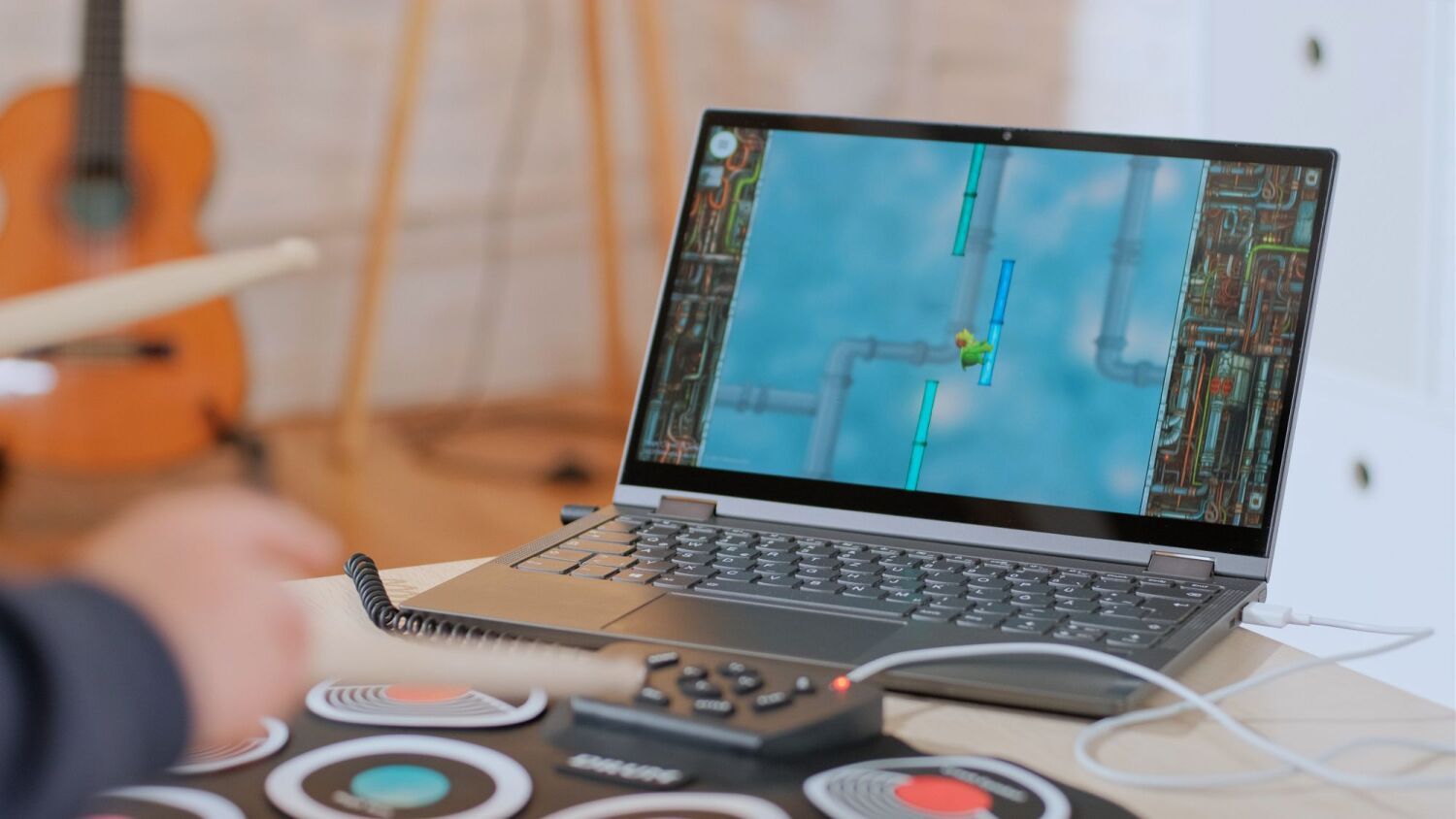
We had no blueprint. Our goal was to allow children to sit down, start the game, and understand what they had to do through gameplay alone, without a tutorial or explanation. They should stay in the game and start playing real drums by focusing only on the game.

Cracking this nut was extremely challenging. For more than two years, we encountered new technical, gameplay-related, and educational challenges every week. On the surface, the game looks simple, almost like a classic jump-and-run game. However, an incredible amount is going on beneath the surface. The drums become the controller, and the system analyzes what is being played and translates it into gameplay.

We discarded things, rethought them, and went through loops. This path was brutally rocky at times, but that’s precisely why the product works today. We are extremely proud of that.

What are parents, teachers, and the gaming community saying about “Drum Revolution”?

I found the gaming community to be very open. At Games Ground in 2023, we had the prototype, and people played, tested, and discussed it from morning to night. Of course, some people said, “That’s not my thing.” But even that feedback was appreciative.

Our game is not a classic rhythm game, which is why we don’t primarily market it to the classic gaming community. It’s unique and new, which means you have to fight against the windmills a little at first.

Some educators have reservations. However, I’m confident that I could address their concerns in person. Children often learn intuitively, long before they can read music. Our goal is not to replace traditional teaching methods, but rather to offer a new approach.

What is the mission of GroovIT?

We want to make learning an instrument “cool” again in the traditional sense. Nowadays, being “cool” means having 10,000 followers on TikTok. It would be great if we could bring instruments back into the mainstream. Music should be accessible regardless of money, location, or previous experience.

Why is Berlin a good location?

I’ve lived in Berlin for almost 20 years. The city has an enormous amount of creative energy, with musicians, developers, studios, and support programs. There are many networks and events that facilitate exchange. Programs from the Medienboard Berlin-Brandenburg have helped us tremendously.

The planned House of Games Berlin is an exciting project, even though it is still under construction. Spaces like this one are important for bringing young studios together and establishing long-term structures.

What gamification trends do you find exciting?

I don’t see myself as someone who is extremely well-established in the Berlin gaming industry or completely up to date on all developments. I wouldn’t presume to say that I know what the last 20 years have looked like or what the next 20 will look like. I don’t have that expertise.

However, I find it exciting that the term “gamification” has been omnipresent for years. Our product is often quickly pigeonholed into the gamification category, even though we actually go far beyond that. That’s why I find the term somewhat inaccurate. Nevertheless, I think it’s fundamentally positive that playful elements are finding their way into more and more digital products. When things become more colorful, intuitive, and enjoyable to use, the user experience can significantly improve — you can see the difference between frustrating interfaces and ones that you can almost playfully click through.

I’m particularly excited by games that offer more than entertainment: games that address historical topics, social issues, and sustainability, as well as social and empathetic aspects. Games can influence people because they make experiences tangible, whether through cooperation, community, or conscious decision-making. For me, this is a great potential of games, even beyond classic gaming. At the same time, gaming should be fun, of course.

What advice would you give young founders?

If you have an idea and the energy to pursue it, then take the plunge! Of course, you should do your research and avoid running blindly into a dead end—that’s part of the process. You can read ten books on the subject and work according to the motto, “Learn from the mistakes of others so you don’t have to make them yourself.” However, reading is no substitute for doing.

There is no right or wrong way. You have to find your own way and make mistakes. The important thing is not to lose sight of the fun. Unfortunately, this can happen quickly, especially when you’re caught up in the day-to-day business of running a company. When that happens, you should try to consciously recapture those moments when you remember why you’re doing it all in the first place.

Published 09. January 2026

More from Interviews

1zu1 ST3AM Roland-Sillman Teaser

Roland Sillmann (WISTA) about places for cooperation like the new House of Games Berlin

In the interview, Roland Sillman talks about the vision behind the House of Games Berlin, the careful site selection process, and why it’s about much more than just real estate. More information

Felix Falk Teaserbild

Felix Falk (game association) about his view on the gaming capital Berlin

In this interview, Felix talks about the opportunities for Germany’s gaming industry, the special role of Berlin, and why the House of Games could gain international visibility. More information

Marcel Hallas, Director Sales & Marketing at Ayming

Marcel Hallas about Targeted R&D Funding for Games Development

Marcel Hallas, Director Sales & Marketing at Ayming, about targeted R&D Funding for Games Development as an Underestimated Lever for the Games Industry. More information