Current language: English

Mephisto

  • Mephisto – Fünf Personen in einer Bar; zwei sind oberkoerperfrei. Ein weiblich gelesene Person in Gelb. Auf einem Tisch stehen leere und volle Flaschen und Gläser.

    Mephisto – Fünf Personen in einer Bar; zwei sind oberkoerperfrei. Ein weiblich gelesene Person in Gelb. Auf einem Tisch stehen leere und volle Flaschen und Gläser.

  • Mephisto – Zwei tanzende Personen auf einer Bühne mit grünen Fliesen, rosa Waschbecken und Beleuchtung. Eine Person trägt einen Anzug, die andere ein Fransen-Kleid.

    Mephisto – Zwei tanzende Personen auf einer Bühne mit grünen Fliesen, rosa Waschbecken und Beleuchtung. Eine Person trägt einen Anzug, die andere ein Fransen-Kleid.

  • Mephisto – Person in golden Paillettenkleidung und Federhut hält das Gesicht einer weiteren Person im Anzug und roter Krawatte mit geschlossenen Augen.

    Mephisto – Person in golden Paillettenkleidung und Federhut hält das Gesicht einer weiteren Person im Anzug und roter Krawatte mit geschlossenen Augen.

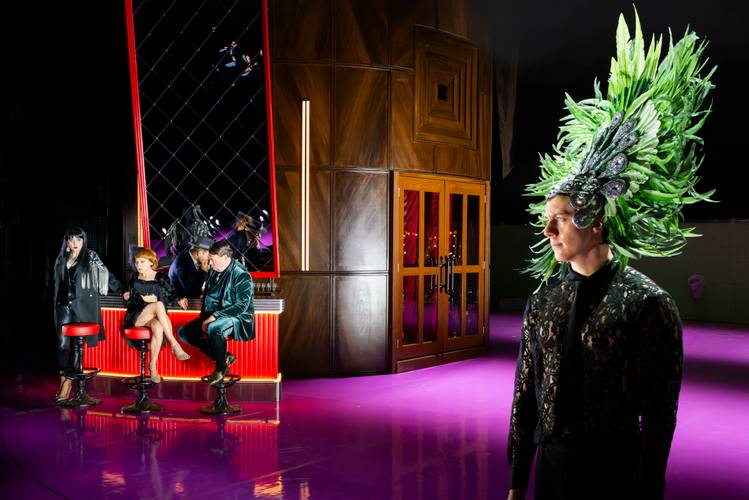
  • Mephisto – Person mit großem blattähnlichem Kopfschmuck im Vordergrund, links drei Personen an einer Bar, davon zwei auf roten Barhockern. Hintergrund in dunklen Tönen.

    Mephisto – Person mit großem blattähnlichem Kopfschmuck im Vordergrund, links drei Personen an einer Bar, davon zwei auf roten Barhockern. Hintergrund in dunklen Tönen.

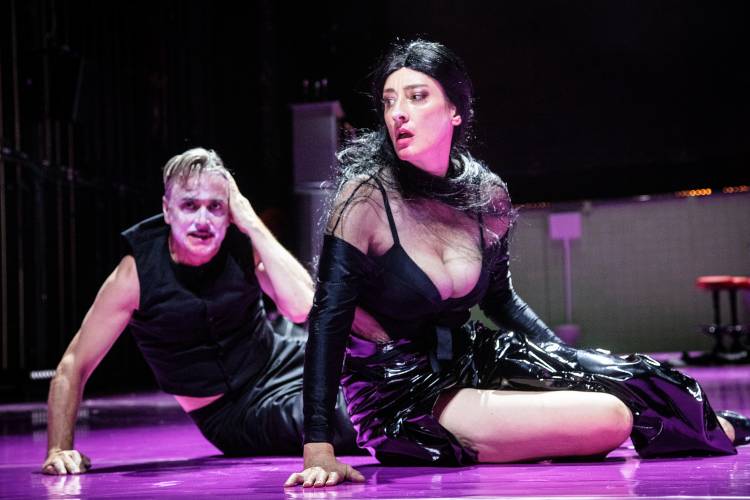
  • Mephisto – Zwei Personen auf lila Boden, die vordere in schwarzem Outfit sitzt, die hintere mit weißem Gesicht streckt sich nach vorne aus.

    Mephisto – Zwei Personen auf lila Boden, die vordere in schwarzem Outfit sitzt, die hintere mit weißem Gesicht streckt sich nach vorne aus.

  • Mephisto – Rot beleuchtete Bühne mit acht Darsteller*innen in bunten Outfits, hinten roter Vorhang, oben Bogen mit Text "ICH BIN NUR EIN SCHAUSPIELER".

    Mephisto – Rot beleuchtete Bühne mit acht Darsteller*innen in bunten Outfits, hinten roter Vorhang, oben Bogen mit Text "ICH BIN NUR EIN SCHAUSPIELER".

Klaus Mann's novel written in exile – a satire about opportunism and the betrayal of once socially accepted values – was immediately banned in 1936. In the spotlight: the famous actor Gustaf Gründgens alias Hendrik Höfgen, who became "a clown to entertain the murderers" during National Socialism. Frank Castorf confronts us with the intoxication of power, the eroticism of betrayal and the charm of downfall – no less alluring then than it is today.

Artists/Collaborators: Von Klaus Mann (Autor/in), Jens Harzer (Hendrik Höfgen), Annabelle Lengronne (Juliette Martens), Max Gindorff (Klaus Mann, Geheimrat Bruckner), Roman Ott (Der Ministerpräsident, Direktor Schmitz, Saxofon), Constanze Becker (Dora Martin, Lotte Lindenthal), Sascha Nathan (Oskar H. Kroge, Theophil Marder), Kathleen Morgeneyer (Hedda von Herzfeld, Nicoletta von Niebuhr), Marina Galic (Rahel Mohrenwitz, Barbara Bruckner), Lili Epy (Angelika Siebert), Sebastian Zimmler (Hans Miklas, Otto Ulrichs), Andreas Deinert (Live-Kamera), Jonathan Bruns (Tonangel), Jens Crull (Live-Schnitt), Meret Blase (Live-Schnittassistenz), Frank Castorf, Aleksandar Denić, Adriana Braga Peretzki, William Minke, Andreas Deinert, Ulrich Eh, Amely Joana Haag, Sebastian Klink

Runtime: Sat, 17/10/2026 to Sun, 18/10/2026

Klaus Mann's exile novel, subtitled "The Story of a Career", which he said he intended "to only portray types, not portraits", was immediately banned after its publication in 1936. For it was easy to recognise the actor, director and artistic director Gustaf Gründgens, once a close artistic colleague and brother-in-law of Klaus Mann, who had risen to fame in the role of Mephisto, in the main character of Hendrik Höfgen. As a writer who had fled the Nazis, was openly homosexual and part of the antifascist resistance, Klaus Mann's "Mephisto" is a scathing satire about the opportunism of the former drawing-room communists who mutated into "monkeys of power" in the blink of an eye in Germany between 1925 and 1936. Gründgens became a prime example of the contradiction between high art amidst the basest barbarism. "But I’m only an ordinary actor" is the last thing Höfgen says in the novel, and an actor has to act. Klaus Mann committed suicide in 1949 by taking an overdose of sleeping tablets. Gustaf Gründgens too, who was a skilled at contorting himself to court success in every system, died fourteen years later of an overdose of sleeping tablets. But the duel between the two dead men lives on in "Mephisto". Frank Castorf confronts us with the intoxication of power, the eroticism of betrayal and the charm of downfall, which we can still be seduced by today just as we were then.

Map

A visual map representation follows. Skip map

Show on map

End of map.

Public transportation

All dates and tickets

2 of 2 dates

  • Sat 17/10/2026 18:00
    Mephisto

    Berliner Ensemble - Großes Haus

  • Sun 18/10/2026 17:00
    Mephisto

    Berliner Ensemble - Großes Haus

The help page for the event calendar answers common questions.. Information about coperations and imprint can be found on our page about partners and terms and conditions.