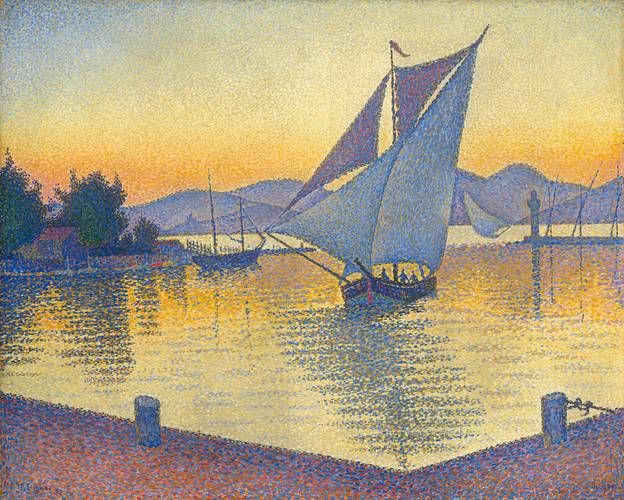
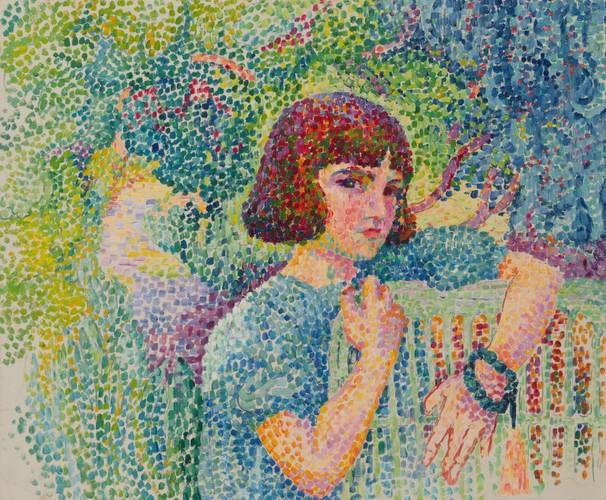
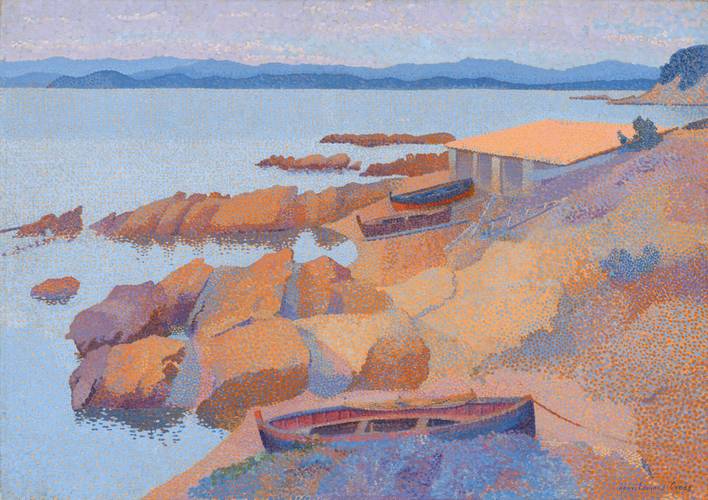
Achieving the highest degree of luminosity and harmony—this was the goal to which Paul Signac dedicated himself when, in the mid-1880s, he introduced a new style of painting to the art world together with Georges Seurat. The exhibition is the first comprehensive Signac exhibition in Germany in 30 years; it highlights the artist’s central role within the Neo-Impressionist movement and explores his influence as a theorist, networker, and exhibition organizer.
At the Impressionists’ final joint exhibition in 1886, artists who would later call themselves Neo-Impressionists exhibited their work in Paris. By juxtaposing unmixed colors, they sought to create an effect in their paintings that would evoke pure light. The landscape motifs resembled those of their Impressionist predecessors, yet they replaced their airy atmosphere and spontaneous brushwork with serially applied dabs of paint in the colors of the prism. This decomposition of colors—which were no longer to be mixed on the palette but in the viewer’s eye—drew inspiration from new findings in optics and the physiology of perception.
The Neo-Impressionist paintings invite viewers to contemplate the harmony within the image, seeking a balance between often complementary colors, between verticals and horizontals, or between surface and space. Other works feature arabesque patterns that extend across the picture plane and abstract real objects. The exhibition presents the artist as one of the central figures of this movement. It explores his artistic oeuvre, from the early coastal landscapes of the passionate sailor, through his interior and portrait paintings, to the socially utopian images of the Côte d’Azur, which he developed into a treasure trove of motifs for Modernism.
The exhibition features over 90 works, more than a third of which are by Paul Signac. They are presented alongside paintings by Lucie Cousturier, Henri-Edmond Cross, Maximilien Luce, Camille Pissarro, Théo van Rysselberghe, Jeanne Selmersheim-Desgrange, Georges Seurat, Jan Toorop, and others. Lenders include the Van Gogh Museum, Amsterdam; the Art Institute of Chicago; the National Gallery of Ireland, Dublin; the Musée d’Orsay, Paris; the Musée du Petit Palais, Geneva; the Archives Signac, Paris; and other national and international collections.
The Museum Barberini, which houses one of the largest collections of Neo-Impressionist works in Germany—including ten pieces by Signac, Henri-Edmond Cross, Albert Dubois-Pillet, Maximilien Luce, and Camille Pissarro from the Hasso Plattner Collection—is presenting Symphony of Colors: Paul Signac and Neo-Impressionism, its third exhibition on the subject, following Color and Light: The Neo-Impressionist Henri-Edmond Cross (2018) and The Honest Eye: Camille Pissarro's Impressionism (2025). An exhibition by the Museum Barberini, Potsdam, and the Kunsthal Rotterdam.
Runtime: Sat, 04/07/2026 to Sun, 11/10/2026
Price info: Sat/Sun, public holidays: € 18.00, Mon, Wed-Fri: € 16.00Daily except Tue from 17:30: € 10.00
Price: €18.00
Reduced price: €10.00
Reduced price info: Children/youth under 18 years: free admission
Youth under 25 years : free admission, every Thursday, 14:00 – 19:00