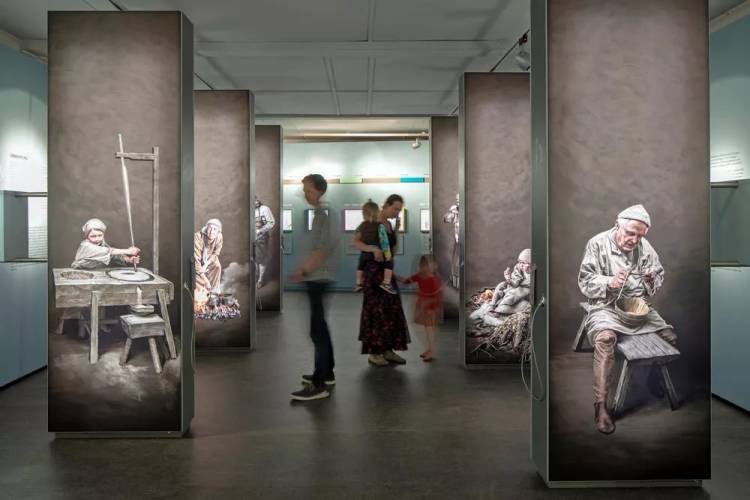
More than 800 years ago, there was a medieval settlement on the site of today’s open-air museum. The permanent exhibition tells its story.
More than 800 years ago, a village settlement was established in what is now Berlin-Nikolassee. How did people live in the Middle Ages? What was village life like? What did they eat? The permanent exhibition at the Düppel Open-Air Museum invites visitors to discover this and more at this historic site.
Right at the entrance to the open-air museum, the exhibition offers insights into the daily life of the medieval rural population in our region and into their era. Around the year 1200, the Slavic-populated area around Berlin was shaped by immigration from the west and the founding of the Mark of Brandenburg. The exhibition brings this development to life. A timeline also shows how the landscape has changed over the millennia and what it was like in the Middle Ages.
Exciting facts and historical contexts surrounding the medieval village—which was excavated and partially reconstructed starting in the 1970s at the site of today’s open-air museum—are presented in an easy-to-understand way. Interactive stations invite visitors to smell, touch, and try things out.
Told History
At audio stations, six fictional villagers also share examples of everyday rural life in the Middle Ages. In this way, they bring a long-gone era back to life and give visitors to the museum village a vivid impression of who the people might have been who once lived here.
(Translated with DeepL)
Price info: Free admission for under-18s and those eligible for concessions | Different admission prices and opening hours may apply for events
Price: €6.00
Reduced price: €0.00