With “Deutschland '99”, the Neue Nationalgalerie is receiving an important work by Christoph Schlingensief (1960-2010) as a donation for its collection. The installation will be presented at the start of this year's Gallery Weekend as part of the collection presentation "
Extreme Tension: Art between Politics and Society 1945 – 2000". At the center is the work “Deutschland Versenken” from 1999, which is part of his project “Deutschland '99”. The Neue Nationalgalerie is particularly pleased that this work will now become a permanent part of its collection thanks to the generous donation from Aino Laberenz, who manages Christoph Schlingensief's estate.
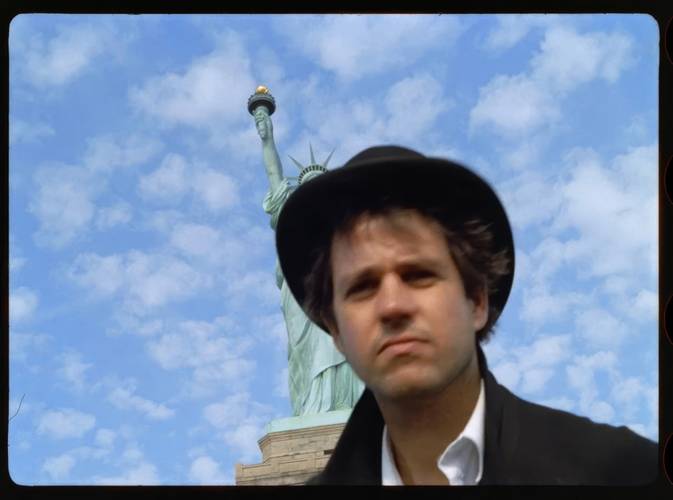
Schlingensief was invited to New York by MoMA PS1 in 1999 and staged the action “Sink Germany” at the Statue of Liberty. The deliberately chosen date for the action, November 9, 1999, was intended as a reference to significant historical events in Germany, such as the Pogrom Night (1938) and the fall of the Berlin Wall (1989). Schlingensief carried out a ritual performance, or “action” in his words, in which he knelt down in front of the Statue of Liberty to commemorate the historic kneeling of former German Chancellor Willy Brandt in Warsaw. He then threw an urn containing the symbolic “ashes of Germany” and a suitcase filled with 99 everyday German objects into the Hudson River, symbolically marking the end of Germany shortly before the start of the new millennium.
Schlingensief's work encompasses a variety of media, including film, theater, opera, television as well as conceptual art, installations and performance, installation and performance art. Schlingensief became known for his transgressive artistic approach, often combining shock value with profound political commentary. In his works, he dealt with themes such as nationalism, identity and the darker aspects of German history. In doing so, he always questioned social norms and cultural complacency. His approach was also deeply interwoven with ethical and moral concerns, which he also explored in his books on topics such as death, illness, exclusion and faith. The Neue Nationalgalerie is therefore particularly pleased to be able to add this important work to its permanent collection as part of Schlingensief's influential oeuvre.
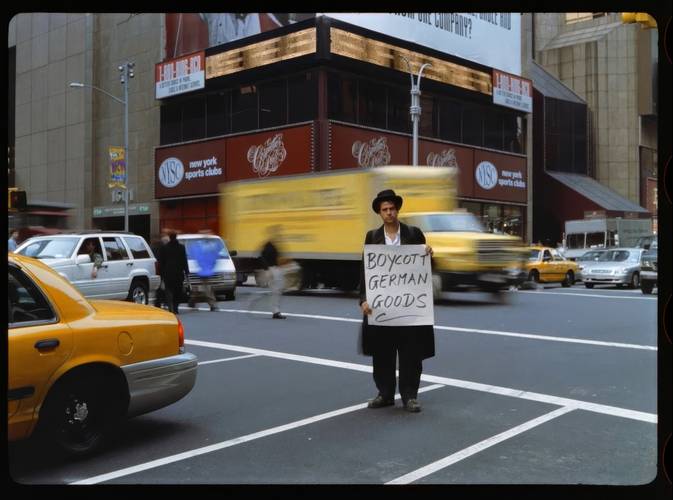
The work “Deutschland Versenken” (1999) with a running time of 1 minute 28 seconds was originally shot on 35mm. It shows Schlingensief in the streets of New York with a sign in his hand, sometimes standing in front of the steps of the Metropolitan Museum of Art, sometimes in Times Square and sometimes in front of the Goethe Institute in New York. The video is shown in the context of three other films in which Schlingensief performs the performance and explains the project in more detail, including in an interview with Alexander Kluge. In addition, there will be visual material and columns from the Frankfurter Allgemeine Zeitung, in which Schlingensief reported on his search for Germany. It is part of his broader project “Deutschlandsuche '99”, the first two parts of which consisted of a theater tour through smaller and larger cities in Germany. With this project, inspired by the Wagner opera “Der Ring des Nibelungen”, he sought to create a modern version of Siegfried, a hero for a reunited, globalized Germany.
The end of the 20th century was marked by a rise in right-wing tendencies in Germany, which prompted Schlingensief to question national identity in the context of the country's fascist past. At the end of “Deutschland '99” in the Namibian desert, Schlingensief declared: “The colonial remains of the former German South West Africa will be blasted with Wagner music one last time, the Nibelungenring will not be sunk into the Rhine, but into the sand.”
The donation and the opening of the room "Christoph Schlingensief. Deutschland '99" will take place on the occasion of the
Gallery Weekend on Friday, May 2, 2025.