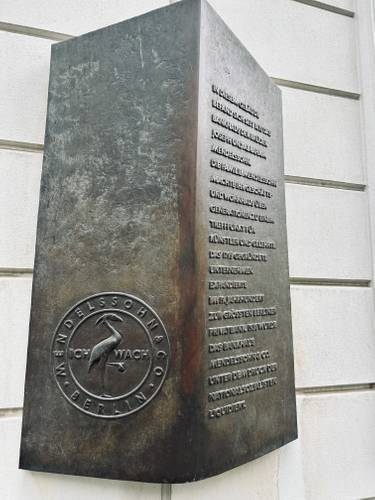
The building that once housed the headquarters of Dresdner Bank still stands on Behrenstraße today. The bank emerged in 1872 from the Jewish banking house Kaskel; Carl von Kaskel and Eugen Gutmann were instrumental in its rise. After its “Aryanization” under National Socialism, the bank collaborated so closely with the SS that it was regarded as the so-called “SS Bank.” Several members of the Gutmann family were murdered in the Holocaust.
This single building illustrates the theme of the city tour “Around Behrenstraße: Jewish Banking Houses in Berlin”—how closely the history of Berlin’s financial center was linked to Jewish entrepreneurs—and how thoroughly that connection was destroyed beginning in 1933.
Starting in the 18th century, Berlin developed into a hub for major Jewish banking houses. A banking district emerged around Jägerstraße, where families such as the Mendelssohns, Bleichröders, Arnholds, Magnuses, and Gutmanns were active; the Cologne-based banking house Sal. Oppenheim is also part of this history. Jewish bankers played a key role in the development of the Berlin Stock Exchange. They financed industrial expansion, supported new companies, and helped turn Berlin into an international financial center.
A figure from 1933 illustrates the extent of their influence: of the 215 private banks in Berlin at that time, over 70 percent were owned or managed by Jews. With the Nazis’ rise to power, their systematic exclusion, expropriation, and dismantling began. By 1935, a quarter of these banks had been “aryanized” or liquidated; by the end of 1938, all of them had been.
The tour begins at Schlossplatz and ends on Jägerstraße. Over a distance of about two to two and a half kilometers, it connects historic sites with the life stories of Jewish entrepreneurs and Berlin’s economic development. The route is free of stairs or other obstacles.
Behrenstraße and Jägerstraße are located in what is now the Mitte district. The Mitte Museum, the district’s museum, tells this story right where it took place—at locations that people pass by every day and whose past is now barely visible.
Meeting point: Schlossplatz 1, 10178 Berlin
End point: Jägerstraße
Participation is free and no registration is required.Translated with DeepL