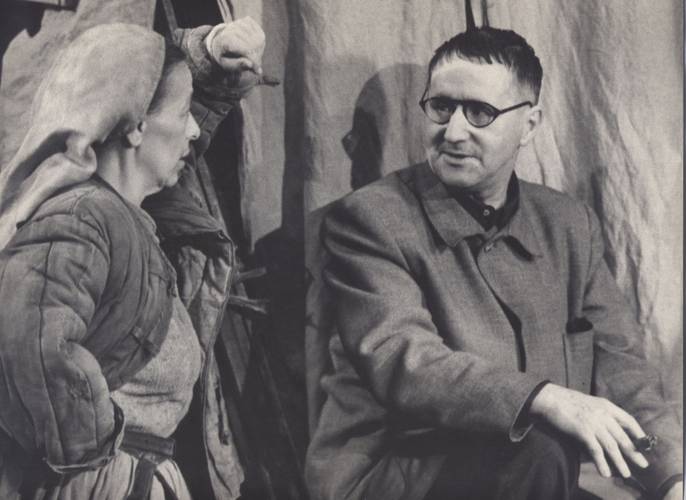
Drawing on the wealth of sources in the theatre archives, members of the Berliner Ensemble stage a reading that brings outstanding productions to life.
Once a work has been staged, it can never be entirely lost, as theatre, the most fugitive of all the arts, lives on in the archives. The groundbreaking experiments conducted in Bertolt Brecht’s theatre were recorded with every means available: reels of film, photographs, prompt books, stage manager’s reports, notes and reviews provide clues to an intense, creative theatrical practice – beginning with the script and rehearsals and extending through to the notes session after each individual performance.
Constanze Becker, member of the Akademie der Künste and of today’s Berliner Ensemble, and Gabriel Schneider, member of today’s Berliner Ensemble, use these treasures to resurrect major productions from the theatre’s history, from Mother Courage (1949) to The Captain of Köpenick (1989).
The staged reading is based on the Berliner Ensemble “logbooks”, which document all the theatre’s shows and rehearsals. The special programme for the preservation of written cultural heritage funded by the Federal Government Commissioner for Culture and the Media (BKM) has made it possible to ensure the conservation of these exceptional sources on theatre history.
An event mounted in cooperation with the Coordination Office for the Preservation of Written Cultural Heritage (KEK), as part of the 3rd KEK annual conference
With Werner Heegewaldt, Ursula Hartwieg (welcome address), Marieluise Nordahl (lecture), Constanze Becker, Gabriel Schneider (staged reading)