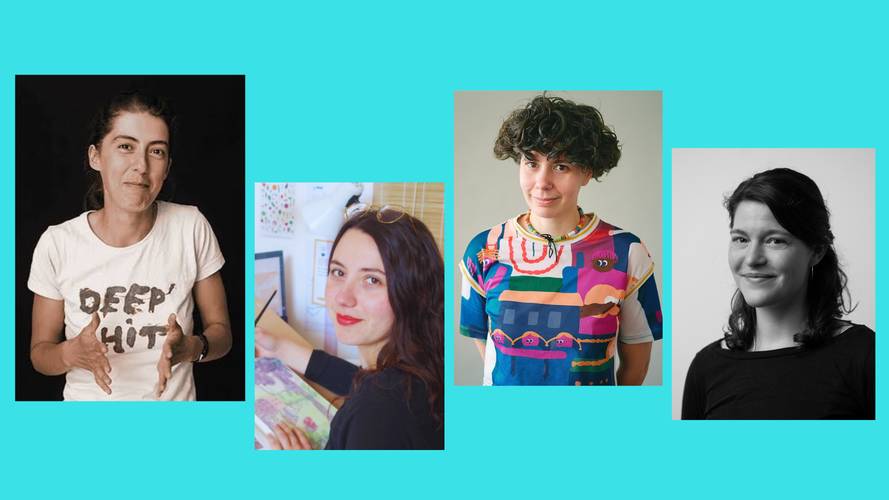
The “Literary Europe” series is dedicated to comparing literary movements in Europe, whether through the works of contemporary authors or by looking back at the past. This evening is dedicated to the theme of “Pioneering Women,” this time in the realm of illustrated literature. EUNIC Berlin, the network of European cultural institutes, welcomes four European female authors and translators who will present a wide variety of works.
Program
Starting at 6 p.m.
Opportunity to visit the exhibition “Lucky Luke: Morris’s Lonely Western Hero” for free
7:00 p.m.
Laura Keilbart in conversation with Maria Kröpfl, Sorina Vasilescu, Nina Six, and Jenya Polsina
Book Table
Modern Graphics
The event will be held in English.
Registration: required via email to eunic(@)eunic-berlin.eu
Four European authors and translators
Marisa Kröpfl works as a bookseller in Vienna, but above all, she has been translating graphic novels for the Austrian publisher bahoe Verlag for some time, including several biographies of women such as *Frida Kahlo* by Dominique Osuch and *Freedom in the Blood* by Christophe Girard and Kudret Güneş. Marisa Kröpfl is an expert on the topic of “Pioneering Women in Graphic Novels.” Her work spans languages, cultures, and perspectives, weaving them together.
Sorina Vasilescu, also known as Sorina Vazelina, is a Romanian graphic designer, illustrator, and comic artist. During the communist regime, she was arrested for political reasons and spent nearly ten years in prison. After the end of the dictatorship, she published her autobiographical memoirs, in which she powerfully documented her experiences of repression, isolation, and inner resistance. In *The Silent Escape*, she tells the story of the artist Lena Constante (1909–2005). The graphic novel combines historical memory with an artistic reflection on freedom, identity, and human resilience.
Nina Six, born in Orléans, lives and works as an illustrator and comic book author in Belgium. Her stories, rendered with delicate lines and vibrant watercolors, often revolve around childhood memories. In her latest work, *La Sorcière de Londres*, she tells the story of the British author Stella Benson (1892–1933). Benson is known as a writer of fantasy literature, a feminist, a journalist, and a traveler, but—unlike her friend Virginia Woolf—she has since been largely forgotten. In her graphic novel and, soon, in a novel, the author brings Stella Benson’s incredible life back into the spotlight.
Jenya Polsina is an artist and comic book illustrator from Kyiv. Together with Anna Ivanenko, she founded “Seri/graph Studio” in 2015. With the start of Russia’s large-scale invasion of Ukraine, they shifted their focus to creating comics on war-related topics. Their books have received numerous awards, such as the “White Ravens.” Approximately 60,000 women currently serve in the Ukrainian armed forces. In *FEMALE MILITARY PERSONNEL*, through sensitively drawn portraits and documentary-style interview excerpts, we meet three women whose names have been changed for security reasons: Lena, Anna, and Nadiya. The protagonists speak openly about contradictions, about sexism within the armed forces, about the cliché that “war is a man’s business,” queer identity and activism alongside their lives as soldiers, weddings held right in the unit, and the grueling worry about family and children back home.
An event organized by EUNIC Berlin, the network of European cultural institutes, in collaboration with the Ukrainian Institute, the Romanian Cultural Institute, the Representation of East Belgium, the Wallonia-Brussels Federation and Wallonia in Berlin, as well as the Austrian Cultural Forum.
With the kind support of the Museum of Communication BerlinTranslated with DeepL