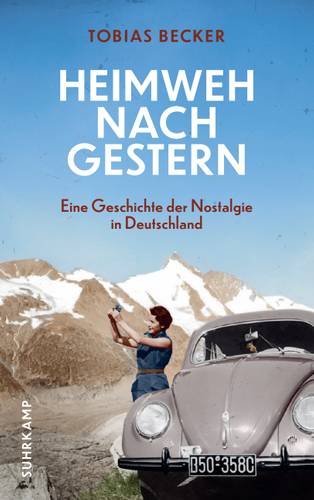
Most of us have probably felt nostalgic at some point. But the longing for a better yesterday reaches far beyond our own memories.
For Tobias Becker, nostalgia reveals a great deal about German society. In his book, he looks at how divided and reunified Germany have dealt with the past: from young people’s rediscovery of the “Golden Twenties” in the 1960s and the return of the Nazi past in the form of the Persilschein (a certificate of political exoneration) to nostalgia being branded a “Western capitalist phenomenon” in divided Germany. Becker also asks why Ostalgie (nostalgia for East Germany) has made it into the German-language Duden dictionary, while Westalgie (nostalgia for West Germany) has not.
According to Becker, the term nostalgia tells us more about the people who use it than those they use it to describe. Retro trends in popular culture and populist parties’ use of history for political ends both show how the way we look back at yesterday reveals who we are today – or who we want to be.
On 5 November at 7 pm, historian and curator Tobias Becker presents his book and talks to journalist and author Jens Bisky about nostalgia and how it is put to use in politics and society.
Tobias Becker teaches German and European history as a DAAD Visiting Professor at Charles University in Prague and as a Privatdozent at Freie Universität Berlin. He previously worked at the Leibniz Centre for Contemporary History Potsdam and the German Historical Institute London. His research covers the history of nostalgia, popular culture and crime; his current work focuses on memories of the Weimar Republic and exile.
Jens Bisky, born in 1966, worked for many years as a literary and cultural editor at the Süddeutsche Zeitung and has been managing editor of Mittelweg 36 at the Hamburg Institute for Social Research since 2021. He is the author of several books. In 2017, he received the Johann Heinrich Merck Prize for Literary Criticism and Essay from the German Academy for Language and Literature. His book “Die Entscheidung. Deutschland 1929 bis 1934” (“The Decision. Germany 1929 to 1934”) was published in 2024.