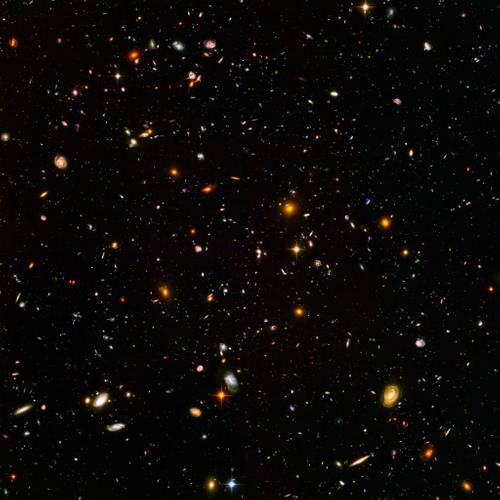
Hubble Ultra Deep Field (2018). Kompositbild des fernen Universums, erstellt auf Grundlage von Beobachtungen des Hubble-Weltraumteleskops – Verschiedene Galaxien und Sterne in einem dunklen Universum verteilt, leuchtend in unterschiedlichen Farben und Formen.
© NASA, ESA, S. Beckwith (STScI) and HUDF-Team
How can we investigate something that eludes direct observation? Dark matter and the Dark Universe have so far remained hidden from the human eye and from direct observation. They become accessible only through detector measurements, models and images. In her short talk with the title Images of the Invisible. The Dark Universe between Measurement and Imagination, Elisaveta Ernst asks how scientific and artistic image-making practices mediate between evidence, speculation and non-knowledge. She also explores how images of the Dark Universe shape ideas of the future and of exoplanetary heritage.
PARTICPANTS
Elisaveta Ernst
Elisaveta Ernst is an art and image historian specialising in the history and theory of photography. She works as Research Coordinator at the Centre for Advanced Study inherit. heritage in transformation at Humboldt-Universität zu Berlin. Previously, she was a research associate at the Chair of Eastern European Art History at the Institute of Art and Visual History, Humboldt-Universität zu Berlin. Her doctoral dissertation received the 2024 Rudolf Arnheim Award for Early-Career Scholars. Elisaveta Ernst’s research – currently conducted within her project “Imaging the Invisible: Epistemological Critique and Exoplanetary Heritage in the Context of the Dark Universe” – focuses on model theory and the critical analysis of image-based knowledge production in art and science.
- Language: German
- Location: Humboldt Lab, 1st Floor
- Part of: On Water
- Ticket required for Lange Nacht der Museen