Current language: English

Alexander Estis und das Trio Scho

Date details

Map

A visual map representation follows. Skip map

Show on map

End of map.

Public transportation

Alexander Estis and Trio Scho

In the beginning, there was Schmonzes

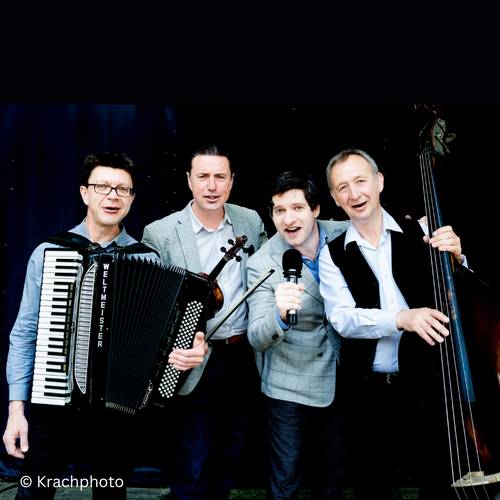
  • Alexander Estis + Trio Scho – Vier Personen mit Instrumenten: Akkordeon mit "Weltmeister", Violine, Kontrabass. Eine Person hält ein Mikrofon. © Krachphoto.

    Alexander Estis + Trio Scho – Vier Personen mit Instrumenten: Akkordeon mit "Weltmeister", Violine, Kontrabass. Eine Person hält ein Mikrofon. © Krachphoto.

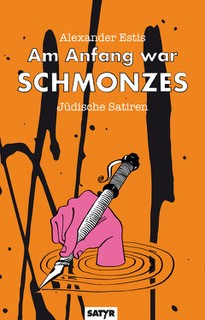
  • Alexander Estis: Am Anfang war Schmonzes – Orangefarbener Hintergrund mit schwarzem Fleckenmuster, lila Hand haelt große Fuehrfeder in Teller. Text: Alexander Estis Am Anfang war SCHMONZES Jüdische

    Alexander Estis: Am Anfang war Schmonzes – Orangefarbener Hintergrund mit schwarzem Fleckenmuster, lila Hand haelt große Fuehrfeder in Teller. Text: Alexander Estis Am Anfang war SCHMONZES Jüdische

In the beginning was the schmonzes. Or perhaps it was the tohu va-vohu? For Alexander Estis, even the origin of the world is a matter of interpretation. That is precisely what makes his literature so compelling. For him, schmonzes is far more than just talk, nonsense, or mere rambling. It becomes a narrative form, the art of digression—and perhaps even a survival strategy.

In his linguistically acrobatic satires, Jewish wit, the Russian storytelling tradition, and a delight in the German language come together—and gleefully contradict one another. His texts are reminiscent of Talmudic thinking: every answer is followed by a new question, every certainty by a doubt, every thought by a counter-thought. It is precisely from this interplay that insight emerges.

But what is Jewish humor? Why is a Jewish joke never just a joke? Perhaps because, in the Jewish storytelling tradition, laughter and tears have been closely intertwined for centuries. In Estis’s work, the punchline becomes a philosophical tool: it exposes prejudices, plays with clichés, and transforms pain into the art of language.

And where could the “schmonzes” be more at home than in Odessa—that legendary port city on the Black Sea, where languages, religions, and cultures have intersected for centuries? Odessa is less a geographical location than a way of life: a blend of Yiddish, Russian, and Ukrainian; of melancholy and exuberance; of stories that may or may not be true. And if they aren’t—all the better for it.

Music is part of this world. The Trio Scho brings Jewish, Ukrainian, and Russian traditions, klezmer, swing, and Eastern European melodies to the stage. Since its founding in 1991 in Poltava, Ukraine, and its subsequent move to Berlin, the ensemble has combined musical virtuosity with subtle humor—true to its motto: The main thing is that it’s not just beautiful, but also “scho.”

Together, Alexander Estis and Trio Scho create an evening that bridges literature and music, Berlin and Odessa, Tacheles and schmonzes. An evening full of wit, a love of language, and melancholy—and full of stories that reveal more about the world than many truths.

Alexander Estis, born in 1986 in Moscow to a Jewish family of artists, lives in Switzerland. There he is considered German; in Germany, he is regarded as Russian; and in Russia, as Jewish. This play on origin, language, and labels shapes his writing. After “successfully dropping out of his doctoral program,” Estis devoted himself to searching for the (non-)sense of life—and found a surprising amount of truth in it. His unmistakable voice combines Jewish humor, linguistic virtuosity, and the Ashkenazi storytelling tradition. He writes essays, commentaries, and columns for publications including the FAZ, SZ, DIE ZEIT, and NZZ. He has received numerous awards for his literary miniatures and satires, most recently the Kurt Tucholsky Prize.

Trio Scho was founded in 1991 in Poltava, Ukraine, and moved to Berlin in 1994. With great enthusiasm, the ensemble blends Jewish, Ukrainian, and Russian musical traditions—songs full of wit and melancholy, longing and a zest for life. Since 1999, Trio Scho has collaborated regularly with singer and actor Karsten Troyke. The ensemble has been honored twice at the Berlin Senate’s music competition.

Alternative events

Food Tour: Kreuzberg culinary

On this tour, you will discover the most important places and the biggest scandals of Kreuzberg. Be part of a 3-hour guided tour with exciting insider stories and make five culinary stops, each with an international or local delicacy. moreabout: Food Tour: Kreuzberg culinary

Next date:
XFood Tour - Kreuzberg kulinarisch
Date:
Sunday, 15/November/2026 15:30 (181 more dates)
Venue:
vor dem Casino 36, am U-Bahnhof Kottbusser Tor
Address:
Reichenberger Straße 174, 10999 Berlin-Kreuzberg
Price:
from €59.61

Kreuzberg Tour: Kriminell und kuschelig

Auf dieser Stadtführung der besonderen Art werfen Interessierte einen Blick hinter die Fassaden von Kreuzberg, dem internationalen Hotspot für den Berliner Lifestyle. moreabout: Kreuzberg Tour: Kriminell und kuschelig
Next date:
Kreuzberg Tour - kriminell & kuschelig
Date:
Sunday, 15/November/2026 19:00 (274 more dates)
Venue:
U-Bahn-Station Kottbusser Tor. Casino 36
Address:
Reichenberger Straße 174, 10999 Berlin-Kreuzberg
Price:
from €27.10

Food Tour durch Berlin-Mitte

In familiärer Atmosphäre flanieren Sie bei dieser Tour durch den Stadtteil Mitte und begegnen an fast jeder Straßenecke zum Teil haarsträubenden Geschichten. Diese werden vom Guide in bekömmlichen Häppchen gereicht - und wenn der Hunger kommt, wird eingekehrt. moreabout: Food Tour durch Berlin-Mitte

Next date:
XFood Tour - Berlin Mitte
Date:
Monday, 16/November/2026 11:30 (180 more dates)
Venue:
Barachel Café
Address:
Rosenthaler Straße 51, 10178 Berlin-Mitte
Price:
from €59.61

Show more events in the category "Bildung & Vorträge"…

The help page for the event calendar answers common questions.. Information about coperations and imprint can be found on our page about partners and terms and conditions.