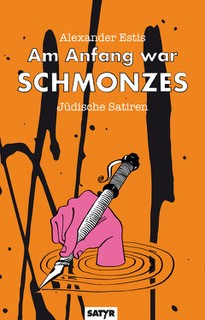
In the beginning was the schmonzes. Or perhaps it was the tohu va-vohu? For Alexander Estis, even the origin of the world is a matter of interpretation. That is precisely what makes his literature so compelling. For him, schmonzes is far more than just talk, nonsense, or mere rambling. It becomes a narrative form, the art of digression—and perhaps even a survival strategy.
In his linguistically acrobatic satires, Jewish wit, the Russian storytelling tradition, and a delight in the German language come together—and gleefully contradict one another. His texts are reminiscent of Talmudic thinking: every answer is followed by a new question, every certainty by a doubt, every thought by a counter-thought. It is precisely from this interplay that insight emerges.
But what is Jewish humor? Why is a Jewish joke never just a joke? Perhaps because, in the Jewish storytelling tradition, laughter and tears have been closely intertwined for centuries. In Estis’s work, the punchline becomes a philosophical tool: it exposes prejudices, plays with clichés, and transforms pain into the art of language.
And where could the “schmonzes” be more at home than in Odessa—that legendary port city on the Black Sea, where languages, religions, and cultures have intersected for centuries? Odessa is less a geographical location than a way of life: a blend of Yiddish, Russian, and Ukrainian; of melancholy and exuberance; of stories that may or may not be true. And if they aren’t—all the better for it.
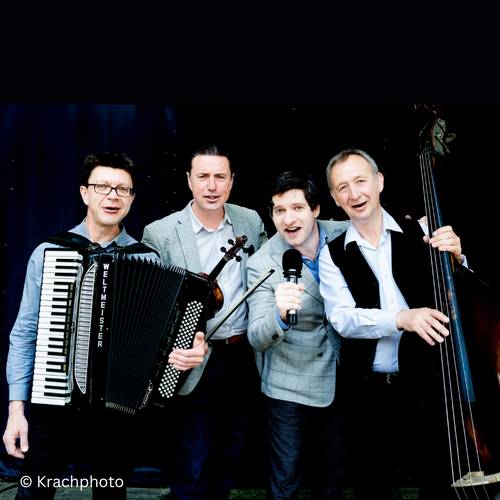
Music is part of this world. The Trio Scho brings Jewish, Ukrainian, and Russian traditions, klezmer, swing, and Eastern European melodies to the stage. Since its founding in 1991 in Poltava, Ukraine, and its subsequent move to Berlin, the ensemble has combined musical virtuosity with subtle humor—true to its motto: The main thing is that it’s not just beautiful, but also “scho.”
Together, Alexander Estis and Trio Scho create an evening that bridges literature and music, Berlin and Odessa, Tacheles and schmonzes. An evening full of wit, a love of language, and melancholy—and full of stories that reveal more about the world than many truths.
Alexander Estis, born in 1986 in Moscow to a Jewish family of artists, lives in Switzerland. There he is considered German; in Germany, he is regarded as Russian; and in Russia, as Jewish. This play on origin, language, and labels shapes his writing. After “successfully dropping out of his doctoral program,” Estis devoted himself to searching for the (non-)sense of life—and found a surprising amount of truth in it. His unmistakable voice combines Jewish humor, linguistic virtuosity, and the Ashkenazi storytelling tradition. He writes essays, commentaries, and columns for publications including the FAZ, SZ, DIE ZEIT, and NZZ. He has received numerous awards for his literary miniatures and satires, most recently the Kurt Tucholsky Prize.
Trio Scho was founded in 1991 in Poltava, Ukraine, and moved to Berlin in 1994. With great enthusiasm, the ensemble blends Jewish, Ukrainian, and Russian musical traditions—songs full of wit and melancholy, longing and a zest for life. Since 1999, Trio Scho has collaborated regularly with singer and actor Karsten Troyke. The ensemble has been honored twice at the Berlin Senate’s music competition.