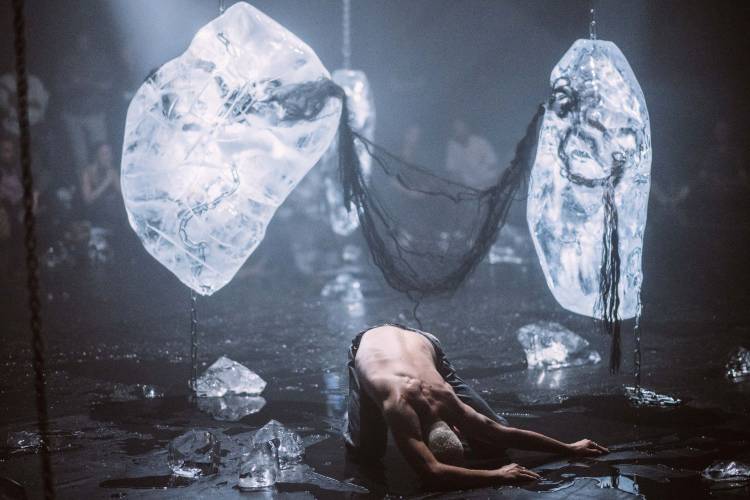
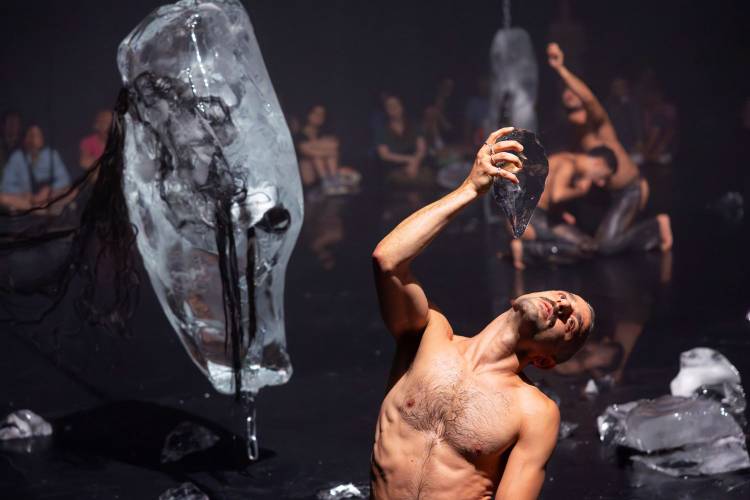
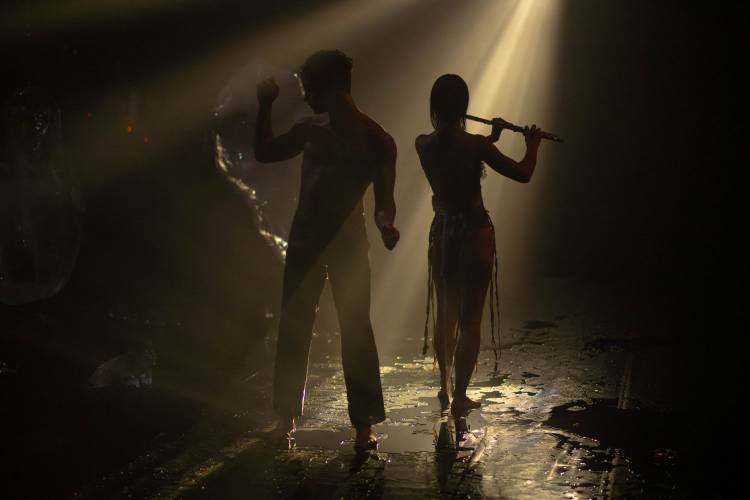
Out of the vast expanse of the night, an opera for the 21st century emerges, bringing new aesthetics and perspectives, and a different relationship to the world: Iranian choreographer Sorour Darabi presents his first opera in Radialsystem with “Mile et Une Nuits” - an immersive performance, which gives space to voices that were pushed aside in ancient myth. The German premiere of Darabi’s opera also marks the opening of the new series wielding fissures – carving cracks in the surface of the now in Radialsystem.
“Mille et Une Nuits” illuminates “One thousand and One Nights” from the perspective of the storyteller, Scheherazade. The original work, conceived by a heterosexual cis man, was often criticised for reducing the figure of Scheherazade to a storytelling instrument, banishing her body, her wishes and her subjectivity into the background to serve the author’s purposes. In Sorour Darabi’s “Mille et Une Nuits”, the night is not just a metaphor for the creation of stories: it is a space in which Scheherazade’s true identity can finally blossom - as queer myth, far away from the demands of a cis-heteronormative world.
Embodied Practice with Sorour DarabiWed 29 07 5.30 pmAdmission is free.The number of participants is limited, please register in advance
Local Hosting with Sorour DarabiFr 31 07 following the performance, in EnglishCo-hosts kiana rezvani (choreographer), Dr. Ashkan Sepahvand (artist and writer)
Artists/Collaborators: Sorour Darabi (Choreografie, Dramaturgie, Texte und Künstlerische Leitung), Aimilios Arapoglou, Li-Yun Hu, Lara Chanel, Felipe Faria, Sorour Darabi, Pablo Altar, Florian Le Prisé, Ange Halliwell (Performance, Gesang, Schauspiel und live Musik), Pablo Altar, Florian Le Prisé (Komposition), Henry Browne (Vocal Coach), Shaly Lopez (Lichtdesign), Jean-Marc Ségalen (Technische Leitung), Alicia Zaton, basierend auf einer Idee von Sorour Darabi (Bühnenbild), Anousha Mohtashami (Kostüme), Ava Ansari (Textredaktion und Englisch-Persische Kuration (POETIC SOCIETIES, Crafted Conseil Remote Residency Program)), Marouane Bakhti (Outside Eye), DEEPDAWN/ Sorour Darabi (Produktion), Emmilou Roessling (Audiodeskription)
A production by Sorour Darabi. Co-produced with Festival Montpellier Danse (Montpellier), CCN Ballet national de Marseille (Marseille), Arsenic – Centre d'art scénique contemporain (Lausanne), Festival d'Automne à Paris (Paris), La Villette (Paris), CND Centre national de la danse (Pantin), Tanzquartier Wien GmbH (Vienna), the Franco-German Transfabrik Fund for the Performing Arts (Berlin), Charleroi danse – Centre chorégraphique de la Fédération Wallonie-Bruxelles (Brussels), Festival Theaterformen (Berlin). With the support of Drac Île-de-France – Ministère de la Culture. ADAMI, SPEDIDAM.
With the support of La Manutention du Palais de Tokyo, CND Centre national de la danse, Trauma Bar and Kino (Berlin); Tanzhaus Zürich (Zurich), PACT Zollverein (Essen), KWP Kunstenwerkplaats (Brussels) & POETIC SOCIETIES (Detroit), KWP Kunstenwerkplaats (Brussels), The Saison Foundation (Japan). Thanks to Palmina D’Ascoli, David Lopez and Thomas Gachet.
The “wielding fissures” series is funded by the Senate Department for Culture and Social Cohesion as part of its cross-disciplinary funding programme. With the support of the Radial Foundation.
Media partners Radialsystem: taz. die tageszeitung, tip Berlin, Rausgegangen, The Berliner.