Zafraan Ensemble
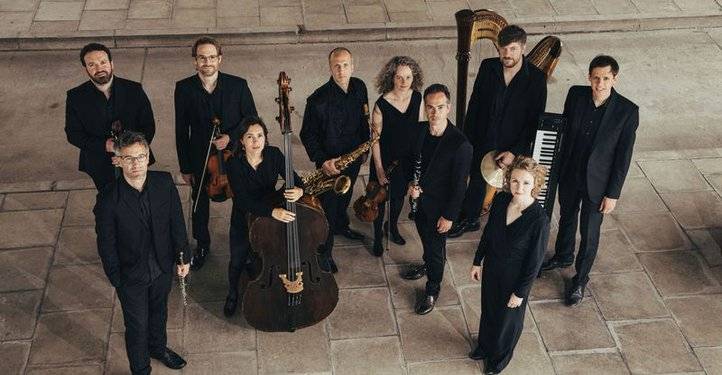
“Man did not weave the web of life; he is merely a strand in it. Whatever he does to the web, he does to himself.” This quote, attributed to Chief Si'ahl, describes on a larger scale processes that can be seen both in the compositions and in the chamber music performance itself. A work is never created without its history. In “Arras,” Keiko Devaux draws on sound influences that represent the professions of her ancestors: the sound of the wind sweeping across the farm fields, the sound of a mechanical loom, and the musical traditions (French chansons and American-Japanese folk music) with which her family members expressed their identity. The spinning of the threads of life, a recurring motif in Indo-European mythology, forms the basis of Eres Holz's composition “Kataklothes”: the figurations of the 10 instruments are woven into a progressive “chorale” that becomes increasingly rhythmic, complex, and playful. Csaba Ajtony's new work “Taajuu” (Haida for “wind”) expands the focus on the visual components of ensemble playing: the interconnection of coordinative gestures and sound-producing movements forms the starting point for the jointly developed composition.Supported by the Azrieli Foundation
Book tickets for this date
Public transportation
-
Train (S-Bahn)
-
Underground
-
Bus
-
Tram
June 26 to 28, 2026: Events, festivals, exhibitions and more things to do for your perfect weekend in Berlin.
more
Zafraan Ensemble
Zafraan Ensemble
© Anton Tal
“Man did not weave the web of life; he is merely a strand in it. Whatever he does to the web, he does to himself.” This quote, attributed to Chief Si'ahl, describes on a larger scale processes that can be seen both in the compositions and in the chamber music performance itself. A work is never created without its history. In “Arras,” Keiko Devaux draws on sound influences that represent the professions of her ancestors: the sound of the wind sweeping across the farm fields, the sound of a mechanical loom, and the musical traditions (French chansons and American-Japanese folk music) with which her family members expressed their identity. The spinning of the threads of life, a recurring motif in Indo-European mythology, forms the basis of Eres Holz's composition “Kataklothes”: the figurations of the 10 instruments are woven into a progressive “chorale” that becomes increasingly rhythmic, complex, and playful. Csaba Ajtony's new work “Taajuu” (Haida for “wind”) expands the focus on the visual components of ensemble playing: the interconnection of coordinative gestures and sound-producing movements forms the starting point for the jointly developed composition.Supported by the Azrieli Foundation
Keiko Devaux - „Arras“ (2020)Eres Holz - „Kataklothes“ (2015)PauseAjtony Csaba - „Taajuu“ (UA)Michaela Rea Catranis - „Inside the Veins of a Petal“ (2025)
Artists/Collaborators: Miguel Pérez Iñesta (Dirigent)
Runtime: Sun, 05/07/2026 to Mon, 14/06/2027
The help page for the event calendar answers common questions..
Information about coperations and imprint can be found on our page about partners and terms and conditions.