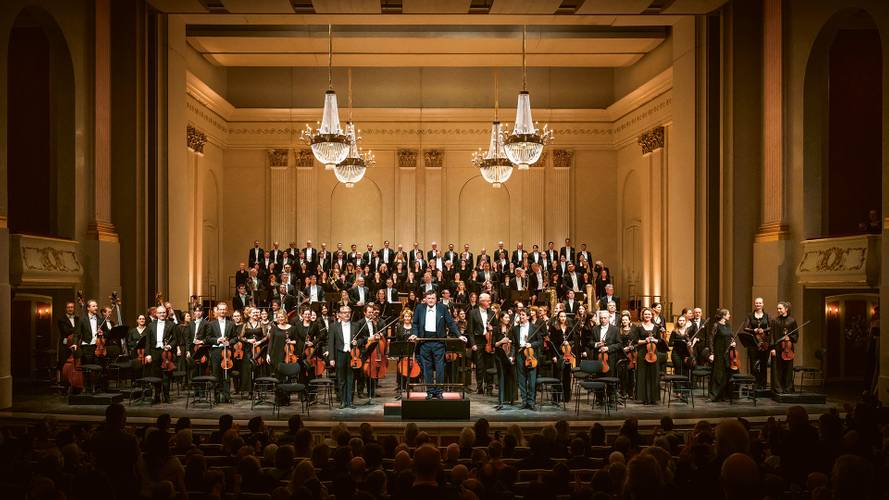
Symphoniekonzert I – Stephan Rabold
© Stephan Rabold
The music of a Viennese classic and the music of a Viennese outsider: In their respective eras, Mozart and Bruckner created works that were innovative and thrilling, with a lasting impact. Through a combination of masterful virtuosity and compositional originality, Mozart established the genre of the piano concerto in the 1780s, providing numerous points of reference for his successors in the 19th century.
The Piano Concerto in C Major, K. 467, captivates with its rich orchestral texture as well as its abundant melodies—it is a work of radiant brilliance and cheerful character. With his Symphony No. 4, Anton Bruckner created a work that brings his highly individual style to the fore in a particularly striking way. It opens up expressive worlds that in many ways point to the “Romantic” era, both as a fundamental concept and in its sonic phenomena. The work, of which various versions developed over long periods of time exist, reveals Bruckner’s intense musical thinking, which often took unexpected paths that his contemporaries could only partially comprehend, yet proved to be forward-looking.
Wolfgang Amadeus Mozart
Piano concert No. 21 C-Dur KV 467
Anton Bruckner
Symphony No. 4 Es-Dur Romantische
Artists/Collaborators: (Komponist/in), (Autor/in)
A performance of the Berliner Festspiele / Musikfest Berlin in cooperation with the Staatskapelle Berlin.