Current language: English

Berliner Medizinhistorisches Museum

  • Berliner Medizinhistorisches Museum

    Various skulls with and without injuries and severe syphilitic bone defects are exhibited as dry specimens from the 18th century in the Charité's Museum of Medical History (BMM).

  • Berliner Medizinhistorisches Museum

    Exterior view of the Berlin Museum of Medical History of the Charité (BMM).

With the help of 750 exhibits, the Berliner Medizinhistorisches Museum tells the story of medicine over the last 300 years.

Science and research have driven modern medicine forward so quickly that radical changes have taken place in the care and treatment of the sick over the last three centuries. Visitors to the Berliner Medizinhistorisches Museum (Museum of Medical History) are given a detailed insight into these changes.

Diagnostics, therapy and concept of man

The history of western medicine can be traced in six rooms. Individual medical histories are used to illustrate the progress, but also the mistakes and detours of medical science.

Historic hospital room in the Museum of Medical History

A historical hospital room allows visitors to take a look at the history of medicine from the patient's perspective. Real cases are shown - such as dealing with a young woman who has to go through a "difficult birth" or the treatment of a patient with blood poisoning.

Highlights at the Medizinhistorisches Museum

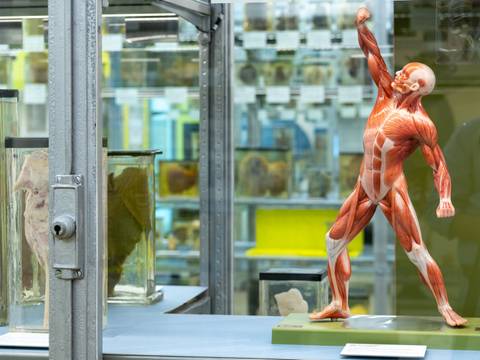
Around 750 specimens show healthy and diseased organs. The collection of specimens was founded by Rudolf Virchow and is primarily used for research purposes. It gives visitors an insight into the functioning and structure of the human body. As young children may be disturbed by the sight of the specimens, young people under the age of 16 must be accompanied.

Berliner Medizinhistorisches Museum: Current events and tickets

Overview tour "SCHLEIM"

Whether as a lubricant, adhesive or protective barrier inside the body - due to its special properties, mucus is incredibly versatile and versatile, which also makes it irreplaceable for many bodily functions. During the tour, you will learn about the... more

Annika Kahrs: Score of Symptoms

In her new performance Score of Symptoms, conceived for the Solistenensemble Kaleidoskop, Kahrs addresses illness and change as existential conditions. The venue – the striking Lecture Hall Ruin at the Berlin Museum of Medical History – becomes a symbol... more

Behind the scenes: Preparations and moulages

On this guided tour, our taxidermist Navena Widulin will take you into her hallowed halls and open her laboratory exclusively for you on this evening. Marvel at the world's largest collection of gallstones and other fascinating specimens from the museum's... more

Wednesday at the museum

The "Wednesday at the Museum" series focuses on selected themes and objects in a one-hour guided tour every second Wednesday of the month. Museum scientists and cultural mediators provide background information on the exhibited works and an insight into... more

Tracing life

The Berlin Medical History Museum of the Charité has an extensive permanent exhibition. The presentation takes its guests - in the spirit of Rudolf Virchow - on a "journey under the skin". more

Address, opening hours and contact information

Map view

A map view follows. Skip map

City map

End of map view

 Address
Charitéplatz
10117 Berlin
Phone
+49 (0)30 450 536 156
Internet
www.bmm-charite.de
Opening Hours
Tuesday, Thursday, Friday and Sunday 10 a.m. to 5 p.m., Wednesday and Saturday 10 a.m. to 7 p.m.
Accessibility
The museum is wheelchair accessible and has an elevator. Disabled WC available.
Admission Fee
€10, concessions €5
Please note
Due to the nature of the pathological anatomical specimens, young people under the age of 16 are only admitted to the museum if accompanied by a parent or guardian. School classes are admitted to the museum from grade 10.

Public transportation

Related Content

Bode-Museum

Museums in Berlin

Berlin's top museums with adresses, informations, opening hours and public transport.  more

Source: Berliner Medizinhistorisches Museum, editing: berlin.de

Last edited: 27 June 2025