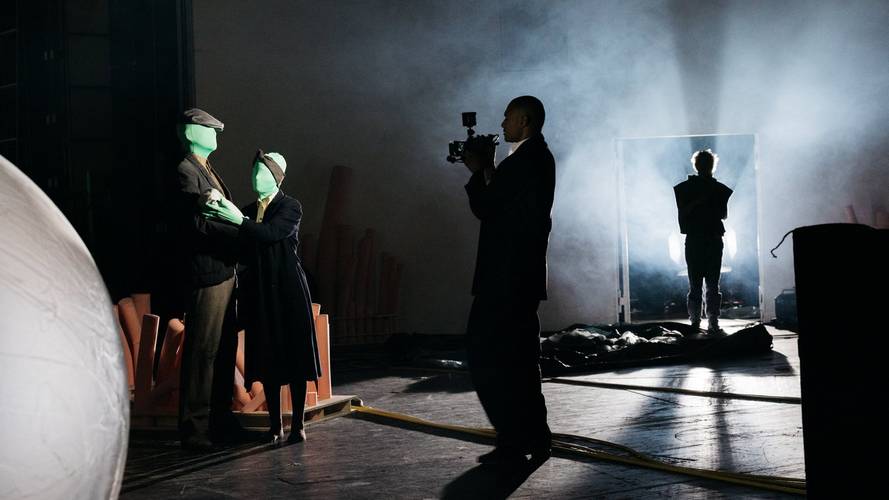
Set during an election season in Germany, when a widespread sense of forgetfulness is taking hold, the play follows the daughter’s questions and her father’s silence to explore the disorientation of the present: the loss of words, the end of shared narratives, but also the possible utopias that open up beyond this end.
To this end, Christopher Rüping and his ensemble turn their attention to German history. Drawing on the Romantic era, the wars, and the ruins of the past, they tell of the most “German” of all seasons and of the disorientation of our times. The play *Deutscher Herbst* is a co-production with the Ruhrtriennale arts festival and will have its world premiere at the Jahrhunderthalle in Bochum. Just a few days later, the production will be performed in Berlin. When people hear “Deutscher Herbst,” they probably think first and foremost of the year 1977. The terror of the RAF and the state’s response shaped an entire generation. But perhaps the term evokes other “autumns” as well? The fall of the Berlin Wall, a song from school days, a painting by Caspar David Friedrich?
While the fortunes of other nations take a turn for the better in the spring, Germany is experiencing its autumn. Autumns are periods when our history becomes more concentrated. Christopher Rüping’s play takes its title from the fall of 1946. That year, the 23-year-old Swedish author Stig Dagerman traveled through Germany. In his homeland, he is a rising star; on assignment for the daily newspaper *Expressen*, he visits Berlin, Hamburg, and the Ruhr region—cities and regions lying in misery, hunger, and ruins. Dagerman calls his literary travelogue *German Autumn*. It rains incessantly, the autumn leaves are falling—and the young Swede asks himself: Will these people, teetering so precariously between the end and the beginning, find their way to democracy or perish? Exactly eighty years have passed since the fall of 1946. Roughly a human lifetime. The play uses this passage of time as an opportunity to paint a picture of the present. The people Stig Dagerman encountered amid the ruins will soon no longer be part of this picture—or perhaps they already aren’t. Nevertheless, the questions remain—or have returned. Will this country stumble back into old fears, or will it find its way to freedom? What spring will follow this fall?