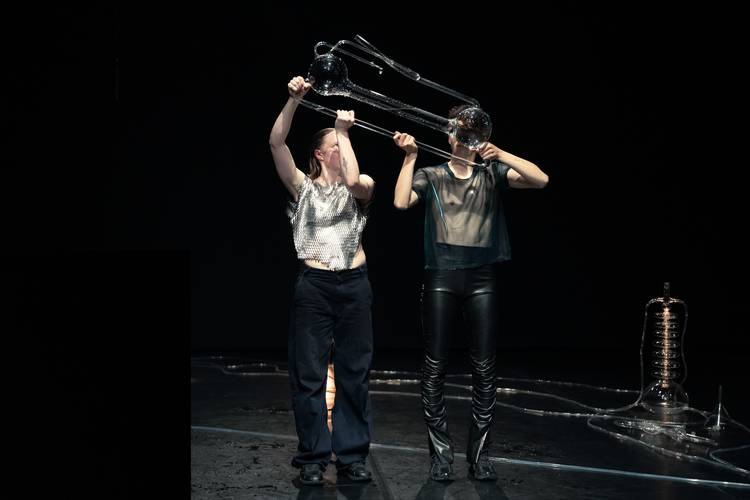
“The Choreography of Water” imagines how water could shape our thinking and way of life. Three dancers explore the body through sound and movement as something fluid, where nature and humans are deeply connected.What could the future look like if we were to treat water as an always co-choreographing entity? Led by such questions, choreographer Simona Deaconescu, visual artist Ioana Vreme Moser, and sound artist Simina Oprescu explore hydrological cycles both within our bodies and on a planetary scale. In a haunted landscape, three dancers experiment with a series of transparent, water-filled, organ-shaped sculptures that generate sound through the flow of air and liquid. “The Choreography of Water” is a sensorial creation that investigates our bodies as fluid territories, where human and non-human, personal and political worlds meet.
TicketsFull 22 € Reduced 15 € Additional service fees for booking online with Reservix apply.
Artist's Note by Simona Deaconescu, Ioana Vreme Moser and Simina Oprescu“The Choreography of Water” holds a very special place in my current practice. Partly due to the strong artistic fingerprint of my collaborators, and partly because it shifts away from the minimal, clinical atmospheres present in my previous works toward haunted, void-like landscapes charged with tension and sensory intensity.Ioana Vreme Moser’s universe, situated at the periphery of technological waste, was deeply inspirational for the piece. When we first met in 2019, she had just received an award for her Fluid Memory. Fluidic Computer, marking the beginning of a fascinating new sculptural series within her practice. At the same time, I was beginning to develop BLOT – Body Line of Thought, which opened a new direction in my own work, exploring the layered dimensions of our more-than-human identities.Five years later, Ioana was designing large hybrid instruments based on the science of fluidics, performing on stage alongside the dancers in “The Choreography of Water”. Their micro-choreographies, encapsulated in fragile glass shells, complete and sometimes provoke the movement performed by the dancers.Simina Oprescu’s sonic dive into the subconscious, through her dark, cyborg-like sound worlds, where listening becomes central to the act of composing, connected “the visual” with “the performed,” “the micro” with “the macro,” and “the inside” of the body with “the outside.”I place “The Choreography of Water” within the thread of my practice that speculates critically on the future of the body through a hybrid, gestational, and atemporal lens. A body through which scientific principles acquire new meanings when confronted with human emotion, highly visual in the imaginative spaces it opens for both performers and audiences.As makers, our imaginary drifted toward distant futures in which humans grow organs outside their bodies. Bodies turned inside out and dispersed through space, laying organs and veins across the floor: “a body of water,” inspired by Astrida Neimanis’s work of the same name, or a Deleuzian “body without organs.” This assemblage of human and non-human body parts forms a speculative fluid computer in which the flow of water simulates the flow of information.For me, choreography is a way of decrypting the world: observing how movement is already scored all around us, while inventing new scores that follow, resist, or disturb that order. In this sense, the performance reflects on how fluid worlds have been scored and rescored by human intervention, from the systems that sustain our bodies to those that sustain the planet. It does this through assemblages of glass, water, and flesh that suggest both the power and danger involved in “re-choreographing” these flows.Resistance, pressure, tension, momentum, conservation states, hypersensitivity, and overflow are physical concepts that became bodily concepts during the rehearsal process. We wanted to invent a new alphabet—a body functioning similarly to the human body, yet slightly displaced—and then dive deeply into that difference.It meant performing within a logic anchored in multilayered temporalities, unpredictable associations, and tense oscillatory emotional states. The same image on stage can evoke two ovaries gestating, two seas connected through a channel, or the twin openings of a weapon ready to fire. The work functions best when we allow ourselves to enter internal mental landscapes, defocusing the mind and allowing it to wander through continuous associations and dissociations of meaning. It is within this anarchy of thought that we might find a strange form of comfort by acknowledging the placelessness of our futures.
1 h 00 min
Production Tangaj CollectiveCo-production Centrul Național al Dansului BucureștiSupported by Goethe-Institut, Istituto Italiano di Cultura Bucarest, Marginal, Qolony, ECOSISTEM – Festival Internațional de Arte PerformativeFunded by AFCN – the Administration of the National Cultural FundThe project does not necessarily represent the position of the Administration of the National Cultural Fund. AFCN is not responsible for the content of the project or for the way in which the project results may be used. These are entirely the responsibility of the funding beneficiary.