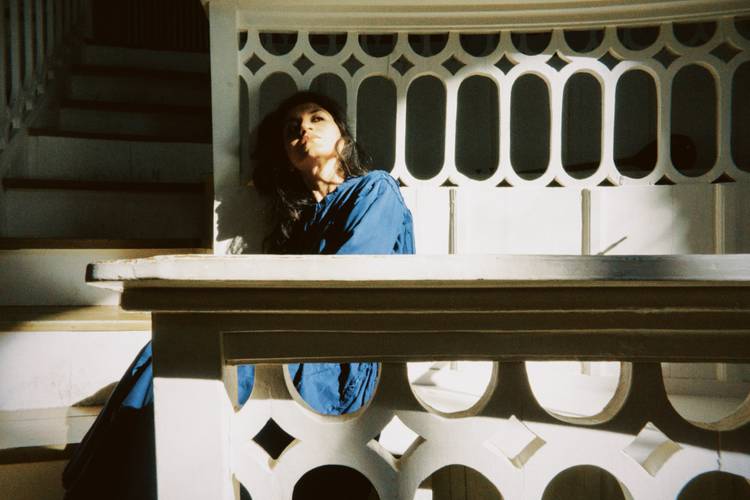
World Premiere: Elshan Ghasimi continues her systematic reinterpretation of the Radīf with *Dastgāh-e Chahārgāh* —six concerts at TA T.
With *Dastgāh-e Chahārgāh*, composer and tar virtuoso Elshan Ghasimiwill continue her multi-year cycle *The Reinterpretation of the Radīf* in the fall of 2026. In this cycle, she explores the entire Radīf —the orally transmitted canon, memory, and musical heritage of Persian music. She is the first woman to undertake a systematic reinterpretation of all twelve subsystems; each serves as the starting point for a standalone contemporary work. The cycle unveils a sonic dimension of classical Persian music that remains largely unknown in Europe. *Dastgāh-e Chahārgāh* will premiere on October 9 at the TA; five additional concerts will follow through December 5.
The first chapter, Dastgāh-e Shur, premiered on November 10, 2022, in the Basilica of the Bode Museum, in cooperation with the Museum of Islamic Art. Since then, Ghasimi has presented her work on the radīf throughout Europe, including at WOMEX 2023 in A Coruña. Trained at the Tehran Conservatory of Music, Ghasimi became familiar with various radīf traditions in Tehran and Azerbaijan. She came to Germany in 2016. As a woman, she had been unable to work publicly as a solo artist in Iran. It was only in Germany that she found the artistic freedom and institutional conditions necessary to develop this long-term project.
In the wake of the massacres in Iran in January 2026 and the ensuing war, the transmission of this cultural memory has taken on added urgency. As a cultural ambassador for Persian musical culture, Ghasimi conveys a more complex and nuanced picture of Iran—a country with cultural traditions dating back millennia that cannot be reduced to regime, repression, and war, but rather points beyond them.
The Radīf
The Radīf —literally “series” or “order”—consists of more than 300 melodic models, the gushehs, which are organized into twelve modal subsystems, the dastgāhs and Āvāz. It is neither a composition nor a written score, but rather a musical grammar that is passed down orally and internalized through listening, playing, and memorization. In every performance, memory, interpretation, composition, and improvisation come together in a new way. Since 2009, the Radīf has been included on UNESCO’s List of the Intangible Cultural Heritage of Humanity.
Ghasimi’s starting point is various versions of the Radīf, particularly the canonical tradition of Mīrzā Abdollāh. Unlike in a traditional Radīf performance, she does not follow a single version but rather relates different versions to one another. All the gushehs of the respective subsystem remain the starting point of her work. She does not simply add new melodies to the Radīf: through the interplay of composition and improvisation, she reshapes transitions, temporal relationships, and internal tensions. In this way, she makes the internal order of the Radīf audible while simultaneously setting it in motion.
The second chapter is devoted to the Dastgāh-e Chahārgāh subsystem. Its musical identity arises not solely from a specific set of notes, but from microtonal nuances, central reference tones, and characteristic melodic movements. Following Shur, Chahārgāh signifies a conscious deepening of the artistic intent: a focused listening to recurrence, transition, and transformation.
Elshan Ghasimi at the TA T
This work finds a special resonant space in the early-Classical rotunda of the Tieranatomisches Theater. The building, designedby Carl Gotthard Langhans, is itself the result of a reinterpretation: it combines ancient models of the circular temple and the amphitheater into a new architecture of knowledge. Built for the teaching of veterinary anatomy, its architecture organizes bodies and directs attention: Who speaks, who listens, and from where? In their own distinct ways, both the building and the work bring traditional orders into a new present.
In 2026, the TA T’s curatorial program will focus on listening in and through this architecture. The program will also center on cultural heritage as a living practice that is continually recreated by the communities that engage with it. Ghasimi’s reinterpretation of the radīf enters into a dialogue with these questions and introduces yet another practice of listening, transmission, and reinterpretation into the historic lecture hall. TA T first presented Elshan Ghasimi’s work during Open Monument Day 2025, curated by Lilli Maxine Ebert. The collaboration will continue in 2026 with Dastgāh-e Chahārgāh.
Conversations
The curator of the Radīf project, Julian Malte Hatem Schindele, and TA T curators Felix Sattler and Paz Ponce have developed a three-part series of conversations with guests to accompany the Saturday concerts.
October 10 — Writer and translator Mahmoud Hosseini Zad speaks on the topic “Translating Means Remembering,” discussing literature, cultural mediation, and the reciprocal images of Germany and Iran.
October 31 — Musicologist and Radīf expert Mona Mirkamalier explainshow musical knowledge is passed down, canonized, and reinterpreted.
December 5 — Media and Middle East studies scholar Nahid Siamdoust focuses on music, the political public sphere, and pop culture in Iran—from Baraye and “Woman, Life, Freedom” to today’s repressive conditions. The talks are specifically aimed at an audience with no prior knowledge.
The talks are aimed at an audience with no prior knowledge and take place following the Saturday performances after an approximately 30-minute intermission. They will be moderated by Julian Malte Hatem Schindele ( Bublitz), Felix Sattler(Chief Curator at TA T), and Paz Ponce (Curator of Outreach and Public Programs at TA T).
Duration of the discussions: Approximately one hour.
Participants
ELSHAN GHASIMI
“In her playing […] every phrase is imbued with deep thought and solemn authority.”
— Michael Church, *Music Lost and Found*
Elshan Ghasimi ( born 1981 in Isfahan, Iran) is a virtuoso of the Persian long-necked lutes tar, setar, and robab, as well as the dayere, and an expert in Persian art music. She is a versatile artist, composer, innovative performer, and dedicated educator whose work explores the intersections between tradition and modernity, East and West, and music and other artistic disciplines.
Deeply rooted in the Radīf, the repertoire of the Persian musical heritage, Ghasimi has devoted many years to mastering it and is now driving forward its reinterpretation in a contemporary artistic context. At the age of 17, she became the youngest member of the Iranian National Orchestra, marking the beginning of her career. She has lived in Germany since 2016, where she continues to perform as a soloist, compose, and collaborate with renowned ensembles such as Concerto Köln. Her work blends the Persian musical heritage with a variety of musical genres—including contemporary classical music, jazz, experimental music, and early music.
PANELISTS
Mahmoud Hosseini Zad (born 1946 in Firuzkuh, Iran) is a writer and translator of contemporary German-language literature into Persian. Among other works, he has translated works by Bertolt Brecht, Friedrich Dürrenmatt, Judith Hermann, Ingo Schulze, Uwe Timm, and Peter Stamm, and was awarded the Goethe Medal in 2013.
Mona Mirkamali is a musicologist and expert on radīf. Her research focuses on the oral transmission of musical knowledge as well as the changes in Persian music brought about by mediatization and standardization.
Nahid Siamdoust is a scholar of media and Middle Eastern studies at the University of Texas at Austin and will be a Humboldt Fellow in Berlin in 2026. She is the author of *Soundtrack of the Revolution: The Politics of Music in Iran* and conducts research on Iranian music, media, public sphere, and politics.
CURATOR
Julian Malte Hatem Schindele is an artist, curator, art historian, and founder of Bublitz. His work centers on long-term artistic collaborations, cultures of memory, and the interconnection of various forms of art and knowledge. He is curating *The Reinterpretation of Radīf*.
Imprint
A collaboration between Bublitz and TA T.
Bublitz:
Curator: Julian Malte Hatem Schindele (Bublitz)
Graphic Design: Masoud Morgan
Bublitz is a curatorial platform founded in 2011 for exhibitions, publications, music, and discussion projects. Its focus is on long-term collaborations with artists and on connecting different art forms and fields of knowledge. Bublitz has been supporting Elshan Ghasimi’s work since 2016.
TA T
Director: Felix Sattler
Curator for Education & Outreach: Paz Ponce
Project Management: Antonia Willisch
Production: Fanny Welz
Communications: Frederike Jaedicke-Nolte
Sponsors, Partners, and Participating Institutions
Temporal Communities; Goethe-Institut; Museum of Ethnology and Museum of Asian Art – State Museums of Berlin; Free University of Berlin; Catholic Academy in Berlin e. V.
Funded by the Senate Department for Culture and Social Cohesion
Mona Mirkamali’s participation is supported by: Center for Cultural Technology (ZfK), Humboldt University of Berlin
Translated with DeepL