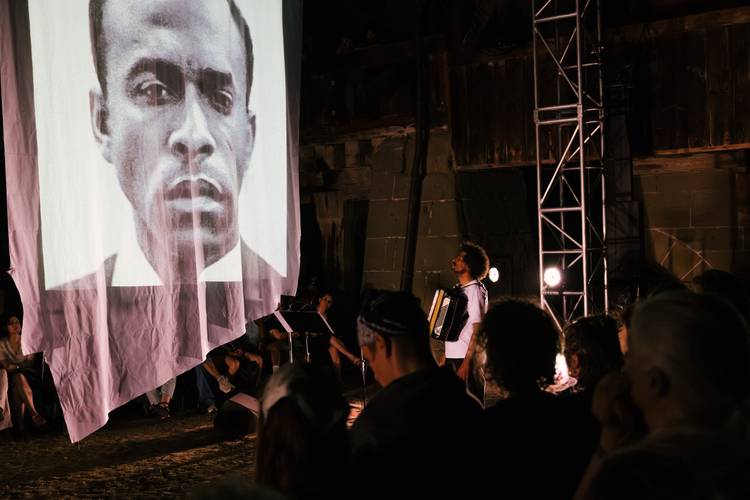
Julian Warner explores Frantz Fanon and the role of violence in the culture war. Amid drum rhythms and physical drills, the stage becomes a space for reflection on colonialism, resistance, and the line between political action and war.“Art is a weapon.”Drawing on Frantz Fanon’s thinking about anti-colonial violence, the performance “DER SOLDAT. Ein Übergangsritual” (“THE SOLDIER. A Rite of Passage”) tells the story of a Black artist who realizes he has become a soldier. He takes the stage as an artist. In the struggle for representation and resources, he is given a weapon—and must ask himself: Is the culture war a war?Together with Markus Acher (The Notwist) on live drums, the artist relives this transformation. Through the interplay of language and the physical power of the percussion, a linguistically and musically captivating performance emerges that questions the historical situation and seeks its own relationship to violence.Frantz Fanon, a psychiatrist and theorist from Martinique, analyzed the role of violence in a world shaped by colonialism with a precision matched by few others. His ideas were taken up by political movements worldwide—from the Black Panther Party to the RAF. “THE SOLDIER” distills these tensions into an intense evening exploring representation, violence, and the question of when violence or its defense becomes necessary.“DER SOLDAT. Ein Übergangsritual” consists of two parts. Part One is a 50-minute musical performance. Part Two is a 60-minute post-performance discussion in a fishbowl format, in which the audience, guided by two group analysts, collectively processes the experience.
50 mins. performance + 60 mins. talk
Artists/Collaborators: Julian Warner (Konzept, Performance, Musik), Markus Acher (Musik und Live-Schlagzeug), Veronica Burnuthian (Stimme), Veronika Maurer (Dramaturgie), Dennis Dita Kopp (Licht, Technik), Sabine Klötzer (Künstlerische Produktionsleitung), Veronica Burnuthian (Übersetzungen), Anna McCarthy (Übersetzungen), Bernd Heimerl (Gruppenanalytiker*innen), Vera Kattermann (Gruppenanalytiker*innen)
The performance addresses experiences of racism. In doing so, racist statements are also reproduced.