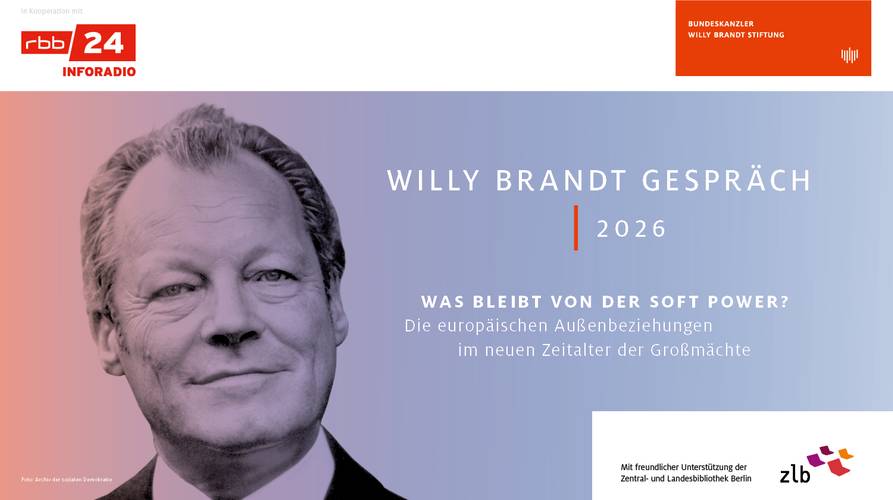
Foreign policy strength does not rest solely on “hard” military or economic power. Willy Brandt was convinced of this. And he introduced this idea to the North-South Commission, which he headed, beginning in 1977. Europe has traditionally relied above all on soft power: on the appeal of a rules-based political order, on institutional cooperation, and on cultural exchange. In addition to building partnerships, this also serves to safeguard its own interests. In the “new era of great powers” (Friedrich Merz), this concept is openly opposed by a new authoritarian drive for great-power status. It manifests itself in tariff conflicts, threats of occupation, and new wars. Soft power is viewed as a weakness. Within Europe, there are calls for the expansion of a hardline European power politics. Can this succeed? And what will be lost through this reorientation?
The 2026 Willy Brandt Dialogue explores the role of soft power in the 21st century. Does it offer an alternative in the face of military escalations and new trade wars? It focuses in particular on European-African relations, which are shaped by colonial history, intensive exchanges, and new competition for influence. Panelists include Federal Minister for Development Reem Alabali Radovan (SPD), Alexander Stroh-Steckelberg from the University of Bayreuth, and Josephine Apraku, known for her podcasts and nonfiction books. Moderator: Harald Asel, rbb24 Inforadio. The opening address will be delivered by Dr. Wolfram Hoppenstedt, Executive Director of the Federal Chancellor Willy Brandt Foundation.
Registration opens on September 1. The Willy Brandt Discussion will also be streamed live.
The event will be recorded and broadcast on October 11, 2026, at 11:00 a.m. (repeat at 9:00 p.m.).
A collaboration between the Federal Chancellor Willy Brandt Foundation and rbb24 Inforadio, with the kind support of the Berlin Central and State Library.Translated with DeepL
Price info: Admission is free.
Booking: Registrations will be accepted via the online form starting September 1.