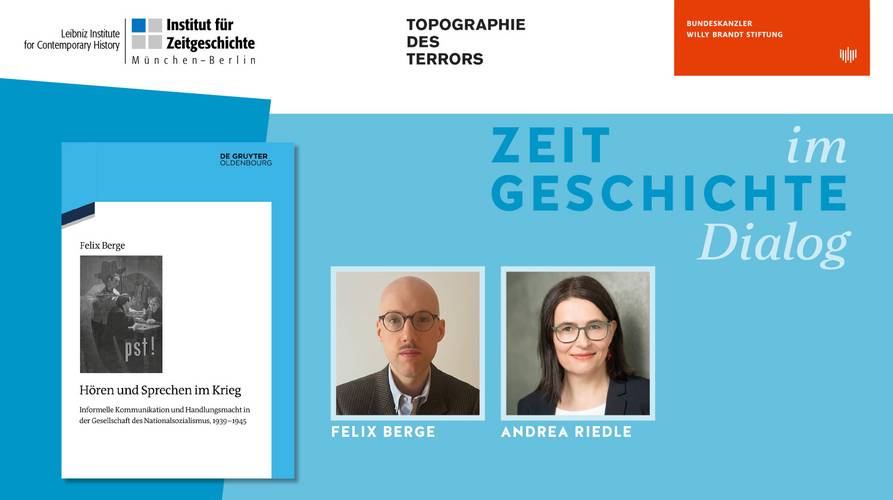
© Foto: Peter Adamik, De Greuter Oldenbourg
In January 1942, the security service of the Reichsführer SS sounded the alarm: the population was building up "its own image" and uncritically accepting "the most nonsensical rumors". What the SD perceived as a problem forms the starting point for Felix Berge's book "Hören und Sprechen im Krieg" (2025). Drawing on a broad range of sources, he examines everyday communication in German society during the Second World War as the collection, appropriation and dissemination of information. How did people exchange information under National Socialist rule? How did communication change during the war when trust in the media collapsed and the truth came under attack from all sides? Informal communication was able to structure society during the crisis, gave individuals sovereignty and was a means of survival. Those who knew more had advantages. But the Germans also articulated fears and violence, they talked about crimes and the Holocaust. The Nazi regime not only fought this "rumor-mongering", it also used informal communication in "word of mouth" itself.
The presentation of the book by Felix Berge will be followed by a commentary by Andrea Riedle (Topography of Terror). The subsequent discussion will be moderated by Dierk Hoffmann (Institute of Contemporary History Munich-Berlin, from March).
Admission free. Registration is not required.
The event will be broadcast as a livestream on and will be available for 14 days afterwards. The event will also be made available as a podcast for listening afterwards.
A joint event of the Federal Chancellor Willy Brandt Foundation, the Institute of Contemporary History Munich-Berlin and the Topography of Terror Documentation Center.Translated with DeepL
Booking: Registration is not required.